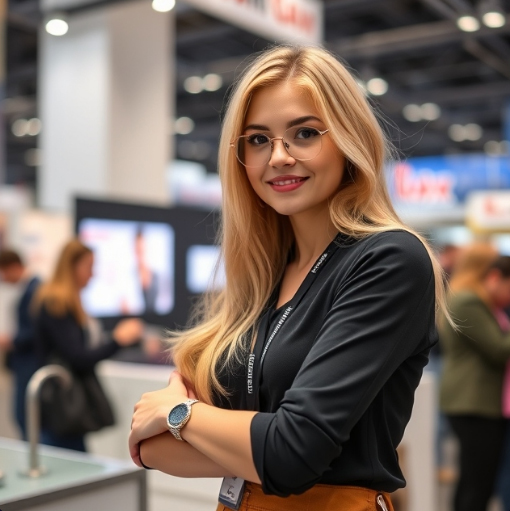
Almaty’s trade show interpreters are a distinct breed within the city’s language services market. Unlike their counterparts in conference halls or government ministries, they work at the intersection of commerce and communication—standing at exhibition stands, navigating B2B meetings, and facilitating deals that can hinge on a single mistranslated technical term. Their work is fast-paced, often improvised, and deeply embedded in the rhythm of Kazakhstan’s expanding trade fair calendar.
The Exhibition Circuit
Almaty is the undisputed hub of Kazakhstan’s trade show industry, with the Atakent Exhibition Center hosting the overwhelming majority of major events. The calendar is dense: KazBuild (construction and interiors), KIOGE (oil and gas), Mining and Metals Central Asia, KazToolExpo, Central Asia Plast World, Print World, and dozens of others rotate through the city year-round. These are not small regional gatherings. KazBuild 2025 drew over 8,000 visitors and 639 companies from 30 countries; Mining and Metals Central Asia featured 515 companies from 30 countries.
Each of these events generates demand for interpreters who can work the floor—not just translate speeches, but facilitate conversations at stands, interpret product demonstrations, and smooth the negotiations that happen in the margins of the official program.
The Chinese Language Imperative
The defining feature of Almaty’s trade show interpretation market is the dominance of Chinese. The Almaty Chamber of Commerce and Industry has issued open calls for Chinese-language interpreters to participate in business meetings, negotiations, exhibitions, and industry events, seeking specialists with confident command of Chinese and Russian and experience in consecutive interpretation for business audiences. This is not a niche demand; it reflects the broader structural reality of Kazakhstan’s trade orientation toward its eastern neighbor.
The language pairs in demand are telling. One freelance listing for the Central Asia Beauty Expo in May 2026 sought consecutive interpreters between Polish and Russian as well as Polish and Kazakh, with the client explicitly noting that if no single interpreter could handle both pairs, two interpreters working as a team would be acceptable. The lesson is clear: trade show interpreting in Almaty often requires flexibility across multiple language combinations, not just deep specialization in one.
The Working Conditions
Trade show interpretation is physically and mentally demanding. Assignments typically cover the full opening hours of an exhibition—often 10:00 to 18:00 for three consecutive days. Interpreters work standing, moving between stands and meeting rooms, switching between consecutive and whispered simultaneous modes as the situation demands. The content ranges from casual networking to technical product specifications, requiring interpreters to absorb specialized vocabulary on the fly.
The work is overwhelmingly project-based. A résumé posted on Kazakhstan’s national employment portal describes a typical profile: an interpreter with eight years of experience, including B2B meetings and trade exhibitions, listing English as advanced and Turkish as intermediate, with a monthly salary expectation starting at 700,000 tenge. This reflects the mid-to-senior end of the market. At the entry level, agencies quote 6,000 tenge per hour for consecutive interpretation, with exhibitions explicitly listed among the typical use cases.
For students, trade shows offer a bridge between academic training and professional practice. In April 2026, thirteen students from Kazakh Ablai Khan University’s Faculty of Translation and Philology served as interpreters at the Crystal Bay Tours Expert Exchange Road Show in Almaty, providing support for business meetings, presentations, and professional exchanges. The university framed the experience as gaining “hands-on experience in both simultaneous and consecutive interpreting in a fast-paced, high-pressure context,” developing “resilience under pressure, communicative adaptability, and rapid decision-making.” These are precisely the skills that trade show work demands.
The Industry Sectors That Drive Demand
The sectoral composition of Almaty’s trade shows shapes the linguistic and technical requirements placed on interpreters. The construction and building materials sector is a perennial source of demand, with KazBuild and Aquatherm Almaty anchoring the September calendar. Mining and metallurgy, oil and gas, and energy exhibitions—Mining and Metals Central Asia, KIOGE, Powerexpo Almaty—attract companies from across the region and beyond, creating demand for interpreters comfortable with technical terminology in extractive industries.
The consumer goods and FMCG sector is another significant driver. The World of Trade International Purchasing Center, scheduled for May and November 2027, brings together FMCG suppliers with retailers from nine CIS countries for structured one-to-one meetings. Events like these require interpreters who can facilitate commercial negotiations, not just translate product descriptions.
The Freelance Model and Its Constraints
Most trade show interpreters in Almaty work as freelancers, moving between assignments as the exhibition calendar dictates. This offers flexibility but also income instability—the exhibition season has peaks and troughs, and interpreters must juggle multiple clients and language pairs to maintain steady work.
Some interpreters build broader practices that encompass trade shows alongside other services. One guide-registered professional in Almaty lists experience at Mining & Metals Central Asia and KIOGE, along with government delegations and VIP tourism groups, describing over 20 exhibition events served and a client satisfaction rate consistently above 95%. This blending of exhibition work with tourism and delegation services is a common survival strategy in a market where no single income stream is sufficient.
A Profession at the Crossroads
Almaty’s trade show interpreters sit at a peculiar intersection of Kazakhstan’s economic ambitions. The country positions itself as a bridge between China, Central Asia, and Europe, and trade shows are where that positioning becomes concrete—where Chinese manufacturers meet Kazakh distributors, where European construction firms pitch to local developers, where regional retailers negotiate with FMCG suppliers. Interpreters are the human infrastructure that makes these encounters possible.
The demand is real and growing, but the profession faces familiar pressures: the concentration of demand around a handful of language pairs, the seasonal nature of exhibition work, and the constant need to master new technical vocabularies as industry sectors evolve. For those who can navigate these constraints, Almaty’s exhibition halls offer steady work and a front-row seat to the commercial diplomacy shaping Central Asia’s economic future.