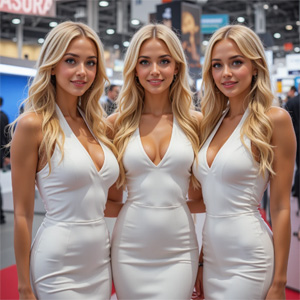
Moscow stands as Russia’s economic heart and one of Eurasia’s most significant exhibition hubs, hosting hundreds of international trade shows every year. From food and beverages to industrial equipment, from lighting technology to logistics automation, these professional exhibitions attract exhibitors from China, Turkey, India, South Korea, and across Europe. In this environment, interpreting and assistance services have evolved from an optional add-on into a critical factor for exhibition success—not merely a language conversion tool, but a strategic investment that drives business negotiations, builds client trust, and closes actual deals.
Core Types of Exhibition Interpreting Services
Interpreting needs at Moscow exhibitions are diverse, with different types of shows requiring different service models.
Booth interpreting is the most common form of service, with interpreters stationed at exhibitor booths to assist with visitor reception, product inquiries, and recording client needs throughout the day. This type of service demands high stamina and endurance from interpreters and is typically billed on a full-day basis. At a coatings exhibition held at Moscow’s Timiryazev Center, for example, a Chinese exhibitor explicitly requested an interpreter to provide Russian-English interpretation at the booth from 10:00 AM to 6:00 PM, answering chemical product inquiries and promptly summarizing key client information for the Chinese team.
Accompanying interpretation and business visit support covers scenarios beyond the exhibition hall. Exhibitors often need to visit clients, explore markets, and attend business dinners before and after the show, during which the interpreter’s role extends to that of a “business assistant,” helping with transportation, accommodation, and schedule coordination. Professional interpreting agencies provide full-process support including airport pickups, bank and government office visits, and medical consultation accompaniment.
Simultaneous interpretation primarily serves large forums, conferences, and seminars held during exhibitions. This service requires professional equipment and at least two interpreters working in rotation, with costs significantly higher than standard booth interpreting. Using the official pricing of Moscow’s main exhibition centers as a reference, simultaneous interpretation equipment (with a basic configuration of one interpreter) costs approximately 49,500 rubles per day, rising to 64,000 rubles for a two-interpreter configuration.
Typical Exhibition Scenarios and Interpreting Needs
Moscow’s main exhibition venues—Crocus Expo, Expocentre, VDNKh, and Sokolniki—each host professional exhibitions across different industries, placing differentiated demands on interpreting services.
The food and agriculture sector has particularly strong demand for exhibition interpreters. WorldFood Moscow, Russia’s largest food exhibition, brings together large numbers of Indian rice exporters, Turkish dried fruit suppliers, and Chinese food processing companies each September. When recruiting exhibition interpreters, an Indian basmati rice manufacturer explicitly required candidates to have experience working with Indian food exporters, to be able to explain the specification differences between rice varieties (such as 1121, 1509, and 1718), packaging options, and payment terms, and emphasized that interpreters need to “understand buyer needs” rather than simply performing literal translation.
The industrial and technical sector demands greater professional depth from interpreters. CeMAT Russia (logistics), Weldex (welding), and Interlight (lighting) bring together technical companies from China, Germany, and Turkey, requiring interpreters to master specialized terminology in welding processes, warehouse automation, and lighting systems. Such exhibitions typically require interpreters to have relevant industry backgrounds or at least the ability to study technical materials in advance.
The consumer and fashion sector, including HouseHold Expo and InterCHARM beauty exhibitions, places more emphasis on interpreters’ communication skills and sales support functions. Exhibitors want interpreters not only to convey product information but also to proactively identify potential buyers, guide conversation direction, and collect client contact details.
Cost Structure and Pricing Factors for Interpreting Services
Pricing for exhibition interpreting in Moscow is influenced by multiple factors that exhibitors should understand when planning their budgets.
Billing units are typically divided into hourly and daily rates. Hourly rates vary considerably depending on the language pair and interpreter qualifications: Russian-English interpretation ranges from approximately €26 to €45 per hour, with daily rates between €164 and €340. Russian-Chinese interpretation starts at $150 per day, with some agencies charging additional fees for travel accompaniment. Pricing for Russian-Turkish and Russian-Arabic is similar to or slightly higher than Russian-English.
Minimum booking duration is a common cost threshold. Most freelance interpreters and agencies require a minimum booking of 2 to 4 hours, with full-day exhibition service typically calculated on a standard 8-hour day. Overtime is charged hourly, and evening services (after 9:00 PM) usually require the client to cover the interpreter’s taxi costs.
Specialized industry premiums are more pronounced at technical exhibitions. Interpreting needs involving chemicals, medical equipment, and industrial automation are typically quoted 15% to 30% higher than general business interpretation, as they require industry knowledge or extensive preparation. Some job postings explicitly require interpreters to be “willing to learn key product points,” and exhibitors should allocate training time or select interpreters with relevant backgrounds.
Emergency booking surcharges are also a cost factor. Orders placed within 24 hours of an exhibition’s start are subject to a 20% rush fee from most service providers. During Moscow’s peak exhibition seasons (spring and autumn), interpreter resources are tight, and booking more than two weeks in advance can avoid premiums and ensure quality candidate selection.
Key Criteria for Selecting Exhibition Interpreters
When choosing interpreting services, exhibitors should look beyond the basic threshold of “language ability” and focus on the following core indicators.
Industry experience takes priority over language certificates. Interpreters with service experience at WorldFood Moscow, ProdExpo, or CeMAT Russia are far more valuable than candidates with only language degrees. The screening criteria that appear frequently in job postings—”has worked at food/FMCG exhibitions,” “has experience working with Indian companies,” “familiar with rice/spice products”—reflect exhibitors’ urgent need for “ready-to-deploy” talent. Exhibitors should ask candidates to provide past exhibition service records or client references during interviews.
Business acumen and initiative are the dividing line between excellent and merely qualified interpreters. One Moscow interpreting service provider emphasized in its self-description that its role is not only interpretation but also “booth reception, VIP client accompaniment, coordinator, registration assistant,” capable of proactively “identifying serious potential buyers rather than merely providing translation.” Such interpreters can take on some sales support functions at the booth, significantly improving exhibition efficiency.
Advance preparation investment also deserves attention. Professional interpreters will ask exhibitors to provide company introductions, product lists, technical specifications, and common terminology glossaries in advance so they can build accurate vocabulary correspondences before the show. Some interpreting agencies also offer “post-show meeting minutes” and “next-step recommendations” as additional services, helping exhibitors convert exhibition contacts into follow-up actions.
Practical Recommendations for Exhibitors
To maximize the return on investment in interpreting services, exhibitors can adopt the following strategies.
Lock in candidates early. During Moscow’s peak exhibition seasons (March-April, September-October), quality interpreters’ schedules are tight, and it is advisable to start interpreter recruitment immediately after confirming the booth. “Confirmed availability for the entire exhibition period” is a common hard requirement in job postings.
Provide thorough briefings. Providing interpreters with product materials, target client profiles, FAQ lists, and bilingual terminology tables before the show can significantly improve on-site communication accuracy and efficiency. Some exhibitors also arrange for interpreters to familiarize themselves with products in advance or conduct brief online training.
Define role boundaries clearly. Clearly define the interpreter’s scope of responsibility in pre-show communications—is it pure language conversion, or does it include client information collection, business card organization, and preliminary screening? Is a follow-up summary required after the exhibition? Clear expectation management can prevent on-site misunderstandings.
Consider team configuration. For large booths or multi-day exhibitions, arranging two interpreters in rotation ensures service quality. Prolonged consecutive interpreting leads to decreased attention and increased error rates, especially in technically demanding negotiations. If budget allows, a configuration of one lead interpreter and one assistant is the more prudent choice.
Interpreting and assistance services at Moscow exhibitions are essentially a form of business communication infrastructure. Amid the multiple challenges of language barriers, cultural differences, and business pace, a suitable interpreter can accurately convey an exhibitor’s product advantages, price competitiveness, and willingness to cooperate to Russian buyers, while fully relaying buyers’ real needs, purchasing conditions, and decision-making logic back to the exhibitor. For companies seeking substantive progress in the Russian market, the value of this investment far exceeds its cost.