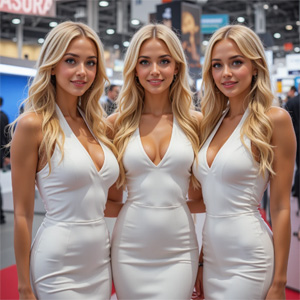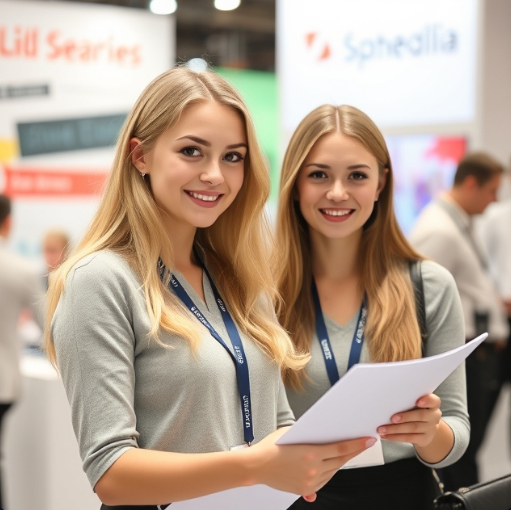
Minsk operates one of the more active exhibition calendars in the post-Soviet space. The Minsk International Exhibition Center on Pavliny Medelki Street, the Belexpo venue, and smaller sites like the Falcon Club Arena and the Football Maneuver host a steady stream of international fairs, forums, and business conferences throughout the year. Behind every stand, every B2B negotiation, and every delegation visit, there is a trade show assistant—often a translator, sometimes an event coordinator, occasionally both at once.
A Calendar Built for B2B
The scale of Minsk’s exhibition program is substantial. In a single week in May 2026, the city hosts the XXXI International Medical Forum “Healthcare in Belarus” with its specialized exhibition at the Minsk International Exhibition Center, the International Exhibition of Furniture and Design at the same venue, and BaReCo, the second exhibition-conference of the bar, restaurant, and coffee industry at the Falcon Club Arena. June brings Belagro-2026, the largest agricultural exhibition in the country, alongside Belfarm, Belproduct, Prodmash, Holod, and Upak as part of Belarusian Agro-Industrial Week.
October continues the pace with the 50th International Wholesale Exhibition-Fair for Light Industry Goods, the XII International Forum “Belarus Dairy,” and EnergyExpo-2026 focusing on energy, ecology, and energy saving. November closes with Prodexpo-2026, described as the largest food exhibition in Belarus, featuring over 15,000 square meters of exhibition space, 140+ participants, and 14,000+ professional visitors, with dedicated B2B negotiations between retail chains and manufacturers.
The XIII Forum of Regions of Belarus and Russia in June 2026 illustrates the diplomatic dimension. A large-scale exhibition-fair at the Minsk International Exhibition Center brings together producers and artisans from Russian regions including Vladimir, Kaliningrad, Moscow, Penza, Pskov, Tula, and Krasnodar, with B2B meetings scheduled for registered participants.
What Trade Show Assistants Actually Do
The role of a trade show assistant in Minsk is broader than the title suggests. A job description for the profession in Belarus outlines responsibilities that range from organizing and conducting excursions for foreign citizens to accompanying them during visits, assisting with accommodation, providing interpretation at presentations, business meetings, and negotiations, and handling written translation of specialized scientific, technical, and journalistic materials.
The personal qualities required are equally expansive: the ability to establish contacts with people of different ages, genders, social statuses, and cultures; clear and coherent speech; a high level of organizational skills; good memory; flexibility of thought; the capacity to pay attention to multiple objects simultaneously; and the ability to make quick decisions in changing situations. This is not a passive role. It requires someone who can function as a translator, a fixer, and a social facilitator, often in the same hour.
The Language Combinations That Matter
The language profile of Minsk’s trade show assistants reflects the country’s economic orientation. English remains the baseline for international business, but the demand for Chinese has grown markedly. Belmedpreparaty, one of Belarus’s largest pharmaceutical companies, has recruited for a simultaneous interpreter position requiring fluent Chinese as a “must-have” and English at a conversational level, with responsibilities including organizing and participating in work trips to China, India, and Europe, preparing negotiations in accordance with business etiquette, and providing interpretation at international meetings, specialized exhibitions, and conferences.
The Chinese goods and services exhibition held in Minsk in September 2026, organized by the China Machinery Industry Federation and marking its fifth edition, brought more than 120 Chinese and Belarusian companies together across automobiles, intelligent equipment, precision machine tools, new energy technology, and medical devices. Events of this scale generate concentrated demand for Chinese-Russian and Chinese-English interpretation, and the assistants who staff them are often the same freelancers who work the broader exhibition circuit.
Other language combinations appear in job listings with less frequency but consistent presence: Korean, German, and Italian translators are sought for roles that combine written and spoken work, sometimes with technical documentation. For Russian-Belarusian events, the linguistic demands are lighter but the organizational demands are similar.
The Working Structure
Trade show assistants in Minsk typically work through one of two channels. The first is direct employment with an exhibition operator. Belinterexpo, the exhibition unitary enterprise of the Belarusian Chamber of Commerce and Industry, has operated since 2002 and organizes national exhibitions abroad and foreign exhibitions in Belarus, in addition to its own exhibition and congress projects. The company offers a full range of services including stand design, business event organization, advertising, visa support, and hotel booking. A translator-journalist position with Belinterexpo, advertised in 2026, involved adapted translation of prepared materials on social, political, and economic topics, remote work, and approximately five articles per month. While this role is editorial rather than on-floor, it reflects the broader ecosystem of language work that supports exhibition operations.
The second channel is freelance or agency-based work. Translators registered with platforms and agencies are called in for specific events—a three-day medical forum, a week-long agricultural exhibition, a delegation visit. The rates vary. A simultaneous interpreter position at Belmedpreparaty was described in one listing as offering a salary within the company’s standard compensation system. A general translator position with Novalink-Group offered 950 to 1,100 Belarusian rubles per month. For freelance exhibition work, rates are negotiated per assignment, often based on hourly or daily minimums.
The Chinese Dimension
The most significant growth area for trade show assistants in Minsk is the China-Belarus relationship. The year 2026 was designated the “Year of China-Belarus Industrial Cooperation,” and the exhibition of Chinese goods and services that opened in September 2026 was explicitly framed by Chinese Ambassador Zhang Wenchuan as “a window for Chinese enterprises to showcase quality products and expand their market presence in Belarus” and “an important bridge for face-to-face communication and establishing long-term commercial ties.”
For trade show assistants, this means that Chinese language competence is no longer a niche specialization. It is a core qualification for anyone hoping to work the higher-profile events on Minsk’s calendar. The demand is not only for booth interpretation but for the full range of support that a Chinese company unfamiliar with Belarusian regulatory and business environments requires: accompaniment to meetings, assistance with documentation, and facilitation of the social interactions that precede contracts.
The Quiet Work of the Exhibition Floor
The role of the trade show assistant in Minsk is not glamorous. It involves long hours on concrete floors, repeated explanations of the same product specifications, and the constant mental switching between languages and registers. But in a city that has positioned its exhibition circuit as a tool of economic diplomacy—a venue where Belarusian producers meet Chinese machinery manufacturers, where Russian regional delegations negotiate with Belarusian retailers, where medical device companies from multiple countries compete for attention—the trade show assistant is the human infrastructure that makes the conversations possible.
The exhibition halls on Pavliny Medelki Street will continue to fill with stands and delegations. The contracts signed at Prodexpo or Belagro or the Forum of Regions depend on translators and assistants who can move between languages and cultures without friction. In Minsk, as elsewhere, the visible output of a successful trade fair rests on invisible linguistic labor.