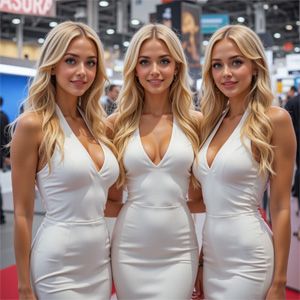
The Timiryazev Centre, which opened in October 2024 on the grounds of the Russian State Agrarian University, has quickly become one of Moscow’s most active exhibition venues, hosting more than sixty congress and exhibition events annually across its 40,000-square-metre complex. Its calendar spans agricultural shows, textile and design fairs, glass industry exhibitions, franchise events, and international machinery forums. Behind the stands and product displays, a specialised workforce of hostesses, booth assistants, and promotional models keeps the commercial machinery running. At the Timiryazev Centre, these roles have evolved well beyond the decorative stereotype: the demand is for personnel who combine presentable appearance with operational competence, product literacy, and the ability to function as the frontline of an exhibitor’s commercial effort.
The Booth Assistant: Operational Core and Strategic Filter
The terminology used in the Russian exhibition industry has shifted. “Hostess” has gradually given way to “booth assistant” or “stand assistant” in professional circles, reflecting an evolution in expectations. At the Timiryazev Centre, the booth assistant is the operational backbone of any stand. A typical day involves greeting visitors, managing the flow of attendees, distributing catalogues and technical documentation, and supporting the sales team in identifying serious business prospects.
The hierarchy within this role is distinct and event-dependent. At BUYBRAND, Russia’s largest franchise exhibition held at the Timiryazev Centre in late September, the assistant’s role is uniquely challenging: unlike selling a physical product, they are selling a business model—an intangible promise of success. A skilled booth assistant learns to qualify serious investors by asking targeted questions about investment budgets, suitable locations, and whether the visitor is seeking a master franchise or a single unit. This filtering ensures that the franchisor’s sales team only spends time on high-potential leads. With thousands of investors passing through the doors, professional assistants manage crowd flow, ensuring that serious prospects are offered a seat at the negotiation table while casual visitors are given brochures.
At Hometextile & Design, held at the Timiryazev Centre in late September, the emphasis shifts toward aesthetic and technical precision. Booth assistants manage product displays, support demonstrations of fabrics and design solutions, and ensure the booth runs efficiently throughout the three-day event. With the exhibition featuring special projects including Trend Rooms and HoReCa solutions, assistants play a vital role in presenting collections effectively. They must be prepared to explain product features, highlight fabric qualities, and handle questions about ordering and distribution channels.
At Mir Stekla, the glass industry exhibition that occupied the Timiryazev Centre in early March, booth assistants serve as the first human contact for visitors ranging from production managers and engineers to architects and procurement specialists. Their ability to quickly assess visitor interest and direct them to the appropriate technical expert can significantly influence the quality of leads generated. For international exhibitors—China represented 89 of the 173 exhibitors at the 2026 edition—booth assistants often serve a dual function, combining reception duties with interpretation.
The Hostess: First Contact and Brand Ambassador
While the term “hostess” has fallen out of favour in some professional circles, the function remains essential. At the Timiryazev Centre, hostesses serve as the first point of contact for visitors, managing foot traffic, distributing promotional materials, and creating a welcoming professional atmosphere. In an exhibition environment where the vast majority of visitors are professional trade attendees, the modern hostess functions as a brand ambassador and a critical component in a company’s lead generation efforts.
The role requires more than a welcoming smile. A skilled hostess acts as an initial filter, greeting attendees and quickly assessing their role and interest level. By qualifying visitors through predefined questions, hostesses ensure that technical staff time is optimised. Their responsibilities extend to managing the flow of visitors, scheduling meetings, coordinating product demonstrations, and capturing lead data accurately.
Language capability commands a premium and is frequently specified in recruitment. A casting for an exhibition at the Timiryazev Centre in May 2025 sought hostesses of model appearance with clear diction and strong communication skills, offering 12,000 RUB for two days of work. For events with significant international participation—such as Hometextile & Design, which brings together exhibitors from Turkey, China, Uzbekistan, and India—hostesses with language skills and cultural competence are essential to facilitating communication between international brands and Russian buyers.
The Model: Visual Impact and Active Engagement
While the line between hostesses and models can blur in practice, models at the Timiryazev Centre serve a distinct function: active engagement with the broader exhibition floor. Their role is to intercept foot traffic in the aisles, distribute samples or promotional materials, and direct visitors toward specific stands. Promotional models may move through pavilions in themed costumes, attract attention to a brand through striking imagery, and pose for photographs with guests—activities that humanise a brand in expansive exhibition halls.
The market rates for models and promotional staff at the Timiryazev Centre vary by event and duration. Agency rates for stand personnel, including models functioning as assistants or consultants, range from 10,000 to 12,000 RUB per person per day, with uniform rental available from 6,000 RUB per set for the duration of the event. For events requiring active distribution of materials, promoters working “on their feet” command 11,000 to 13,000 RUB per day. Premium promotional models—those with height requirements, striking appearance, or English-language capabilities—command 13,000 to 18,000 RUB per day.
In industrial and B2B contexts, where booths often showcase heavy equipment and complex technologies, models serve to create a visual focal point and draw crowds that might otherwise pass by. However, the distinction between a model and a booth assistant lies primarily in emphasis: models focus on visual presentation and promotional engagement, while assistants handle informational and logistical tasks. In practice, individuals working in these roles frequently possess overlapping skills, and the boundaries shift depending on the event’s needs.
The Agency Ecosystem and Practical Considerations
Exhibitors at the Timiryazev Centre have access to a well-developed agency market serving Moscow’s exhibition venues. Agencies such as YSM, which has operated since 2000, maintain databases of models, hostesses, and booth assistants with experience across the Timiryazev Centre, Crocus Expo, and Expocentre. They offer transparent selection processes, allowing clients to review candidate profiles with photographs, parameters, language proficiency, and relevant experience before signing a contract. Some agencies also provide uniform rental or tailoring services, recognising that coordinated appearance is part of the brand presentation.
For exhibitors, several practical considerations apply. Staffing should match booth scale and event type. Product training matters: booth assistants and models who understand the basics of what they are presenting perform measurably better than those who receive only a script. Advance briefing on key products, target visitor profiles, and qualification criteria improves lead quality.
The specific demands of the Timiryazev Centre’s calendar should also inform staffing choices. For BUYBRAND, assistants need familiarity with franchise terminology—master franchise, royalty fees, unit economics. For Hometextile & Design, they need to distinguish upholstery fabrics from curtain fabrics and understand contract textile applications. For Mir Stekla, they need enough product literacy to articulate the value proposition of automated sealing robots or specialty coatings. The most successful staffing decisions are those that recognise the venue’s diversity and match personnel capabilities to the specific industry on display.
The human infrastructure of the Timiryazev Centre—the hostesses managing registration desks, the assistants qualifying leads, the models drawing crowds—is not incidental to the exhibition economy. It is the layer through which brands become legible to visitors, and through which the venue’s dozens of annual events become productive commercial encounters rather than mere displays of products.