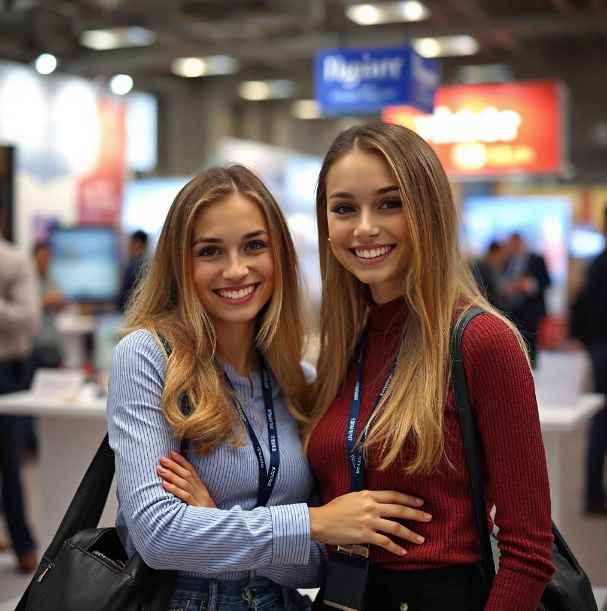
Crocus Expo, the largest exhibition centre in Eastern Europe, hosts a calendar dense with international trade fairs—ProdExpo, InterCHARM, CTT, and dozens of others. Behind the stands and product displays, a specialised workforce of hostesses, booth assistants, and promotional models keeps the commercial machinery running. At Crocus Expo, these roles have evolved well beyond the decorative stereotype: the demand is for personnel who combine presentable appearance with operational competence, language skills, and enough product literacy to function as the frontline of an exhibitor’s sales effort.
The Hostess and Booth Assistant: From Greeting to Qualification
The terminology used in the Russian exhibition industry has shifted. “Hostess” has gradually given way to “booth assistant” or “stand hostess” in professional circles, reflecting an evolution in expectations. At Crocus Expo, the booth assistant is the operational core of any stand. A typical day involves receiving and coordinating visitors, preparing tea and coffee, answering questions about the company and its products, recording contact information left at the stand, and directing serious prospects to sales managers.
The hierarchy within this role is distinct. At consumer-oriented events, hostesses may focus on engagement and sample distribution. At B2B technical exhibitions, the emphasis shifts toward crowd management, information provision, and visitor qualification. The modern hostess at a venue like Crocus Expo acts as an initial filter—greeting attendees and quickly assessing whether the person approaching is a curious student or a high-potential procurement director. By qualifying visitors through predefined questions, they ensure that technical staff time is optimised for maximum return on investment.
Language capability commands a premium. Official Crocus Expo staffing rates for 2025–2026 list stand attendants without foreign languages at approximately 7,000 RUB per day, and those with a basic foreign language at approximately 8,000 RUB per day. For events with significant international participation, English is standard, and other languages are available according to exhibitor needs. The most effective assistants bring an intuitive understanding of when to engage and when to step back, allowing sales conversations to develop organically.
The Model: Active Engagement and Visual Impact
While the line between hostesses and models can blur in practice, models at Crocus Expo serve a distinct function: active engagement with the broader exhibition floor. Their role is to intercept foot traffic in the aisles, distribute samples or promotional materials, and direct visitors toward specific stands. Promotional models may move through pavilions in themed costumes, attract attention to a brand through striking imagery, and pose for photographs with guests—activities that humanise a brand in expansive exhibition halls.
The market rates for models at Crocus Expo vary by event and duration. A casting for InterCHARM in October 2026 offered 7,000 RUB per day plus 500 RUB for lunch, with work including product presentation and communication with visitors. Another InterCHARM casting listed 6,000 RUB for a full eight-hour day. A general casting for an unnamed Crocus Expo exhibition in late October offered 8,000 RUB per day for four days of three-hour shifts, with tasks described as greeting, inviting visitors to the stand, and pleasant communication. Agency rates for promotional models across Moscow venues range from approximately 1,265 to 1,680 RUB per hour, or 7,590 to 10,081 RUB for a six-hour shift, depending on the model’s level and requirements.
In industrial contexts, where booths often showcase heavy equipment and complex technologies, models serve to create a visual focal point and draw crowds that might otherwise pass by. At B2B exhibitions, however, the model’s function increasingly overlaps with that of the booth assistant: the distinction lies primarily in emphasis, with models focused on visual presentation and promotional engagement while assistants handle informational and logistical tasks.
The Food Industry Context: ProdExpo and Beyond
What distinguishes exhibition staffing at Crocus Expo from other venues is the specificity of its flagship events. ProdExpo, Russia’s largest international food and beverage exhibition, brings together thousands of producers and retail buyers each February. Booth assistants working for food and beverage brands are increasingly expected to possess more than general exhibition experience. A booth assistant working for a beverage company may need to answer questions about preservatives and acid content; one working for a dairy producer may need to discuss pasteurisation methods and shelf-life specifications.
The most successful assistants are those who can engage substantively, not merely direct inquiries to a waiting sales manager. Agencies that specialise in food exhibition staffing often seek candidates with backgrounds in food technology, chemistry, or related fields. For international exhibitors, the booth assistant often serves a dual function, combining reception duties with basic interpretation—handling initial inquiries from Russian visitors, explaining product specifications, and collecting contact information for follow-up.
The Agency Ecosystem and Official Channels
Exhibitors at Crocus Expo have two primary routes for sourcing this workforce. The official venue route offers standardised, published rates and a regulated safety net, but comes with rigidity. The agency route offers greater flexibility and access to specialised personnel—models with specific looks, assistants with technical backgrounds, or multilingual staff—but requires more vetting and coordination.
Moscow-based agencies serving Crocus Expo maintain databases of models, hostesses, and booth assistants with experience across the venue’s calendar. Some providers offer combined services, including interpreters for exhibitions, promotional models, and stand assistants, recognising that different exhibitors require different configurations of skills. For events with international participation, the distinction between a booth assistant and an interpreter matters: a general assistant may manage reception and lead capture, while a technical interpreter handles negotiations and product specifications.
Practical Considerations for Exhibitors
For companies planning to exhibit at Crocus Expo, several practical considerations apply. Staffing should match booth scale and event type: a standard booth typically requires one to two assistants handling reception and information gathering, while larger custom booths with demonstration areas may need three to five staff members with differentiated roles.
Product training matters. Booth assistants and models who understand the basics of what they are presenting perform measurably better than those who receive only a script. Advance briefing on key products, target visitor profiles, and qualification criteria improves lead quality. For exhibitors with complex technical offerings, separating interpretation from operational functions produces better outcomes than expecting one person to do everything.
Booking early is advised. Crocus Expo’s calendar is crowded, and demand for experienced bilingual staff peaks during major events. The venue’s official staffing services and the agencies that supply personnel both recommend planning well in advance, particularly for exhibitions with significant international participation.
The human infrastructure of Crocus Expo—the hostesses managing registration desks, the assistants qualifying leads, the models drawing crowds—is not incidental to the exhibition economy. It is the layer through which brands become legible to visitors, and through which the venue’s hundreds of annual events become productive commercial encounters rather than mere displays of products.