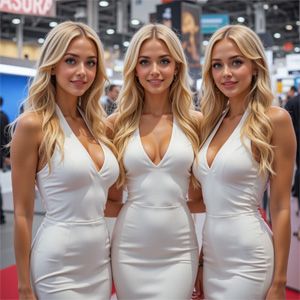
Expoforum’s exhibition calendar depends on a workforce that rarely appears in the official programmes: the hostesses, booth assistants, and models who staff the stands, manage visitor flow, and shape the first impression a brand makes. At a venue hosting over 160 events annually, these roles have evolved well beyond the decorative stereotype. In the Russian B2B exhibition market, particularly at Expoforum, the demand is for personnel who combine professional presentation with operational competence—and who can function as the frontline of a company’s commercial effort.
The Hostess: From Greeting to Gatekeeping
The hostess role at Expoforum is more layered than its Western counterpart. At a venue where exhibitions range from industrial forums to jewellery fairs, hostesses manage registration desks, direct visitor traffic, distribute materials, and maintain the professional tone of an exhibition environment. For exhibitors hiring private hostesses, expectations include greeting visitors according to a prepared script, managing seating and meeting areas, and ensuring the booth remains presentable throughout the day.
The hierarchy within this role is distinct. At consumer-oriented events, hostesses may focus on engagement and sample distribution. At B2B technical exhibitions—such as those held regularly at Expoforum—the emphasis shifts toward crowd management, information provision, and professional decorum. The best hostesses possess what industry observers describe as situational awareness: scanning the crowd, spotting confused visitors before they ask for help, and managing bottlenecks without being asked.
Language capability commands a premium. Hostesses without foreign languages start at approximately 24 EUR per hour, those with one foreign language around 28 EUR per hour, and those with English plus another language around 30 EUR per hour. For events with international participation, English is standard, while German, French, Italian, and other languages are available according to exhibitor needs.
Booth Assistants: The Operational Core
The booth assistant role has diverged sharply from the hostess function. At technical exhibitions, the demand is for a “stand hostess with technical knowledge”—professionals who combine hospitality with basic product literacy. Their functions typically include visitor qualification, lead capture and data management, and basic product information.
Visitor qualification is perhaps the most commercially significant task. With exhibitions of scale, exhibitors cannot afford to spend equal time on every visitor. A skilled assistant quickly identifies whether a visitor is a procurement manager, an engineer, a distributor, or a casual attendee—allowing the technical team to focus on genuine prospects. Lead capture follows: assistants collect business cards, record visitor details, note specific product interests, and flag serious buyers for follow-up. Poor lead capture is one of the most common failures at international exhibitions, and one of the easiest to prevent with a competent assistant.
For international exhibitors at Expoforum, the ideal booth assistant combines Russian fluency, working proficiency in the exhibitor’s language, and enough familiarity with the sector to function as a preliminary filter. Agencies increasingly recruit students from technical universities for these roles, valuing theoretical knowledge over pure presentation skills.
Models: Visual Impact with Purpose
While the distinction between hostesses and models can blur, models at Expoforum serve a distinct function. Promotional models are often engaged purely for visual impact or to wear branded attire, drawing attention to a booth in crowded exhibition halls. They may move through pavilions in themed costumes, attract attention to a brand through striking imagery, distribute invitations to a stand, and direct interested visitors to the booth for more detailed consultation.
The key difference from hostesses is that models are primarily engaged for their visual presence and ability to draw crowds, whereas hostesses are functional roles focused on communication and logistics. In industrial contexts, where booths often showcase heavy equipment and complex technologies, models can serve to humanize a brand and create a visual focal point in expansive exhibition spaces.
The market for models at Expoforum varies widely by event type. A jewellery exhibition may seek professional models for five days of work at a fixed rate, while a vape industry show might request body-art models at a significantly higher daily rate. The common thread is that the model’s presence is calibrated to the event’s audience and the brand’s desired image.
The Agency Ecosystem and Practical Considerations
The staffing market serving Expoforum has developed into a specialised segment with precise divisions of labour. Some agencies focus on hostesses and promoters, emphasising language capabilities and professional presentation. Others provide model hostesses who combine presentation skills with hosting experience. Still others specialise in interpretation services for Russian and foreign exhibitors.
For exhibitors, several practical considerations apply. Booking early is advised; Saint Petersburg’s exhibition calendar is crowded, and demand for experienced bilingual staff peaks during major events, with agencies recommending planning at least one month ahead. Staffing should match booth scale: a standard 9–18 square metre booth typically requires one to two assistants handling reception and information gathering, while larger custom booths with demonstration areas may need three to five staff members with differentiated roles.
Product training matters. Booth assistants and hostesses who understand the basics of what they are presenting perform measurably better than those who receive only a script. Advance briefing on key products, target visitor profiles, and qualification criteria improves lead quality. And for exhibitors with complex technical offerings, separating technical interpretation from operational functions produces better outcomes than expecting one person to do everything.
The human infrastructure of Expoforum—the hostesses managing registration desks, the assistants qualifying leads, the models drawing crowds—is not incidental to the exhibition economy. It is the layer through which brands become legible to visitors, and through which the venue’s hundreds of annual events become productive commercial encounters rather than mere displays of products.