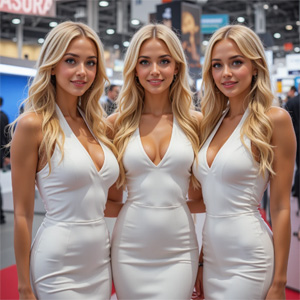
In the cavernous halls of Moscow’s Timiryazev Centre and Crocus Expo, where the air carries the subtle chemistry of innovation—the faint scent of resins, the metallic whisper of electroplating lines, and the quiet hum of precision machinery—a critical professional ensures that every visitor interaction yields the right commercial reaction: the Russian stand assistant.
The paints and coatings industry operates in a world of exacting technical specifications, regulatory compliance, and heavy industrial decision-making. At premier events like Interlakokraska and ExpoCoating Moscow, where a single contract for anti-corrosion coatings or a complete electroplating line can run into millions of dollars, the standard “booth model” is not merely inadequate—it can actively damage a brand’s reputation in this precision-driven sector.
The Stage: Moscow’s Premier Coating Events
Interlakokraska stands as the undisputed leader in the Russian paints and coatings sector. Celebrating its 30th anniversary in 2026, this international exhibition draws together 287 companies from 10 countries—including China, Turkiye, Iran, and South Korea—across over 14,700 square meters of exhibition space. The event attracts over 12,000 professional visitors: paint technologists, chief engineers, and purchasers from manufacturing companies across Russia.
ExpoCoating Moscow serves as the essential autumn event, with a specific emphasis on application technologies, surface treatment, and industrial coating processes. The 2026 edition is scheduled for October 19-21 at Crocus Expo, drawing 225+ exhibitors and over 13,700 buyers, with an extraordinary 95% of visitors holding direct purchasing authority.
Why the Coating Industry Demands a Specialized Approach
The paints and coatings sector is built on chemistry, engineering, and meticulous application. Clients invest in solutions that offer durability, color fidelity, environmental compliance, and cost-efficiency. In Moscow’s competitive market—where relationships are key and technical knowledge is high—trust is paramount. A language barrier or an unprofessional interaction can undermine confidence in your product.
A professionally trained stand assistant ensures that your first impression is as impeccable as the finishes you provide. She is far more than a greeter; she is a Technical Ambassador, a Brand Guardian, and a Cultural Liaison, essential for making meaningful connections in the demanding Russian market.
The Three Pillars of the Coating Stand Assistant
The Qualified Lead Generator and Facilitator
The assistant’s first job is to filter and qualify visitors rapidly. At Interlakokraska, the show floor is dense with serious buyers—paint technologists, chief engineers, and purchasers from holdings and manufacturing companies from all over Russia.
A skilled assistant engages visitors with strategic questions:
- “What type of coating application do you run—liquid, powder, or electroplating?”
- “What substrates do you coat? Metal, plastic, wood, concrete?”
- “What performance requirements do you need—corrosion resistance, temperature tolerance, chemical resistance?”
- “Are you looking for raw materials, application equipment, or testing instruments?”
This qualification ensures that senior technical staff and sales engineers focus only on high-value prospects, maximizing ROI from the exhibition.
The Technical Communicator and Bridge
In an industry where precision is paramount, miscommunication is not an option. The stand assistant serves as the technical bridge between international exhibitors and Russian buyers. Russian buyers seek detailed answers about product chemistry, performance characteristics, and application parameters. They want to know: Does this coating meet our climate requirements? Is it compliant with Russian technical regulations? How does it perform in salt spray testing?
The assistant must be able to differentiate between coating types (powder coatings, liquid paints, anti-corrosion primers, electroplated finishes), understand application methods, and navigate compliance concerns—including GOST certification and performance in extreme climates.
The Cultural Protocol Officer
In the Russian coating industry, relationships matter as much as technical specifications. Russian business culture heavily emphasizes hospitality and relationship-building—a practice that extends to the exhibition floor. A professional Russian stand assistant knows that:
- Formal address is expected: Using correct titles and patronymics signals respect
- Hospitality builds trust: Offering tea, coffee, or water is culturally expected and facilitates commercial conversations
- Business cards carry weight: Exchanging cards with both hands and taking a moment to read the received card demonstrates genuine interest
The assistant serves as the exhibitor’s cultural guide, navigating these expectations so that the international team can focus on the technical conversation.
The Coating-Specific Skillset: From Resins to Rectifiers
To understand the specific demands of a coating industry stand assistant, one must look at the exhibit categories at Moscow’s premier events:
| Category | Key Terms the Assistant Must Know |
|---|---|
| Coating Types | Powder coating, liquid paint, primer, topcoat, electroplating, anodizing, galvanizing |
| Raw Materials | Resins (epoxy, polyester, acrylic), pigments, solvents, biocides, additives, hardeners |
| Application Equipment | Spray booth, electrostatic gun, dip tank, curing oven, electroplating line |
| Testing & Quality | Viscosity, solids content, adhesion (cross-cut test), gloss meter, salt spray chamber |
| Environmental Compliance | VOC (volatile organic compounds), low-VOC, water-based, wastewater treatment |
| Industry Applications | Automotive coatings, aerospace primers, marine paints, industrial maintenance coatings |
A stand assistant working this floor must also understand application methods—the basics of spray application, dip coating, electrostatic application, and electroplating processes—and speak the language of testing.
The Growing Importance of the Russian Coating Market
Several factors make the Russian coating industry particularly dynamic—and particularly demanding for exhibition staff.
The Push for Technological Sovereignty
At Interlakokraska 2026, the plenary session focused on the “Strategic Directions of Development of the Paint and Coating Sub-Industry,” with participation from the Russian Ministry of Industry and Trade. The Russian government is actively supporting domestic coating production and import substitution. As Anton Alikhanov, Minister of Industry and Trade of Russia, stated: “Over 30 years of its existence, the show has established itself as the most important platform for the exchange of experience, knowledge and innovations in the paint and coating industry”.
This environment creates significant opportunities for international suppliers—but also requires skilled local support to navigate import regulations, certification requirements, and government procurement processes.
The Shift in Supply Chains
With evolving global trade dynamics, the Russian coating market has seen a significant influx of raw materials and equipment from China, Turkiye, Iran, and South Korea. At Interlakokraska 2026, 139 foreign companies exhibited alongside 160 Russian companies. This international character creates demand for multilingual assistants, with Mandarin and Turkish speakers increasingly valued.
The Sustainability Imperative
ExpoCoating Moscow has introduced a new Functional Specialty Coating zone, focusing on low-carbon, environmentally friendly coatings, long-lasting anti-rust protection, and energy-efficient application processes. Assistants who understand the language of low-VOC, water-based, and high-durability coatings are particularly valuable as exhibitors position their products within Russia’s green industrial transition.
Sourcing the Right Talent
To find stand assistants who meet these elevated standards, consider:
- Specialized Agencies: Work with Moscow-based agencies experienced in providing staff for chemical, industrial, and B2B events. Provide them with detailed information about your technology and audience.
- Language and Technical Aptitude: Prioritize candidates who are fluent in Russian and English and who demonstrate the ability to grasp technical concepts quickly.
- Industry-Adjacent Recruitment: Chemistry, materials science, or engineering students can be excellent candidates—they bring inherent interest and credibility to the role.
Professional agencies require bookings 2–3 weeks in advance and provide profiles with photographs and past experience for client approval.
Cost Guide (Daily Rates for an 8-hour Shift)
| Experience Level | Approx. Daily Rate (RUB) | Best Suited For |
|---|---|---|
| Standard Hostess/Stand Staff | 8,000 – 12,000 | Basic greeting, leaflet distribution, traffic management |
| Technical Stand Assistant | 10,000 – 15,000+ | Most coating booths requiring lead generation and technical awareness |
| Multilingual Assistant | Premium rates | High-end exhibitors with Chinese, Turkish, or German-speaking visitors |
At Moscow’s coatings exhibitions, your products demonstrate innovation and resilience. Your people must reflect those same qualities—knowledgeable, adaptable, and built to last. A professional Russian stand assistant is the final coat of excellence on your exhibition presence: she enhances, protects, and ensures your performance is nothing short of flawless.
She is the precision interface that translates chemistry into commerce, technical specifications into trust, and visitor interactions into signed contracts.