In the technologically advanced halls of Moscow’s Crocus Expo International Exhibition Center, the air hums with the future of materials science. Here, carbon fiber meets aerospace engineering, glass-reinforced plastics transform automotive design, and bio-based composites promise a sustainable industrial revolution. This is the world of Composite-Expo, Russia’s only international specialized exhibition for composite materials, and Rosplast, the leading exhibition for plastics and polymer materials.
Composite-Expo 2026, the 18th edition of this flagship event, takes place April 22–24, 2026, in Pavilion 3, Hall 13 of Crocus Expo. The exhibition spans approximately 15,000 square meters, hosting 270 exhibitors from nearly 20 countries, including China, Turkey, Germany, Italy, the United States, and Brazil, while attracting over 7,500 professional visitors—90% of whom are industry specialists with direct purchasing authority. Concurrently, Rosplast 2026, running June 16–19, 2026, at Crocus Expo Pavilion 1, complements the composites sector with a focus on plastics machinery, materials, and production automation.
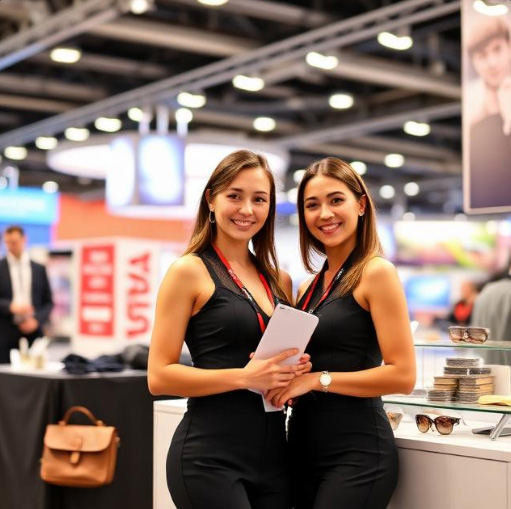
Amidst the dense discussions of resin systems, fiber reinforcements, and autoclave curing cycles, one professional ensures that every visitor interaction cures into a solid commercial bond: the Russian exhibition booth assistant. In an industry where a single contract for carbon fiber prepregs or an automated filament winding machine can reach millions of dollars, these specialized professionals have become the indispensable human interface between international technology and the Russian market.
The “Advanced Material” Professional
Unlike consumer trade fairs, Moscow’s composites events operate in a world of high technical specificity, rigorous certification requirements, and multi-industry application knowledge. The standard “booth model” or a simple greeter is not merely inadequate—it can actively damage a brand’s credibility in this precision-driven sector.
According to Moscow-based agencies that specialize in industrial exhibition staffing, the modern composites booth assistant has evolved into a strategic asset—a multifunctional specialist who combines language fluency, cultural intelligence, and materials science literacy. The role encompasses three critical functions: technical communicator, lead qualification specialist, and cultural protocol officer. For the composites sector, a fourth essential element is required: familiarity with the language of advanced materials and their industrial applications.
Composite-Expo’s visitor profile demonstrates exactly why this expertise matters. Attendees include “development managers, engineers, consultants, decision makers, representatives of ministries and departments, heads and leading experts from aeronautics, automotive, ship-building, tool manufacturing, mass transport, power, oil and gas, military-industrial complex, chemical and mining, medical, sport and leisure, instrument making, construction, and other industrial enterprises”. These are not browsers—they are buyers with specific technical requirements and project budgets.
The Composites-Specific Skillset: From Resins to Reinforcement
To understand the specific demands of a composites industry booth assistant, one must look at the exhibit categories at Moscow’s premier events.
At Composite-Expo 2026, the exhibition covers the entire composites value chain:
| Category | Specific Examples |
|---|---|
| Raw Materials | Resins (epoxy, polyester, vinyl ester, phenolic, polyurethane), thermoplastics, carbon fiber, glass fiber, aramid fiber, basalt fiber, natural fibers |
| Reinforcements & Modifiers | Fabrics (woven, non-crimp, 3D), mats, rovings, additives, fillers, colorants, release agents |
| Semi-Finished Products | Prepregs (carbon/epoxy, glass/epoxy), SMC (sheet molding compound), BMC (bulk molding compound) |
| Manufacturing Technologies | Hand lay-up, spray-up, filament winding, pultrusion, resin transfer molding (RTM), vacuum bag molding, autoclave curing, compression molding, injection molding |
| Processing Equipment | Ovens, autoclaves, filament winding machines, pultrusion lines, presses, CNC machining centers, waterjet cutters |
| Testing & Quality Control | Mechanical testing (tensile, compression, shear), NDT (ultrasound, thermography), thermal analysis (DSC, TGA) |
| Finished Products | Aerospace components, automotive parts, wind turbine blades, pressure vessels, pipes, tanks, marine hulls, sports equipment |
| Software & CAD/CAM | Composite design software, ply book generation, simulation tools |
A booth assistant working this floor must be able to:
- Differentiate between resin systems: Understand the basic differences between epoxy (high performance, aerospace), polyester (cost-effective, general purpose), vinyl ester (corrosion resistance), and phenolic (fire resistance)
- Recognize reinforcement types: Distinguish between carbon fiber (high stiffness, lightweight), glass fiber (cost-effective, electrical insulation), aramid (impact resistance), and basalt fiber (chemical resistance)
- Understand basic process terminology: Know the difference between hand lay-up (low volume, simple shapes), filament winding (cylindrical parts, pressure vessels), pultrusion (constant cross-sections), and RTM (medium volume, complex shapes)
- Speak the language of testing: Recognize terms like Tg (glass transition temperature), fiber volume fraction, void content, and interlaminar shear strength
- Navigate application sectors: Understand that an aerospace buyer prioritizes certification and traceability, an automotive buyer prioritizes cycle time and cost, and a construction buyer prioritizes durability and weather resistance
Key Terminology for Composites Booth Assistants
To be effective, a Russian booth assistant must command a working vocabulary that spans materials science, manufacturing engineering, and quality control:
| Category | Key Terms (English/Russian) |
|---|---|
| Resins | Epoxy (эпоксидная смола), polyester (полиэфирная смола), vinyl ester (винилэфирная смола), phenolic (фенольная смола), curing agent (отвердитель), catalyst (катализатор) |
| Fibers | Carbon fiber (углеродное волокно), glass fiber (стекловолокно), aramid (арамид), basalt (базальтовое волокно), tow (ровинг), fabric (ткань), mat (мат) |
| Processes | Hand lay-up (ручная выкладка), filament winding (намотка), pultrusion (пултрузия), RTM (RTM), autoclave (автоклав), vacuum bag (вакуумный мешок), prepreg (препрег) |
| Properties | Tensile strength (прочность на растяжение), flexural modulus (модуль упругости при изгибе), impact resistance (ударопрочность), Tg (температура стеклования), fatigue life (усталостная прочность) |
| Applications | Aerospace (аэрокосмическая), automotive (автомобильная), wind energy (ветроэнергетика), marine (судостроение), oil & gas (нефтегазовая), construction (строительная) |
The Three Pillars of the Composites Booth Assistant
Based on the technical density and commercial stakes of events like Composite-Expo and Rosplast, the role of the composites booth assistant rests on three critical pillars.
The Technical Filter and Lead Qualifier
At Composite-Expo 2025, the exhibition drew 7,500 visitors, 90% of whom were industry specialists with specific project needs. The assistant’s first and most critical job is to filter and qualify these visitors rapidly and accurately.
A skilled assistant engages visitors with strategic questions that identify their position in the supply chain and their purchasing authority:
- “What industry sector do you work in? Aerospace, automotive, construction, marine, or oil & gas?”
- “What type of composites do you currently use—carbon fiber, glass fiber, or other reinforcements?”
- “What manufacturing processes are you running—hand lay-up, filament winding, pultrusion, or compression molding?”
- “Are you looking for raw materials (resins, fibers), processing equipment, testing services, or finished components?”
- “What is your annual consumption of composites or your equipment budget?”
- “Do you require certification to aviation standards (AS9100) or specific Russian regulatory compliance?”
This qualification ensures that senior technical staff and sales engineers focus only on high-value prospects, maximizing ROI from the exhibition. As the Composite-Expo organizers note, the event is specifically designed to “promote exhibitors in establishing new business contacts and partner relations”. The assistant is the first point of contact in that process.
The Technical Communicator and Bridge
In the composites industry, precision is paramount. A misunderstanding about fiber orientation, cure temperature, or resin compatibility can lead to catastrophic part failure. The booth assistant serves as the technical bridge between international exhibitors and Russian buyers.
Russian buyers at Composite-Expo come with detailed technical questions. They want to know:
- Does your prepreg meet our specific Tg requirements for aerospace applications?
- Is your resin system compatible with our existing autoclave cure cycle?
- What is the fiber volume fraction achievable with your filament winding equipment?
- Do you have certification for use in Russian civil aviation (or other regulated industries)?
- How does your carbon fiber perform in high-cycle fatigue applications?
The assistant translates not just words, but the intent and nuance of technical inquiries. They communicate product specifications, performance data, processing parameters, and compliance documentation accurately and professionally. When the technical question exceeds their knowledge—as it inevitably will—they seamlessly hand off to the exhibitor’s engineer, ensuring the visitor never feels dismissed or frustrated.
As the Composite-Expo business program demonstrates, the integration of science and industry is central to the event. The 7th R&D Conference, “Practical Use of Composite Materials in Different Industries,” runs concurrently with the exhibition. A skilled assistant can direct visitors from the booth to relevant conference sessions, creating additional engagement opportunities.
The Cultural Protocol Officer and Logistics Anchor
In the Russian industrial sector, relationships matter as much as technical specifications. According to exhibition industry experts, Russian business culture places a high premium on face-to-face interaction, hospitality, and demonstrated reliability.
A professional Russian booth assistant knows that:
- Formal address is expected: Using correct titles and patronymics (first name + patronymic) signals respect for the visitor’s position
- Hospitality builds trust: Offering tea, coffee, or water is not merely polite—it is culturally expected and facilitates commercial conversations
- Documentation matters: Russian buyers expect detailed technical data sheets, certificates, and compliance documentation to be readily available
- Follow-through is critical: Promises made at the exhibition must be documented and followed up promptly post-show
The assistant serves as the exhibitor’s cultural guide, navigating these expectations so that the international team can focus on the technical conversation. For international exhibitors—particularly from China, Turkey, and other non-Russian markets—this local expertise is invaluable.
Composite-Expo attracts exhibitors from nearly 20 countries, including China, Turkey, Germany, Italy, the United States, Brazil, Finland, the Netherlands, and many others. A local assistant who understands both the Russian market and the exhibitor’s home culture is a powerful asset.
The Venue Factor: Conquering Crocus Expo
Moscow’s composites events are held primarily at Crocus Expo International Exhibition Center, one of Europe’s largest and most prestigious exhibition complexes.
Crocus Expo is located approximately 20 kilometers from central Moscow, at the 65-66 km mark of the MKAD ring road. Traffic on the MKAD is notoriously unpredictable, particularly during morning and evening rush hours. Professional assistants know to arrive early—often before the 9:00 AM exhibition opening—to ensure that demo equipment is calibrated, product samples are displayed properly, and the booth is pristine before the first buyer walks in.
Accessibility is a key consideration. The Myakinino metro station provides direct access to Crocus Expo, and many professional assistants use public transport to avoid traffic delays. For those driving, the venue is accessible from both the outer and inner sides of the MKAD, with specific exits designated for Crocus City.
The venue spans multiple pavilions. Composite-Expo 2026 is located in Pavilion 3, Hall 13, while Rosplast 2026 takes place in Pavilion 1. A professional assistant must be intimately familiar with the layout of these pavilions to guide lost attendees efficiently.
The Growing Importance of the Russian Composites Market
Several factors make the Russian composites market particularly dynamic—and particularly demanding for exhibition staff.
The Push for Industrial Modernization
Russia is actively investing in domestic composites production capabilities. The government recognizes composites as strategic materials for aerospace, defense, automotive, and construction sectors. At Composite-Expo, the conference program includes discussions of “strategic directions of development” and “practical aspects of composite materials use in various industries”.
This environment creates significant opportunities for international suppliers from China, Turkey, India, Iran, and other friendly nations—but also requires skilled local support to navigate import regulations, certification requirements, and government procurement processes.
The Shift in Supply Chains
With evolving global trade dynamics, the Russian composites market has seen a significant influx of raw materials and equipment from China, Turkey, and other non-Western countries. At Composite-Expo 2025, 135 foreign companies exhibited alongside 135 Russian companies, representing 6 countries.
This international character creates demand for multilingual assistants. While English remains important, Mandarin and Turkish speakers are increasingly valued. As the exhibition data indicates, China, Turkey, and other Asian markets are significant participants.
The Wide Range of Application Sectors
Composites are used across an extraordinary range of Russian industries, each with its own vocabulary, standards, and buyer expectations:
| Application Sector | Key Priorities for Russian Buyers |
|---|---|
| Aerospace | Certification (AS9100), traceability, lightweighting, high-temperature performance |
| Automotive | Cycle time, cost reduction, impact resistance, Class A surface finish |
| Construction | Durability, weather resistance, fire performance, GOST compliance |
| Oil & Gas | Corrosion resistance, high-pressure capability, temperature tolerance |
| Marine | Water resistance, UV stability, impact strength |
| Wind Energy | Fatigue life, large-part manufacturing capability, field repair |
| Medical | Biocompatibility, sterilization compatibility, radiolucency |
An assistant who understands the different priorities of these sectors can tailor their engagement approach accordingly, asking the right qualifying questions and highlighting the most relevant product features.
The Hierarchy of Composites Booth Assistants
Given the technical demands and varying needs of exhibitors, Moscow agencies typically offer a tiered staffing model for industrial events:
| Role | Primary Function | Required Knowledge | Best For |
|---|---|---|---|
| Bilingual Hostess | Welcoming visitors, badge scanning, brochure distribution, traffic management | Professional presentation; basic Russian/English fluency | Brands needing general visitor management and brand presence |
| Booth Assistant | Product presentations, basic Q&A, lead qualification, explaining product ranges | Composites industry terminology; understanding of material categories; sales awareness | Mid-sized exhibitors with standard product lines |
| Technical Specialist / Interpreter | In-depth technical discussions, VIP buyer engagement, complex negotiation support | Advanced composites knowledge (resin chemistry, processing, testing); understanding of application sectors; multilingual skills | Premium exhibitors with complex products requiring detailed explanation |
According to Moscow staffing data, professional exhibition assistants can help reduce participation operating costs by approximately 30% and increase visitor engagement efficiency by as much as 50%. Daily rates for experienced composites industry assistants typically reflect the specialized nature of the field, with technical specialists and rare language combinations commanding premium rates.
Why Your Composites Brand Cannot Afford a Novice
In the high-stakes world of advanced materials—where a single contract for aerospace-grade prepreg or an automated filament winding machine can run into millions of dollars—the margin for error in technical communication is zero.
A professional Russian exhibition booth assistant:
- Builds credibility instantly by answering technical questions about resin systems, fiber reinforcements, processing parameters, and performance characteristics accurately and confidently
- Filters casual visitors from serious procurement decision-makers—protecting your engineers’ time for the conversations that generate revenue
- Bridges the language gap with Russian plant managers, materials engineers, and quality control specialists who prefer to work in their native language
- Navigates Russian business culture—understanding that technical competence must be demonstrated and relationships built before contracts are signed
- Collects precise lead data—noting material requirements, processing needs, application sectors, and follow-up timelines for effective post-show outreach
- Stays current on industry trends, including the push for import substitution, the influx of Chinese and Turkish materials, and the growing demand for sustainable composites
As the Composite-Expo organizers emphasize, the exhibition’s purpose is defined by three components: industrial and economic relations development, scientific and technical information exchange, and wide introduction of innovative technologies. The booth assistant is instrumental in achieving all three.
Finding Qualified Composites Booth Assistants in Moscow
The most successful exhibitors source their assistants through specialized Moscow agencies that maintain rosters of pre-vetted professionals with industrial and materials science experience.
These agencies typically provide:
- Pre-show preparation including product line briefings, technical glossary creation (English/Russian), application sector overviews, and lead capture training
- During-show support including visitor engagement, live demo assistance, sample management, meeting coordination, and VIP handling
- Post-show follow-up including lead database organization, visitor feedback analysis, and market intelligence gathering
Composite-Expo 2026 exhibitors are advised to book their assistants 4–6 weeks in advance of the April 22–24 show dates, as the most qualified industrial professionals are reserved early. The deadline for exhibitor applications was March 20, 2026, but staffing should be arranged separately through exhibition service providers.
Conclusion: The Curing Agent for Commercial Success
In the high-precision, high-stakes world of Moscow’s composites industry exhibitions, a gleaming display of carbon fiber panels or a stack of technical datasheets is not enough. The difference between a successful market entry and an expensive lesson in silence often comes down to the person standing at the front of the booth.
The professional Russian exhibition booth assistant is the first handshake, the technical interpreter, and the lasting impression for thousands of potential buyers. They translate not just words, but fiber specifications, cure cycles, and certification requirements. They ensure that a Chinese carbon fiber manufacturer connects with a Russian aerospace Tier 1 supplier, that a Turkish filament winding machine finds its way to a Russian pressure vessel producer, and that a European resin system gains the trust of a Russian automotive composites molder.
As Composite-Expo positions itself as “the unique in Russia the international specialized exhibition of composite materials which visually shows achievements in sphere of materials technology, promoting exhibitors in establishing new business contacts and partner relations,” the human element remains paramount. The assistant is not overhead—they are the curing agent that transforms exhibition presence into profitable commercial relationships.
For any international composites, advanced materials, or plastics company looking to break into the dynamic, demanding, and opportunity-rich Russian market—a market actively pursuing industrial modernization and hungry for innovative material solutions—investing in a professional Russian exhibition booth assistant is not an expense. It is the essential component of your exhibition strategy.
After all, in the composites industry, the strength of the final product depends entirely on the quality of the interface between reinforcement and matrix. The same is true for market entry: success depends on the quality of the professionals you place at the interface between your brand and the Russian buyer.