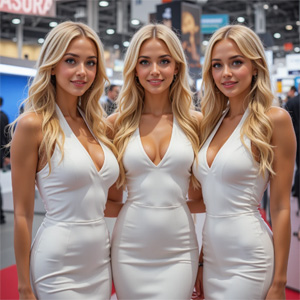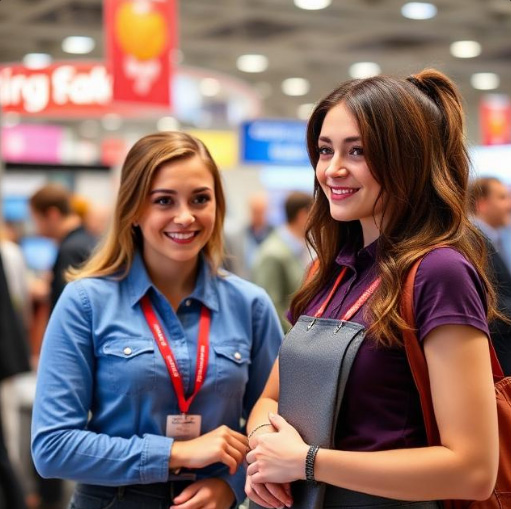
MOSCOW – The cavernous halls of Crocus Expo on the city’s outskirts smell of fresh hay, grain dust, and industrial lubricant. Executives from German tractor manufacturers stand beside distributors of Kazakhstani fertilizers, while Russian dairy farmers debate the merits of Israeli irrigation systems. In the midst of this B2B chaos, a highly specialized professional is working the floor: the Russian agricultural exhibition assistant.
While the western stereotype of a trade show “hostess” often leans toward the purely aesthetic, the role at Moscow’s premier agribusiness events—such as AGROPRODMASH and AGRAVIA—has evolved into a sophisticated, technical sales function. In an industry where a mistranslated specification for a grain dryer could cost a buyer millions of rubles, these assistants have become the essential bridge between Russian buyers and the international market.
The “Agro-Hostess” vs. The Promoter
In the Russian exhibition industry, a clear hierarchy exists. At a consumer goods expo, a promouter might simply hand out pens and energy drinks. However, at an agriculture machinery or food processing trade fair, the demand is for a “Stand Hostess with Technical Knowledge.”
According to service platforms like MoscowHostess.ru and specialized linguistic agencies, the requirements for agriculture shows are distinctly rigorous. These women (and increasingly, men) are often required to possess:
- Technical Vocabulary: Fluency in specific terminology regarding poultry farming, veterinary science, feed milling, grain storage, and dairy equipment.
- Language Skills: Unlike domestic shows, events like AGROS and Global Fresh Market attract a massive contingent of international exhibitors from China, Turkey, Germany, and Italy. Hostesses are hired specifically for English, Mandarin, or German fluency to function as interpreters at the booth.
- B2B Decorum: The audience at these events is not the general public. They are corporate farm owners, procurement managers from retail giants like Magnit and X5 Group, and government regulators from the Russian Ministry of Agriculture.
Navigating the “Grain Corridor” of Commerce
The job is grueling. An assistant at AGROPRODMASH, held annually at the Expocentre Fairgrounds, might spend ten hours on her feet in steel-toed boots, moving between a milling machine and a packaging robot.
“It is not about looking pretty,” explains a coordinator who hires staff for these events. “It is about data capture. We need them to stand next to a piece of heavy machinery, take notes for the Chinese engineers during a service demonstration, and translate the technical questions of a Russian collective farm manager.”
The stakes are high. Many of these exhibitions, such as AGRAVIA (International Exhibition of Technologies for the Agro-Industrial Complex) , serve as the primary entry point for Western technology into the Eurasian Economic Union. With sanctions shifting the landscape, alternative suppliers from Turkey and China are flooding the market, making accurate communication at the booth a bottom-line necessity.
The Rise of the “Bilingual Agronomist”
The industry is moving away from generic modeling agencies. Increasingly, professional hostess agencies are recruiting university students from the Russian State Agrarian University and the Timiryazev Agricultural Academy. These students possess the theoretical knowledge to discuss field forage production or greenhouse vegetable cultivation while looking professional in a branded polo shirt.
“We look for interpreters first, models second,” says one agency listing for the AgroProdMash exhibition. “Can she explain the difference between a meat slicer and a portioning line? If she can, we will pay triple the rate.”
The Business of Survival
Despite Russia’s focus on agricultural sovereignty (“import substitution”), the domestic industry still relies heavily on foreign machinery. Events like Global Fresh Market (sponsored by the Russian Agricultural Bank) are packed with attendees looking for seeds, fertilizers, and plant protection products that cannot be sourced locally.
For the women working the booths, this is serious business. They are often the gatekeepers. They control the appointment calendars for the VIP buyers, they filter out the tire-kickers, and they ensure that when a representative from Auchan or Azbuka Vkusa walks by, the booth looks active, professional, and knowledgeable.
As the 2026 exhibition season kicks off this fall, the exhibition assistant remains one of the most undervalued yet critical cogs in Russia’s agricultural supply chain. They are not just facilitating conversations; they are helping to feed the country, one translated brochure at a time.