In the high-tech pavilions of Moscow’s Crocus Expo and the strategic conference halls of the Digital Business Space, the future of unmanned aviation is taking shape. As Russia positions itself as a hub for unmanned aerial vehicle (UAV) innovation—hosting flagship events like AeroNext, Drone Russia Expo, and the Moscow Drone Summit—the air buzzes with discussions of flight controllers, collision avoidance systems, and freight drone logistics.
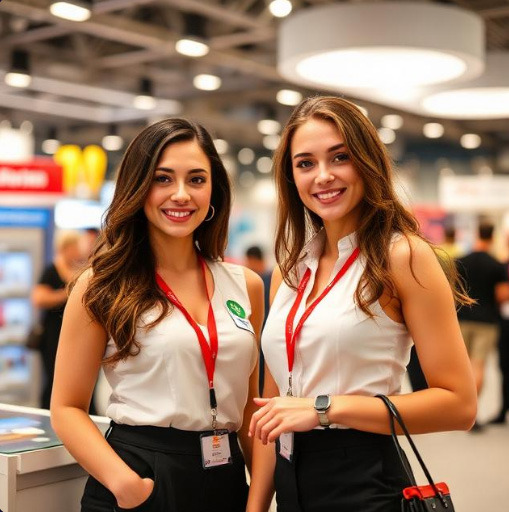
However, amidst the intricate hardware displays and regulated airspace negotiations, one professional ensures that these high-tech events stay grounded in commercial reality: the Russian drone exhibition assistant. In an industry caught between rigorous state regulation and cutting-edge R&D, these assistants act as the crucial interface between international innovation and the local market.
The “Pre-Flight” Specialist: More Than a Sky Watcher
The drone industry is unique because it operates at the intersection of consumer curiosity, national security, and industrial logistics. The standard “booth model” is ill-suited for this environment. According to local staffing agencies, drone events demand a “Pre-Flight Specialist”—an assistant who can help navigate the complex regulatory and technical landscape of unmanned aviation.
The visitor profile at these events is dual-faceted. On one hand, you have procurement managers from Rosneft, Gazprom, and RZD (Russian Railways) looking to survey gas pipelines or inspect railway tracks. On the other, you have representatives from the Federal Air Transport Agency (Rosaviatsiya) discussing no-fly zones and “Electronic Warfare” countermeasures. An assistant must seamlessly switch between talking logistics ROI with a CTO and discussing frequency bands with a regulator.
The Drone-Specific Skillset: From Payload to FPV
Unlike general tech shows, the lexicon of drone events is highly specific. A competent assistant must be familiar with the key categories dominating the exhibition floor:
- Industrial Inspection & Mapping: LiDAR sensors, thermal cameras, photogrammetry software, and long-endurance fixed-wing UAVs.
- FPV & Racing: Low-latency video transmitters, high-C rating batteries, and frame durability.
- Agriculture: Spraying systems, tank capacities, and coverage rate calculations.
- Counter-UAS (C-UAS): Detection radar, jamming guns, and spoofing systems (often requested by government delegates).
- Logistics & Cargo: Payload capacity (kg), delivery radius, and parachute recovery systems.
An assistant who can ask, “Are you looking for a quadcopter for photogrammetry or a heavy-lift octocopter for logistics?” filters out hobbyists from serious buyers instantly.
Navigating the “Regulatory Airspace”
The Russian drone market is heavily defined by registration laws, pilot certification, and airspace access restrictions. A Russian assistant is invaluable here because they understand the local “rules of the sky.”
When a foreign manufacturer talks about “Beyond Visual Line of Sight (BVLOS)” capabilities, the Russian buyer immediately thinks about the bureaucratic hurdles to obtain permission. A skilled assistant can translate the technical capability into a local reality: “This drone can fly 50 km, but to do so in the Moscow region, you will need to file a flight plan through the GOST- 2025 portal, which we can assist with.”
Furthermore, with the recent focus on “Technological Sovereignty,” international exhibitors benefit greatly from assistants who can position their hardware as compliant with local data storage laws, ensuring that the mapping data collected does not violate security protocols.
The Hierarchy of Drone Event Staffing
Due to the mix of “prosumers” and government VIPs, the staffing model often requires a specific structure:
- The Bilingual Receptionist: Manages the high volume of hobbyists and students, ensuring they don’t monopolize the time of the C-suite executives. They maintain the “flight line” order for simulator demos.
- The Technical Interpreter: A specialist who understands the difference between a “Flysky” and “Crossfire” radio protocol, or can explain “Return-to-Home” (RTH) failsafe mechanisms in technical Russian.
- The Security Liaison: Often used at invitation-only booths (defense or industrial), this assistant checks credentials, secures NDAs, and ensures that sensitive payload data is not visible to casual passersby.
Logistics: The “No-Fly Zone” Inside the Hall
Drone exhibitions have unique logistical quirks that standard assistants must manage. RF Interference is the enemy of a drone show.
- Battery Management: Professional assistants help manage “Lipo bags” (fireproof storage for Lithium Polymer batteries), ensuring that hundreds of volatile batteries are charged safely and not left unattended on the floor.
- Demo Etiquette: While propellers are usually removed, a skilled assistant is strict about safety barriers. They ensure that visitors do not reach into the motor zone of a tethered demo drone, maintaining a professional safety standard.
Why Your UAV Brand Cannot Afford a Grounded Assistant
In the drone industry, the gap between a “toy” and a “tool” is often just a conversation. A novice assistant might enthusiastically show a visitor the “cool spinning blades,” but a professional assistant steers the conversation toward “autonomous waypoint navigation” or “pixel accuracy.”
For international companies targeting the Russian industrial sector—oil/gas, agriculture, or logistics—the assistant is the “ground control station.” They ensure that when the serious buyer lands at your booth, they speak the same language, understand the compliance landscape, and trust that your technology can handle the vast, harsh, and highly regulated Russian skies. They don’t just staff the booth; they keep the commercial flight plan on course.