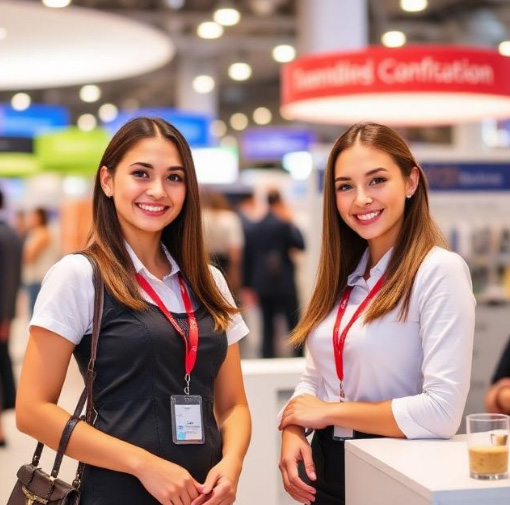
In the temperature-controlled halls of Moscow’s premier exhibition venues, where every degree Celsius matters and every minute of temperature deviation can mean millions in spoiled goods, a different kind of professional keeps commerce flowing. This is the world of Russia’s cold chain industry—a sector responsible for transporting everything from pharmaceuticals and vaccines to seafood, flowers, and frozen foods across the vast expanse of Eurasia.
At events like Cold Chain Eurasia, the International Conference on Continuous Refrigeration Chains, and logistics-focused exhibitions such as CeMAT Russia and TransRussia where cold chain solutions are a key focus, the stakes could not be higher. Here, amid discussions of reefer containers, temperature data loggers, and pharmaceutical logistics, the cold chain trade show assistant has emerged as an indispensable asset—the human link between refrigeration technology and commercial success.
The “Temperature-Controlled” Professional
Unlike general trade fairs, Moscow’s cold chain events operate in a world of extreme precision. The industry encompasses a complex ecosystem: refrigerated transport (trucks, rail cars, sea containers), cold storage warehouses, temperature monitoring systems, packaging solutions, and specialized software for tracking cold chain integrity. The visitors are not casual browsers—they are logistics directors from pharmaceutical giants, procurement managers from major retail chains, quality assurance specialists from food importers, and fleet operators managing hundreds of temperature-controlled vehicles.
The standard booth greeter cannot navigate this environment. According to Moscow-based agencies specializing in exhibition staffing, a professional cold chain assistant must possess industry-specific knowledge that goes far beyond basic hospitality.
“The Russian cold chain market has unique characteristics,” explains one industry briefing. “Buyers prioritize reliability, compliance with sanitary regulations, and performance in extreme weather conditions. A local assistant who understands these nuances can highlight features that matter most—like how a refrigeration unit performs at -30°C or whether a warehouse meets Russian phytosanitary standards.”
The Cold Chain Skillset: From Reefers to Data Loggers
To understand the specific demands of a cold chain booth assistant, one must look at the product and service categories on the exhibition floor. At CeMAT Russia, for instance, the cold chain segment includes:
- Refrigerated Storage: Cold rooms, blast freezers, temperature-controlled warehouses
- Refrigerated Transport: Reefer trucks, intermodal containers, rail cars, air cargo solutions
- Monitoring Technology: Temperature data loggers, IoT sensors, real-time tracking systems
- Packaging Solutions: Insulated containers, gel packs, vacuum-insulated panels
- Pharmaceutical Logistics: GDP-compliant shipping, vaccine distribution, clinical trial supplies
- Food Logistics: Seafood, produce, dairy, frozen goods transportation
A professional trade show assistant working this sector must be able to intelligently discuss these categories, answer basic technical questions, and—crucially—know when to direct a visitor to the appropriate engineer or sales manager. They need to understand terms like “cold chain integrity,” “temperature excursion,” “GDP (Good Distribution Practice),” and “reefer telematics.”
Key Terminology for Cold Chain Assistants
To be effective, a cold chain booth assistant must have a working knowledge of the following terms, often switching between Russian and English:
| Category | Key Terms |
|---|---|
| Equipment | Reefer container, blast freezer, cold room, refrigerated truck, eutectic plates |
| Process | Cold chain integrity, temperature mapping, pre-cooling, cross-docking |
| Compliance | GDP (Good Distribution Practice), HACCP, phytosanitary certification, sanitary norms |
| Monitoring | Data logger, real-time tracking, IoT sensors, temperature excursion, alarm thresholds |
| Pharma | Vaccine cold chain, clinical trial logistics, 2-8°C shipping, cryogenic storage |
| Food | Seafood logistics, produce ripening, frozen food transport, shelf life management |
The Three Pillars of the Cold Chain Assistant
Based on the technical nature of events like Cold Chain Eurasia and CeMAT Russia, the role of the assistant rests on three critical pillars.
The Technical Bridge
Cold chain is a technical industry. Visitors come with specific questions about temperature ranges, power requirements, monitoring capabilities, and compliance documentation. A professional assistant bridges the gap between the visitor’s query and the exhibitor’s expertise.
“Many of our clients are logistics engineers or quality assurance specialists,” notes one Moscow staffing agency. “They don’t want to talk to someone who can’t differentiate between a single-temperature and a multi-temperature reefer. The assistant must be able to handle the first level of technical conversation and then seamlessly hand off to the expert”.
The Compliance Navigator
The Russian cold chain market operates under strict regulatory frameworks, including sanitary-epidemiological requirements, phytosanitary controls, and customs regulations for temperature-sensitive imports. A local assistant understands these compliance landscapes and can reassure visitors that your equipment or service meets Russian standards.
At conferences like Cold Chain Eurasia, where sessions cover “Key Trends and Competencies of the Refrigerated Chain Market,” assistants who understand regulatory issues are particularly valuable.
The Lead Qualification Engine
At events like CeMAT Russia, which attracts nearly 400 exhibitors and over 15,000 professional visitors, the volume of foot traffic can be overwhelming. A skilled assistant qualifies visitors quickly and efficiently, asking targeted questions such as:
- “What type of temperature-sensitive products do you handle?”
- “What is your average shipment volume?”
- “Do you need refrigerated storage, transport, or both?”
- “What temperature ranges are critical for your operations?”
This filtering ensures that senior sales personnel focus only on high-value prospects, maximizing ROI from the exhibition.
The Cultural and Linguistic Dimension
Moscow’s cold chain events are increasingly international. Cold Chain Eurasia 2026, for example, brings together participants from Russia, China, India, Iran, and the EAEU countries. CeMAT Russia draws exhibitors and visitors from across Europe and Asia.
This international character creates a significant demand for multilingual assistants. According to Moscow-based agencies, the most sought-after language pairs are:
- Russian-English: Essential for most international business
- Russian-Mandarin: Increasingly critical given China’s role as a major trading partner
- Russian-Turkish: Valuable for connections with Turkish suppliers and transit routes
Beyond language, the assistant serves as a cultural bridge. Russian business culture values relationship-building and face-to-face interaction before deals are concluded. A professional assistant knows to invite visitors for coffee, introduce them using correct titles and patronymics, and facilitate the trust-building conversations that precede commercial agreements.
The Venue Factor: Navigating Moscow’s Exhibition Landscape
Moscow’s cold chain events take place at two primary venues, each with distinct characteristics.
Crocus Expo International Exhibition Center —home to CeMAT Russia and many logistics exhibitions—is a sprawling complex located approximately 20 kilometers from the city center. Traffic on the MKAD ring road is notoriously unpredictable, especially during the September rush when CeMAT Russia takes place. Professional assistants know to arrive early—often before the 9:00 AM opening—to ensure the booth is ready. They must be intimately familiar with the layout of the pavilions to guide lost attendees efficiently.
The Radisson Collection Hotel Moscow (formerly Hotel Ukraina) hosts the Cold Chain Eurasia conference. This venue, located in one of Moscow’s famous “Seven Sisters” Stalinist skyscrapers on Kutuzovsky Prospekt, presents a different environment—less sprawling but with its own logistical nuances. Assistants working here need to be adept at managing conference-style interactions, including VIP delegate management and formal session support.
The Growing Importance of the Russian Cold Chain Market
Several factors make the Russian cold chain market particularly dynamic—and particularly demanding for exhibition staff.
The Import Replacement Dynamic
Following geopolitical shifts, Russia has accelerated its development of domestic cold chain infrastructure. There is growing demand for equipment from China, Turkey, and other friendly nations. This creates opportunities for international exhibitors but also requires skilled local support to navigate import regulations, certification requirements, and cultural differences.
The Geography Challenge
Russia’s vast territory—spanning 11 time zones—presents unique cold chain challenges. A logistics director from Vladivostok has different requirements than one from St. Petersburg or Novosibirsk. A professional assistant understands these regional differences and can ask the right questions to match solutions to specific geographic needs.
The Pharmaceutical Focus
Cold Chain Eurasia devotes significant attention to pharmaceutical logistics, including sessions on vaccine distribution, clinical trial supplies, and biological sample transport. Assistants working this segment need familiarity with GDP requirements, temperature excursion protocols, and the specific sensitivities of different pharmaceutical products.
The Hierarchy of Cold Chain Assistants
Given the technical demands and varying needs of exhibitors, Moscow agencies typically offer a tiered staffing model for cold chain and logistics events:
| Role | Primary Function | Required Knowledge | Best For |
|---|---|---|---|
| Standard Hostess | Welcoming visitors, badge scanning, brochure distribution, traffic management | Basic logistics awareness; professional appearance | General visitor management |
| Experienced Booth Assistant | Product presentations, basic Q&A, lead qualification, explaining specifications | Cold chain terminology; understanding of equipment categories; sales awareness | Brands needing engaged visitor interaction |
| Technical Specialist / Hybrid | In-depth technical discussions, VIP buyer engagement, complex negotiation support | Advanced cold chain knowledge; compliance understanding; multilingual skills | Premium exhibitors with serious technical buyers |
According to Moscow staffing agencies, daily rates for experienced cold chain assistants typically range from 10,000 to 15,000 rubles, with technical specialists commanding premiums for rare language combinations or pharmaceutical expertise.
Why Your Cold Chain Brand Cannot Afford a Novice
In the high-stakes world of temperature-controlled logistics, a single contract can be worth millions of dollars, and a single misunderstanding can lead to spoiled product and lost trust. The margin for error in technical communication is zero.
A professional cold chain trade show assistant:
- Builds credibility by answering technical questions about temperature ranges, monitoring systems, and compliance standards
- Filters casual visitors from serious procurement decision-makers
- Bridges the language gap with Russian engineers, quality managers, and logistics directors who prefer to work in their native language
- Navigates Russian business culture—understanding that technical competence must be demonstrated before contracts are signed
- Collects precise lead data—noting temperature requirements, volume needs, and geographic territories for effective post-show follow-up
- Stays current on industry trends, including the shift toward domestic Russian logistics providers and the influx of equipment from China and Turkey
Conclusion: The Human Element in a Temperature-Controlled World
In the precise, high-stakes world of Moscow’s cold chain exhibitions, a gleaming reefer display or a stack of technical specifications is not enough. The difference between a successful market entry and an expensive lesson in silence often comes down to the person standing in front of the booth.
The professional cold chain trade show assistant is the first point of contact, the trusted technical explainer, and the last impression for thousands of potential buyers. They translate not just words, but temperature specifications, compliance requirements, and cultural expectations. They ensure that a Chinese refrigeration unit finds its way to a Russian pharmaceutical warehouse, and that a Turkish cold storage solution gains the trust of a Moscow seafood importer.
For any international company looking to break into the dynamic, demanding, and opportunity-rich Russian cold chain market—a market driven by a vast geography, a growing pharmaceutical sector, and increasing demand for temperature-sensitive food and medical products—investing in a specialized trade show assistant is not an expense. It is the critical control point in your exhibition strategy.
As one seasoned logistics exhibitor at CeMAT Russia noted: “Your equipment can maintain temperature perfectly. But without the right assistant to explain it, your booth will be just another cold spot on the exhibition floor.”