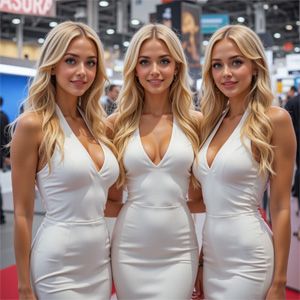
Trade show models in Moscow have evolved far beyond the traditional “booth babe” stereotype. Today, they function as integral members of marketing teams, brand ambassadors trained to communicate, qualify leads, and create memorable first impressions at some of Russia’s largest industrial and commercial exhibitions. From construction expos at Crocus Expo to lingerie forums and metalworking fairs, these professionals occupy a unique niche that blends modeling, public relations, and sales support.
What Trade Show Models Actually Do
The role is multifaceted. On any given exhibition day, a trade show model in Moscow might be found greeting visitors, demonstrating products, collecting contact data through surveys, distributing branded materials, or guiding guests toward sales specialists.
At Mosbuild, one of Russia’s largest construction exhibitions, agency-supplied models have worked as “stand hostesses” in corporate-colored suits, managing registration desks, welcoming guests, gathering contact information, and even preparing and serving drinks in negotiation areas while maintaining the stand’s cleanliness. At the same event, another team of promo models wore custom-branded jumpsuits designed specifically for the occasion, moving throughout the exhibition hall to distribute leaflets and direct visitors to the client’s zone.
For Lingerie Show-Forum, the requirements are more specialized: models with specific physical parameters (height 168–180 cm, bust 70B-C, hips 92–96 cm, natural breasts, no scars or tattoos) are hired to demonstrate lingerie collections for buyers over three working days. The daily rate for this role was advertised at 7,000 rubles, or 21,000 rubles for the full event.
At smaller industrial exhibitions like Metalworking, the functional requirements emphasize lead generation: “collecting surveys, brief company presentation, and if necessary — recording a short video with the client’s text” for a rate of 6,000 rubles per day.
The Agency Ecosystem
Moscow’s trade show model market is dominated by specialized agencies that handle casting, training, and logistics. Some agencies provide models for fitting and demonstrating clothing at your stand, stand hostesses, promo models, and multilingual translators covering English, German, French, Spanish, Italian, Turkish, Czech, Arabic, Chinese, and Korean. They offer flexible engagement models — a full day (12 hours), an exhibition day (8 hours), or short negotiation sessions (1–2 hours).
Other agencies offer a broader palette: photo models, mannequin models, stand hostesses, translators, body-art models, exotic-appearance models, and go-go dancers. Some cover exhibitions, presentations, and even provide actors for film and mass scenes.
One agency emphasizes a consultative approach, noting that “selection solely by external data does not always solve business problems” and stressing the importance of communication skills, product knowledge, and adherence to corporate dress codes.
Pricing and Compensation
Rates vary considerably by role, experience, and event type. According to agency listings for 2026, standard promo models and stand hostesses working a 10:00–18:00 shift typically earn 10,000–12,000 rubles per day. Helpers or promo staff of “ordinary appearance” earn slightly less at 9,000–10,000 rubles.
Models with English-language skills or translation duties command 12,000–15,000 rubles daily. The top tier — described as “high level, tall, busty, working in heels, uncomfortable or revealing costumes, exotic appearance, the most beautiful” — reaches 13,000–15,000 rubles per day. For cashless payment, agencies typically add a 15% surcharge.
Hourly rates for promo models start at 1,600 rubles per hour with an eight-hour minimum shift. Some short-term castings offer 200 rubles/hour for 4–6 hour shifts.
For context, the average annual salary for a model (broadly defined) in Moscow is reported at 927,334 rubles, or approximately 446 rubles per hour, with a range from 526,725 to 1,151,748 rubles. Trade show work, being event-based and often requiring specific presentation skills, typically pays above the baseline model wage.
Selection Criteria and Professional Standards
Agencies consistently emphasize that appearance alone is insufficient. Key selection criteria include:
- Communication skills: “Confident speech, friendliness, and ability to work with large numbers of people”
- Experience: “Experience participating in events” is listed as a primary consideration
- Language proficiency: Determined by task — meeting a guest versus delivering a full product presentation are different requirements
- Stress tolerance and teamwork: Essential for multi-day exhibitions with high visitor traffic
- Scenario readiness: Understanding what to say, where to direct visitors, and when to involve company representatives
Before events, models receive briefings on company products, event programs, and interaction scenarios. For larger projects, a supervisor coordinates shifts, distributes positions, and serves as the link between client and team.
The Branding Dimension
Many agencies now offer integrated branding services alongside personnel. Custom-branded uniforms are designed and manufactured for specific events, ensuring visual cohesion. Promo girls and hostesses can be dressed in company-branded clothing or themed costumes created, made, or selected for the occasion.
This extends to the physical environment: some agencies also rent mannequins for product display, with male abstract full-height mannequins available at 8,000 rubles for the first day and 500 rubles for each subsequent day, plus delivery costs.
Trade show modeling in Moscow has professionalized significantly. The market rewards agencies that can supply not just attractive faces but trained communicators who understand the commercial objectives behind their presence. For exhibitors — whether a construction materials company at Mosbuild or a lingerie brand at a specialized forum — the choice of promotional personnel is increasingly recognized as a strategic decision that affects lead generation, brand perception, and ultimately return on exhibition investment. The days when a pretty face alone sufficed are long gone; today’s Moscow trade show model is a hybrid professional, part ambassador, part sales assistant, and part brand embodiment.