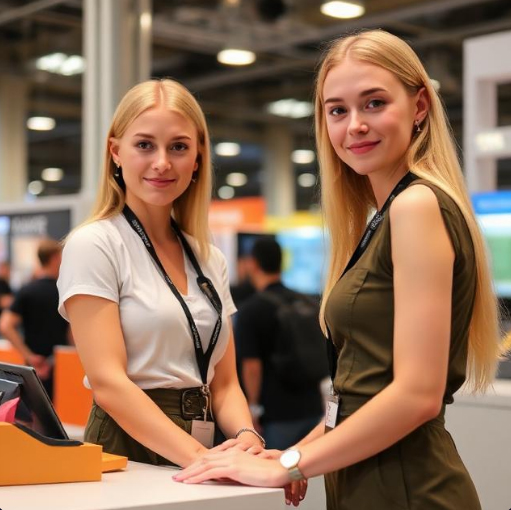
In Moscow’s major exhibition venues, a specialized professional works behind the scenes to enable the deals and technical exchanges that drive Russia’s technology sector. IT industry exhibition interpreters are far more than language converters—they serve as business facilitators, cultural bridges, and technical consultants rolled into one.
The Epicenter: Sviaz and Moscow’s IT Exhibition Scene
Moscow hosts several major technology exhibitions, with Sviaz standing as the largest telecommunications and information technology event in Russia. Since 1975, this four-day gathering has drawn thousands of industry professionals to the Timiryazev Centre each spring. As part of “Russian Week of High Technologies,” Sviaz 2026 brought together more than 360 companies from Russia, Belarus, and China, covering everything from 5G infrastructure and data centers to artificial intelligence.
Other key venues include the Expocenter, Crocus Expo, and Sokolniki Exhibition Center, which together host nearly two-thirds of Moscow’s exhibitions. For international exhibitors—particularly the growing number of Chinese technology firms—navigating these events without professional interpretation support is virtually impossible.
A Strategic Role, Not Just Translation
At an IT exhibition, interpreters perform a demanding role that goes well beyond language conversion. According to Moscow-based staffing agencies, the modern exhibition interpreter functions as a strategic business partner.
Technical Vocabulary Mastery
Interpreters must handle complex terminology across multiple technology domains:
| Domain | Example Terms |
|---|---|
| Telecommunications | Optical time-domain reflectometer, passive optical networks, session initiation protocol |
| Network Infrastructure | GPON, SD-WAN, edge computing, data center architecture |
| Consumer Electronics | ANC (active noise cancellation), IP68 waterproofing, IoT interoperability |
| Standards & Compliance | EAC certification, GOST standards, TR CU technical regulations |
This is not vocabulary acquired through general language study. Professionals with engineering backgrounds or technical training are particularly valued in this field.
Real-Time Processing and Formats
Exhibition interpreting is predominantly consecutive interpretation, though some situations require whispered simultaneous interpretation (chuchotage) during technical presentations or negotiations. Interpreters must process information quickly, manage multiple speakers, and maintain precision under pressure.
Cultural Intelligence
Russian business culture values relationship-building and direct communication, while international partners—particularly from China—often follow different protocols. A skilled interpreter navigates these differences, sometimes offering subtle guidance to ensure smooth communication.
The Language Demand: Chinese-Russian Takes Center Stage
A review of exhibitor lists for Sviaz 2026 reveals a striking trend: Chinese technology companies dominate the international presence. Major Chinese exhibitors include Shenzhen-based telecommunications equipment manufacturers, fiber optic cable producers from Jiangsu and Zhejiang provinces, and network infrastructure solution providers from across China.
This concentration has created intense demand for Chinese-Russian interpretation services. One freelance platform recently posted a project specifically seeking a “Chinese & Russian Exhibition Interpreter” for a Moscow trade show, describing the role as standing with the exhibitor and smoothly rendering conversations between Mandarin and Russian.
Other language pairs remain relevant. English-Russian remains a standard requirement, while Turkish, German, Japanese, and Korean also see demand depending on the specific exhibition and exhibitor mix.
What Exhibition Interpreters Earn
Compensation reflects the specialized skill set required. Freelance platforms show exhibition interpreting projects typically ranging from $100 to $150 USD per day. For technical professionals with proven experience in IT events, rates can be significantly higher:
| Service Type | Approximate Rate (2026) |
|---|---|
| Basic foreign-language booth hosting | 8,000 RUB/day |
| Technical exhibition interpreting | $100–150/day |
| Simultaneous interpreting (conferences/forums) | $150–200/day |
| Remote online interpreting (follow-up) | ~$50/hour |
Experienced interpreters with proven track records in telecommunications events command premium rates, particularly for Chinese-Russian or Japanese-Russian pairs where qualified professionals remain relatively scarce.
The Service Ecosystem
Moscow has developed a robust infrastructure to support international exhibitors. Translation agencies specializing in technical fields offer comprehensive services including booth staffing, equipment provision, and emergency interpreter deployment.
Some agencies accumulate terminology databases from past exhibitions, collecting instructions, equipment descriptions, and compiling specialized glossaries to update their technical dictionaries in specific subject areas. This preparation is essential—one agency notes that a single mistranslated technical specification can undermine a product’s market credibility.
Training and Professional Development
The demand for exhibition interpreters has reshaped professional education in Moscow. Institutions like the Moscow Aviation Institute have developed specialized curricula for “linguists-engineers” who combine technical knowledge with language skills.
Professional organizations also play a role. The Association of Interpreters and the Moscow Translation Club hold regular forums addressing industry transformation, including the impact of AI on translation and cybersecurity standards for linguistic companies. These events help interpreters stay current with emerging technologies and market demands.
The Future: AI and the Human Interpreter
The rise of artificial intelligence presents both challenges and opportunities for the profession. Moscow-based interpreters increasingly use AI tools for real-time transcription and terminology support, but the human interpreter remains essential for capturing nuance, managing complex technical exchanges, and navigating cultural differences.
As one industry observer noted: “AI can handle 80% of a simple conversation, but at a technical exhibition, the other 20% is jargon so new it isn’t in the dictionary, or irony so dry the machine misses it completely.” For high-stakes exhibition environments where contracts worth millions are negotiated, the human interpreter remains irreplaceable.
Practical Advice for Exhibitors
For international companies planning to exhibit at Moscow’s IT shows, industry experts recommend:
- Book at least 20 days in advance to allow interpreters time to familiarize themselves with product documentation and technical terminology
- Provide materials early—product manuals, technical specifications, and company introductions should be shared 4–6 weeks before the event
- Schedule a pre-event briefing to walk through the demonstration process and confirm terminology with the interpreter
- Choose interpreters with relevant technical backgrounds—engineering or computer science education is particularly valuable for complex IT products
The IT industry exhibition interpreter in Moscow is a specialist whose work enables the conversations that shape Russia’s digital future. Whether standing beside a Chinese fiber optics manufacturer at the Timiryazev Centre or providing whispered interpretation during a 5G standards discussion, they bridge not just languages, but markets, technologies, and business opportunities.