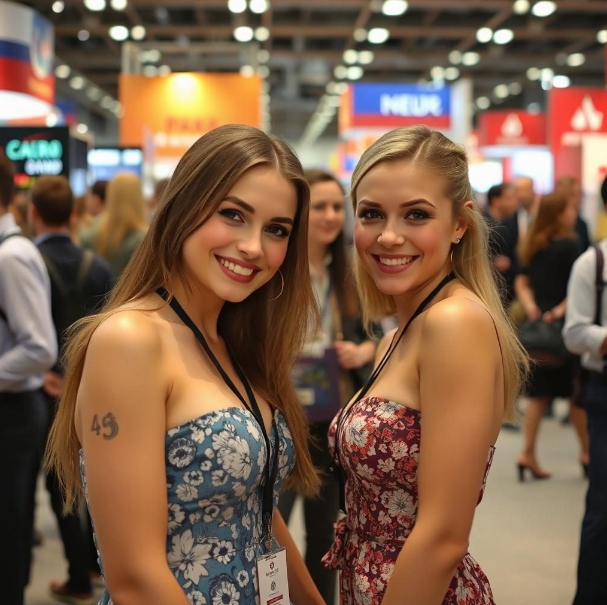
At the ExpoForum in St. Petersburg, where thousands of exhibitors and visitors from dozens of countries converge each year, the interpreter occupies a role far more critical than that of a simple language conduit. Unlike the glamorous presence of trade show models, the interpreter works in the technical trenches—standing beside the exhibitor’s engineering team, translating product specifications in real time, and ensuring that a conversation about pipeline tolerances or seafood import quotas does not collapse into mutual incomprehension. In a city that hosts over 160 exhibition events annually, these language professionals form the invisible infrastructure of international commerce.
The Hierarchy of Interpreting at Russian Exhibitions
The Russian exhibition industry draws a practical distinction between types of interpreting services. Line interpreting—often called booth interpreting—covers the everyday work of standing at a stand, translating visitor questions, and facilitating follow-up contact. Consecutive interpreting, by contrast, is reserved for protocol events and high-level negotiations where accuracy and formality are paramount. For most exhibitors at industrial trade shows in St. Petersburg, line interpreting is the baseline requirement: the interpreter must be technically literate enough to follow a discussion about metal alloys or fishing quotas while remaining personable enough to keep a visitor engaged.
The scale of international participation at St. Petersburg events underscores this need. The Eighth International Fishery Forum, held at ExpoForum in October 2025, gathered official delegations and business representatives from 40 countries and more than 2,500 participants. The linguistic support for that event alone covered simultaneous and consecutive interpretation across six languages: English, Chinese, Turkish, Spanish, Vietnamese, and French. This is not a peripheral service but a core operational component of any major exhibition in the city.
What the Work Actually Looks Like
A trade show interpreter in St. Petersburg might spend the morning translating a Chinese manufacturer’s pitch to a Russian distributor, the afternoon accompanying a delegation on a factory tour, and the evening reviewing technical documents for the next day’s negotiations. The work is physically demanding—standard shifts run eight hours, with overtime calculated beyond that—and mentally exhausting, requiring the interpreter to switch between languages while absorbing unfamiliar technical vocabulary on the fly.
The technical threshold varies by industry. Construction and industrial exhibitions demand familiarity with materials, specifications, and engineering terminology. Seafood and agricultural forums require knowledge of quotas, certifications, and import regulations. For rare language pairs—particularly Asian languages paired with Russian—the pool of qualified interpreters narrows considerably, and rates rise accordingly.
The Market and Its Rates
Pricing for interpreting services in the St. Petersburg exhibition market reflects this specialization. Standard line interpreting in European languages starts at around 2,100 rubles per hour for standard-category specialists, with international-level interpreters commanding higher rates. For Chinese-Russian interpretation at events like the Russian Industrialist forum at ExpoForum, rates begin at approximately $150 per day for standard exhibition work, rising to $200 or more for business accompaniment and off-site assignments. English-Russian interpreters in St. Petersburg quote rates in the range of 3,000 rubles per hour or 18,000 rubles for a full day, though these figures vary with the interpreter’s qualifications and the complexity of the assignment.
The ExpoForum group itself offers interpretation services to international participants, providing both written translation and simultaneous interpretation for events held at the venue. For specialized forums like the St. Petersburg International Gas Forum, interpreting services are available alongside meeting room rentals, allowing exhibitors to conduct negotiations with language support integrated into the facility booking.
The Human Dimension
What distinguishes a good trade show interpreter from a merely competent one is the ability to function as what one industry description calls a “technical bridge.” The interpreter must not only convert words but also navigate the cultural expectations of both parties—knowing when a Russian engineer’s blunt assessment needs softening for a Chinese client, or when a Turkish buyer’s indirect inquiry requires clarification before it can be answered.
For exhibitors who have traveled thousands of kilometers to St. Petersburg, the interpreter is often the only person at the stand who can explain what is being said, what is being asked, and what should happen next. In the crowded halls of ExpoForum, where booths compete for attention and business cards change hands by the hundreds, that quiet voice in the ear remains the most reliable instrument of actual communication.