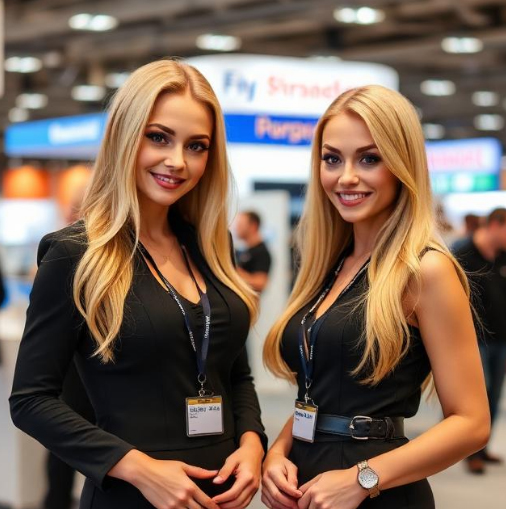
In the cavernous halls of Moscow’s Timiryazev Centre and Crocus Expo, the air is thick with the scent of industrial lubricant, fresh grain, and the hum of heavy machinery. Here, amidst the chaos of international B2B commerce, a specialized professional is reshaping the landscape of the poultry and meat industry trade show: the Russian booth assistant.
Far removed from the Western stereotype of a purely decorative “hostess,” the role at premier events like the Meat and Poultry Industry Russia (MAP Russia) and AGROS (now AGRAVIA) has evolved into a sophisticated, technical sales function requiring industry-specific knowledge and multilingual fluency. For international exhibitors, these assistants have become the essential bridge to the vast Russian market.
From “Promoter” to “Agro-Hostess”
The distinction is clear within the Russian exhibition industry. At a consumer goods expo, a promouter might simply hand out pens and samples. However, at agricultural trade fairs, the demand is for a “Stand Hostess with Technical Knowledge”.
Organizers and staffing agencies like ExpoPersonnel and EventForce Russia report rigorous requirements for these events. The successful candidate must possess a triad of specific skills:
- Technical Vocabulary: They are expected to have fluency in specific terminology regarding poultry farming, veterinary science, feed milling, and egg processing.
- Multilingual Capability: With the Moscow shows attracting international exhibitors—particularly from China, Turkey, Brazil, and Germany—hostesses are hired specifically for English, Mandarin, or German fluency to function as interpreters at the booth.
- B2B Decorum: The audience consists of corporate farm owners, procurement managers from retail giants like Magnit, and government regulators. The role demands serious engagement, not just a smile.
Core Responsibilities: More Than a Greeting
At the 2026 MAP Russia exhibition, which expects over 10,000 visitors and 200 exhibitors, the workload is grueling. An assistant might spend ten hours on her feet in steel-toed boots, managing a spectrum of strategic duties:
- Real-Time Technical Interpretation: When a Chinese engineer introduces a new egg-sorting robot, the assistant provides consecutive interpretation, ensuring precise understanding of technical parameters.
- Lead Qualification & Data Capture: Experienced assistants quickly identify decision-makers—farm owners, production managers, and top executives—separating them from casual observers to save sales teams valuable time.
- Product Demonstrations: Whether it is a new feeding system or a ventilation unit for climate control, hostesses facilitate live showcases and answer operational questions.
- Brand Image Enhancement: As Narine Bagmanyan, President of Asti Group (the organizer of MAP Russia), noted, for up to 60% of exhibitors, this is their first time in Russia. The hostess is the first touchpoint, and their professionalism directly reflects the brand.
The “Invisible” Preparation and The “Visible” Cost
The job begins long before the doors open. Professional hostesses undergo extensive preparation, studying exhibition maps, memorizing product catalogs, and familiarizing themselves with key personnel and technical specifications. This training ensures they can accurately explain complex innovations, such as the automated sorting and packaging lines from companies like ZENYER or the feed additives from Brazil’s BTA Additives—both major exhibitors in 2026.
For international exhibitors budgeting for Moscow, the cost structure is specific. Based on 2025 market rates, hiring a specialized “Agro-Hostess” costs between 800 and 1,500 rubles per hour (8,000 – 10,000 RUB per eight-hour day), while a technical interpreter commands a premium of 2,000 – 3,000 RUB per hour.
In an industry where a mistranslated specification for a feed additive could cost a buyer millions of rubles, the human element of the poultry trade show is critical. The Moscow exhibition assistant is no longer a passive figure; they are a technical ambassador, a cultural interpreter, and a strategic asset. As Russia continues to pivot its agribusiness imports toward China, Turkey, and India, these professionals are the linchpins ensuring that the path “from feed to food”—the slogan of MAP Russia—is navigated successfully.