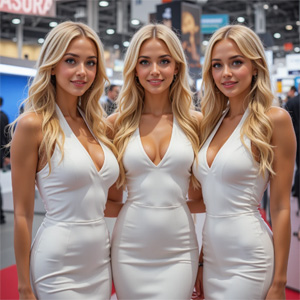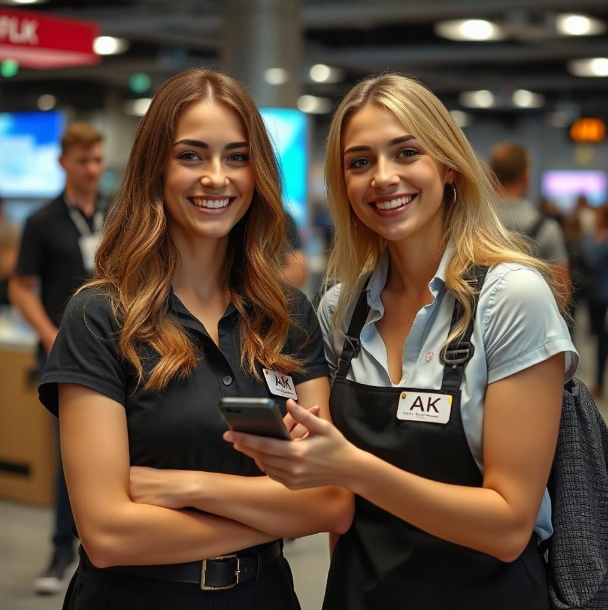
Moscow’s giant exhibition venues — Timiryazev Centre, Crocus Expo, VDNH—host thousands of events every year. What visitors see are booths, products, and logos. What they rarely notice is the workforce that keeps the machinery running smoothly: hostesses, stand assistants, promotional models, and multilingual support staff.
Distinguishing the Roles: Model, Hostess, Stand Assistant
In Moscow’s trade show ecosystem, these roles often blur together, yet each has a distinct function. A hostess typically handles greeting, wayfinding, and registration desk duties. A stand assistant works inside the booth, managing product demonstrations, refreshments, and visitor data collection. A promotional model is a role centered on visual appeal, drawing attention, and building brand recognition.
As one exhibition agency puts it, the boundaries are flexible: “The distinction between a model and a hostess can be subtle. Models focus on visual presentation and promotional interaction, while hostesses often take on informational and logistical tasks. In practice, individuals working in these roles frequently possess overlapping skills, and the boundaries can shift depending on the event’s needs.”
Who Works, and Under What Conditions?
Moscow’s trade show staffing market spans a wide range of ages and experience levels. Some listings target the 18–45 range, while others are open to students and school-age youth from 16. Experience is often not required—recruiters emphasize communication skills, punctuality, and a “well-groomed appearance.”
Pay varies widely depending on the role, the prestige of the event, and the worker’s experience. The range stretches from modest offers of 1,500 rubles per day to 2,000 rubles, up to daily rates starting at 10,000 rubles for experienced stand assistants. For experienced personnel working through agencies, that figure can exceed 12,000 rubles.
Agencies: Intermediaries and Standards
In Moscow, trade show staffing is handled through specialized agencies. Firms such as Worldpromo, Z models, Stendistka, Promo-Girls, and Expomodel offer organizers and exhibitors a broad range of services: models, hostesses, stand assistants, interpreters, and even head waiters.
Some of these agencies have been operating since the early 2000s. Krasota-ONLINE, for instance, states that it has supplied personnel to major institutions including the Administration of the President of Russia, Expocentre, and Crocus Expo since 2001. Stendistka emphasizes that it has been in the industry since 2006 and trains staff capable of multitasking.
Agencies do more than recruit. They also offer training, costume supply or rental, supervision, and reporting. For exhibitors, this amounts to a one-stop solution.
The Unseen Side of the Job: Routine and Demands
Trade show hostessing or stand assisting may look like “easy work” from the outside. The details in job listings tell a different story.
A typical stand assistant’s day includes preparing the booth, serving tea and coffee, distributing refreshments, answering visitor questions, keeping the stand tidy, and collecting dishes. Some listings explicitly include “washing dishes” among the duties.
Physical endurance is a significant requirement. One listing specifies working hours of 9:30 to 18:00, with the note that “two people will take turns standing watch until 20:00.” This reflects the reality of being on one’s feet and adapting to long shifts throughout the event.
Language and Cultural Competence
At Moscow’s international trade shows, language skills are becoming increasingly critical. At major sector events such as PIR Expo, hostesses are sometimes expected to know Turkish, Chinese, or Italian alongside Russian and English. This also includes understanding Russian business culture—grasping the importance of addressing a client by their patronymic name.
Experienced hostesses do more than greet. They also profile visitors. Distinguishing a curious student from the purchasing manager of a large hotel chain is seen as critical to using technical staff’s time efficiently.
Sectoral Differentiation
Different trade shows require different staff profiles. At technology fairs such as Electronica-Transport, hostesses are expected to have basic knowledge of intelligent transport systems, automated fare collection, and driver condition monitoring. At gastronomy fairs such as PIR Expo, product knowledge is expected at a level that allows conversation about coffee bean origins or roasting temperatures.
This shows that the job is not merely “smiling and directing.” Modern trade show staff must develop an understanding of the industry their brand represents.
Assessment: Invisible but Indispensable
This invisible workforce of Moscow’s trade show economy actually stands on the front lines of the city’s commercial diplomacy. It is these workers who create a booth’s first impression, guide visitors in the right direction, and make the first contact for a potential business connection. While pay is relatively modest, the sector serves as a gateway—offering industry experience, language practice, and networking opportunities. Given the density of Moscow’s international trade show calendar, the presence of this invisible army remains a quiet but solid component of the city’s commercial appeal.