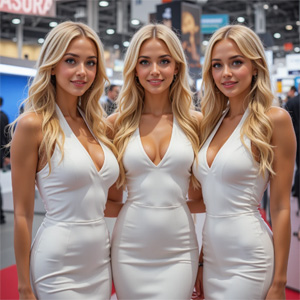
Russia’s exhibition industry relies on a vast, temporary workforce that remains largely invisible to the visitors it serves. From international trade fairs in Moscow to regional expos in Novokuznetsk, the demand for hostesses, promoters, stand assistants, and demonstrators is constant—and the market that supplies them operates on principles of speed, flexibility, and minimal barriers to entry.
The Roles Behind the Stand
Exhibition staffing in Russia encompasses a spectrum of functions that often overlap in practice. A stand assistant typically handles initial consultations, communicates with potential clients, and collects contact information—business cards and visitor details—forming the backbone of exhibitor lead generation. Unlike street-level promotion, this role involves representing the company professionally rather than distributing flyers.
Hostesses at exhibitions perform a distinct function: welcoming guests, assisting with navigation, distributing promotional materials, and maintaining a friendly atmosphere at the stand. At some events, particularly those with international participation, hostesses with English language skills and “model appearance” are specifically requested.
Promoters at exhibitions focus on visitor engagement—approaching attendees, explaining promotions or giveaways, and assisting with QR code scanning or other interactive mechanics. At the Coal Russia and Mining exhibition in Novokuznetsk, promoters were hired for four days to distribute leaflets and business cards, with pay of 300 rubles per hour.
Some roles demand specialized knowledge. A robotics exhibition in Moscow sought demonstrators to guide guests through exhibits, conduct tours and quests, operate robots, and lead master classes. This illustrates how exhibition staffing can require technical familiarity alongside communication skills.
Who Works and What They Earn
The workforce is overwhelmingly young, with job listings routinely targeting students and those seeking part-time income. Experience is frequently listed as “not required,” with employers emphasizing instead traits like responsibility, a well-groomed appearance, and “decent business attire.”
Pay structures vary by role, location, and event duration. For a stand hostess position at the COMAUTOTRANS exhibition in Moscow, pay started at 1,500 rubles per day, with meals provided and “career growth opportunities” mentioned. Promoters at the St. Petersburg Technical Fair earned 350 rubles per hour for a three-day assignment. At the ProdExpo food and beverage exhibition, promotional models and hostesses were hired for four days to greet guests, prepare tea and coffee, answer questions, and clear dishes from tables.
Some positions offer more substantial compensation. A hostess role at a Moscow design toy exhibition paid 300 rubles per hour, with the example of 160 working hours translating to 48,000 rubles—positioned as compatible with studies. Promo-interviewers in St. Petersburg working at shopping centers and exhibitions earned between 65,000 and 85,000 rubles monthly for part-time work.
The Agency Infrastructure
Exhibition staffing in Russia flows largely through specialized agencies and temporary personnel providers. These intermediaries handle recruitment, training, coordination, and on-site management, offering exhibitors a one-stop solution.
Agencies like Akula (founded 2016 in Moscow) specialize in promotional personnel selection and BTL campaigns, listing clients including AliExpress, Wildberries, KFC, and M.Video. Marex Promo, operating for over ten years, provides event personnel across Russia with services including qualification checks, training, and on-site coordination through supervisors. AnyTie, a resident of the National Association of Event Organizers, claims a database of over 600 vetted staff and has worked with Sber, VK, the Moscow Government, and Yandex.
Some agencies operate at the intersection of staffing and exhibition infrastructure. RussCom IT Group, an associate member of UFI (the Global Association of the Exhibition Industry), provides models, hostesses, interpreters, and data entry operators for exhibitions and congresses, alongside technical audit and registration services.
A significant portion of the market operates through civil law contracts (GPH) rather than traditional employment, allowing both parties flexibility. Temporary staff provision services operate under Chapter 53.1 of the Russian Labor Code, with agencies acting as the official employer handling HR, tax, and legal obligations while providing ready-to-work specialists.
The Working Reality
Exhibition staffing is rarely glamorous, despite the polished image of the role. Stand hostess duties at a major event like MosBuild included not only greeting guests and distributing brochures but also preparing drinks and snacks in the negotiation area and maintaining cleanliness across the stand. A ProdExpo listing explicitly included “clearing dirty dishes from tables” among responsibilities.
The hours can be long. A design toy exhibition hostess position involved 11-hour shifts (11:00 to 22:00) on a 2/2 schedule. Promoter roles at trade fairs commonly run from 10:00 to 18:00, with some days extending to 16:00, and breaks of 30 minutes to an hour unpaid.
Sector and Regional Variation
The market responds to the specific character of each exhibition. At the Housing and Utilities exhibition, promotional personnel were categorized by function: general promotional staff and “hostesses of model appearance with English language knowledge,” with additional services including dress rental, shoe rental, custom tailoring, professional makeup, and business hairstyling. This formalization of appearance standards reflects the visual dimension of exhibition work.
Regionally, the market extends far beyond Moscow and St. Petersburg. Novokuznetsk’s mining exhibition, Samara’s retail and corporate events, and Tomsk’s student-oriented hostess positions all draw on the same basic model: short-term contracts, modest hourly or daily rates, and a workforce motivated by flexible scheduling and accessible entry.
An Invisible but Essential Layer
Exhibition event staffing in Russia functions as an invisible layer beneath the country’s visible commercial and cultural gatherings. The pay is modest and the work is temporary, but for thousands of young Russians—students, early-career professionals, and those seeking supplementary income—it offers a low-barrier entry point into professional environments, language practice, and networking. For exhibitors, the agency infrastructure provides rapid access to vetted, trained personnel without the administrative burden of direct employment. The result is a market defined not by prestige or permanence, but by the mutual flexibility it affords both the events that need workers and the workers who need income.