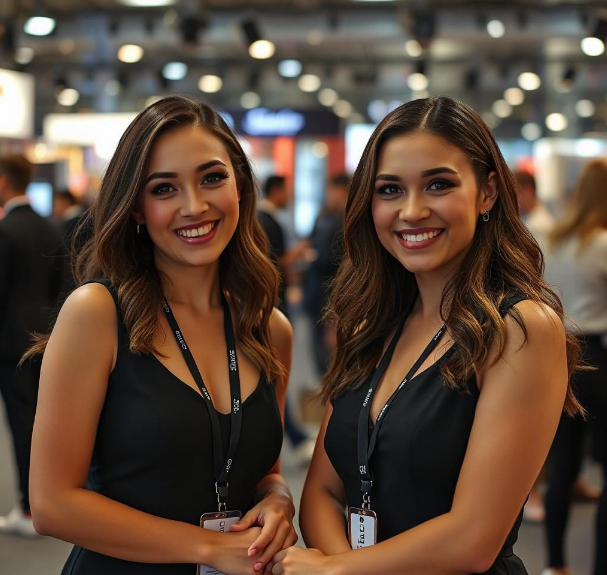
When visitors walk through the doors of the Timiryazev Centre, they see the polished displays, the gleaming machinery, and the banners of international brands. What they rarely notice is the workforce that makes the commercial machinery turn: the exhibition assistants, booth staff, and interpreters who serve as the human interface between exhibitor and buyer. At Moscow’s newest and most technologically advanced exhibition venue, these professionals have evolved far beyond the decorative stereotype of the traditional “hostess.” They are now operational filters, lead qualifiers, and cultural brokers whose performance directly shapes an exhibitor’s return on investment.
Opened in October 2024 on the grounds of the Russian State Agrarian University, the Timiryazev Centre spans 40,000 square meters and hosts more than sixty congress and exhibition events annually. Its calendar ranges from the Golden Autumn agricultural show to the China Machinery Fair, Hometextile & Design, and Mir Stekla. This diversity demands a flexible, professionalized staffing corps—one that understands the distinct rhythms of a franchise expo versus a glass industry trade fair.
From Greeter to Strategic Filter
The terminology shift is telling. In professional Russian exhibition circles, “hostess” has largely given way to “booth assistant” or “stand assistant,” reflecting a change in function as much as language. At the Timiryazev Centre, the assistant’s day begins before the first visitor arrives: reviewing product literature, memorizing qualifying questions, and coordinating with sales managers on lead handoff protocols.
Their primary commercial function is filtration. In a venue that attracted thousands of professional trade attendees, not every badge-scanner is a procurement manager. Experienced assistants distinguish between students collecting free pens and decision-makers seeking quotes. At BUYBRAND, Russia’s largest franchise exhibition, this skill becomes particularly acute: assistants must qualify investors by probing budget levels, location preferences, and whether the prospect seeks a master franchise or a single unit—an intangible sale that requires conversational sophistication rather than a simple product pitch.
The physical demands are considerable. Assistants stand for extended periods, manage crowd surges during peak hours, and maintain professional composure across three-day events. At Mir Stekla, where Chinese manufacturers constituted 89 of 173 exhibitors in the 2026 edition, bilingual assistants often serve a dual function: greeting Russian visitors while simultaneously translating basic product specifications and collecting contact data for follow-up.
The Interpreter as Technical Necessity
For international exhibitors, the distinction between a general interpreter and a technical interpreter is critical. In B2B sectors—metallurgy, machinery, agriculture—Russian engineers and procurement specialists prefer to negotiate in their native language, and technical discussions lose precision without industry-specific vocabulary. Chinese-Russian and English-Russian language pairs are in highest demand at the Timiryazev Centre, mirroring shifting trade patterns.
The compensation reflects this expertise. Bilingual technical interpreters command daily rates significantly higher than standard promotional staff, with premiums of 40–60% for in-demand language combinations. For a Chinese machinery manufacturer seeking Russian distributors, a skilled interpreter is not a luxury but the difference between a signed contract and a misunderstood specification.
The Cultural Dimension
What distinguishes exhibition staffing in Russia from Western European norms is the weight of formal presentation. Russian business culture places high value on appearance as a signal of corporate stability. As one industry guide notes, if staff members dress casually, Russian visitors may directly conclude that the company is “informal” or “financially unstable.” At the Timiryazev Centre, this translates into expectations of tailored suits, polished grooming, and formal business etiquette—a firm handshake, direct eye contact, and measured hospitality.
Hospitality itself carries cultural weight. Offering tea, coffee, or snacks is not merely a courtesy but an expected practice that builds rapport and encourages visitors to linger. A skilled assistant manages this hospitality without allowing the commercial purpose of the stand to dissolve into social conversation.
The Economics of Staffing
For exhibitors, personnel represents a significant portion of event budgets. Daily rates in Moscow vary by role and language capability, with promotional models sometimes earning performance incentives—a base rate plus a bonus for each qualified contact collected. This structure rewards active engagement rather than passive presence, acknowledging that an assistant’s value lies not in hours logged but in leads generated.
The Timiryazev Centre’s own regulations provide facility managers and engineering staff, but these are logistics personnel, not sales or marketing experts. Exhibitors must bring their own brand representatives—or hire specialized staff who can function as the first human contact for a technical brand.
The Human Connection
In the competitive landscape of Moscow’s industry exhibitions, where major contracts are negotiated and technological standards set, the exhibition assistant remains the critical first connection. They are the friendly guide in a sea of information, the cultural translator between business norms, and the operational core that keeps a stand running smoothly. The Timiryazev Centre’s success depends not only on its advanced engineering systems and transformable halls but on this invisible workforce—the professionals who turn foot traffic into business relationships, one qualified conversation at a time.