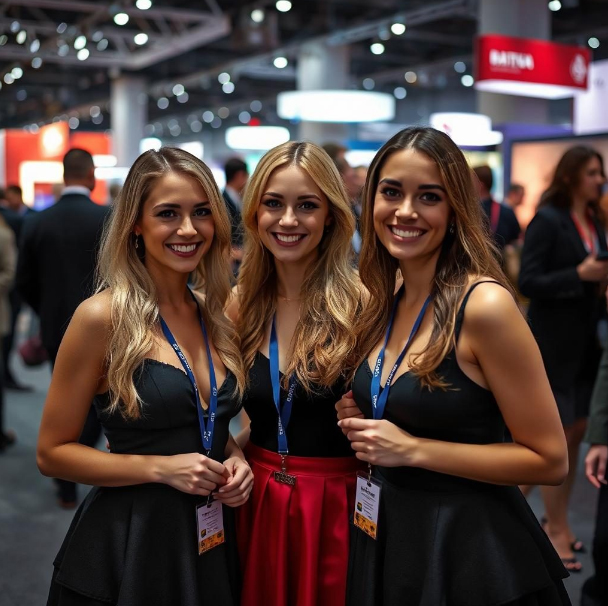
Crocus Expo, the sprawling exhibition complex on the outskirts of Moscow, hosts dozens of international trade fairs each year, from automotive parts and food technology to pharmaceuticals and industrial machinery. Behind the polished stands and product displays, a specialized workforce of exhibition assistants—often referred to as booth assistants, stand hostesses, or trade fair support staff—keeps the commercial machinery running. Their role has evolved far beyond the decorative stereotype of the traditional “hostess,” becoming an operational and strategic function that exhibitors increasingly rely on to convert foot traffic into qualified business leads.
From Greeting to Qualification: The Modern Booth Assistant
In the professional circles of the Russian exhibition industry, the terminology has shifted. “Hostess” has gradually given way to “booth assistant” or “stand hostess,” reflecting an evolution in expectations. At Crocus Expo, the booth assistant is the operational core of any stand. A typical day involves receiving and coordinating visitors, preparing tea and coffee, answering questions about the company and its products, recording contact information, and directing serious prospects to sales managers.
The hierarchy within this role is distinct. At consumer-oriented events, assistants may focus on engagement and sample distribution. At B2B technical exhibitions, however, the emphasis shifts toward crowd management, information provision, and visitor qualification. The modern assistant acts as an initial filter—greeting attendees and quickly assessing whether the person approaching is a curious student or a high-potential procurement director. By qualifying visitors through predefined questions, they ensure that technical staff time is optimized for maximum return on investment.
For international exhibitors, this function becomes even more critical. While many Russian buyers in Moscow speak some English, they conduct business in Russian. A local booth assistant ensures seamless communication, de-escalates misunderstandings that machine translation might miss, and builds the trust necessary for B2B deals in the Russian market. A job listing for a WorldFood Moscow exhibitor at Crocus Expo illustrates the scope: responsibilities range from English-Russian interpretation during meetings with Russian buyers to explaining product specifications, collecting buyer contact details, and following up after the exhibition.
The “All-in-One” Reality of Stand Support
Industry experience reveals that booth assistants at Crocus Expo perform duties that extend far beyond smiling and greeting. Job postings describe responsibilities including meeting contractors, accepting deliveries, distributing heavy product samples, managing coffee-break zones, monitoring food supplies, policing the zone for unauthorized distributors, and maintaining general order. This “all-in-one” nature means a Russian booth assistant often acts as hostess, cleaner, logistics coordinator, and security monitor simultaneously. Their ability to seamlessly handle these varied tasks is crucial for a successful exhibition.
The scale of Crocus Expo—multiple pavilions connected by enclosed walkways, thousands of exhibitors across dozens of simultaneous events—creates a challenging environment for visitor engagement. In this context, the first interaction a visitor has at a stand carries disproportionate weight. A knowledgeable assistant who can immediately identify whether a visitor is a serious buyer, a distributor, or a journalist saves everyone time. A multilingual interpreter who can facilitate a spontaneous meeting with a walk-in partner creates value that no amount of pre-scheduled appointments can replicate.
Language Capability and Compensation
Language capability commands a premium at Crocus Expo. Official venue staffing rates for 2025–2026 list stand attendants without foreign languages at approximately 7,000 RUB per day, and those with a basic foreign language at approximately 8,000 RUB per day. For events with significant international participation, English is standard, and other languages are available according to exhibitor needs. The most effective assistants bring an intuitive understanding of when to engage and when to step back, allowing sales conversations to develop organically.
For students in Moscow, exhibition work has become a viable income stream. The local Chinese student community notes that Crocus Expo and other venues host a dense calendar of international exhibitions from August through December, with Chinese exhibitors particularly in need of assistants who speak Chinese, can navigate the venue, and possess passable Russian. Daily rates for students typically range from 3,000 to 8,000 RUB, depending on experience and language proficiency. The work is episodic—usually three to four days per exhibition—and the most successful assistants prepare in advance by studying terminology glossaries provided by exhibitors.
Industry Specialization: From Food to Pharmaceuticals
What distinguishes exhibition staffing at Crocus Expo from other venues is the specificity of its flagship events. ProdExpo, Russia’s largest international food and beverage exhibition, brings together thousands of producers and retail buyers each February. Booth assistants working for food and beverage brands are increasingly expected to possess more than general exhibition experience. An assistant working for a beverage company may need to answer questions about preservatives and acid content; one working for a dairy producer may need to discuss pasteurization methods and shelf-life specifications. Agencies specializing in food exhibition staffing often seek candidates with backgrounds in food technology, chemistry, or related fields.
At technical exhibitions such as RIMTOS (metalworking and machine tools), the demands are different but equally rigorous. Hostesses must manage safety protocols around moving industrial equipment, direct traffic to prevent bottlenecks, and qualify visitors with targeted questions: “Are you looking for CNC lathes or additive manufacturing solutions?” For events like ExpoCoating Moscow, assistants must be prepared to engage with technologists and chief engineers who arrive with specific technical tasks, supporting live demonstrations of coating equipment and connecting visitors with the right engineering representatives.
The pharmaceutical sector presents yet another layer of complexity. At Apteka Expo, assistants and interpreters must navigate terminology related to active pharmaceutical ingredients, good manufacturing practices, and the complex regulatory landscape of the Russian pharmaceutical market. Booth assistants need to explain product features, highlight unique selling points, and handle questions about ordering, distribution, and regulatory compliance—all while maintaining the professional credibility essential in a highly regulated industry.
The Agency Ecosystem and Practical Considerations
Exhibitors at Crocus Expo have two primary routes for sourcing this workforce. The official venue route offers standardized, published rates and a regulated safety net, but comes with rigidity. The agency route offers greater flexibility and access to specialized personnel—models with specific looks, assistants with technical backgrounds, or multilingual staff—but requires more vetting and coordination.
Moscow-based agencies serving Crocus Expo maintain databases of models, hostesses, and booth assistants with experience across the venue’s calendar. Some providers offer combined services, including interpreters for exhibitions, promotional models, and stand assistants, recognizing that different exhibitors require different configurations of skills. For events with international participation, the distinction between a booth assistant and an interpreter matters: a general assistant may manage reception and lead capture, while a technical interpreter handles negotiations and product specifications.
Staffing should match booth scale and event type. A standard booth typically requires one to two assistants handling reception and information gathering, while larger custom booths with demonstration areas may need three to five staff members with differentiated roles. Product training matters as well. Booth assistants who understand the basics of what they are presenting perform measurably better than those who receive only a script. Advance briefing on key products, target visitor profiles, and qualification criteria improves lead quality.
Booking early is advised. Crocus Expo’s calendar is crowded, and demand for experienced bilingual staff peaks during major events. The venue’s official staffing services and the agencies that supply personnel both recommend planning well in advance, particularly for exhibitions with significant international participation. Shift rotation is another practical consideration: interpreting is mentally exhausting, and assistants face sustained public engagement across long exhibition days. Scheduling personnel to rotate every 60 to 90 minutes prevents fatigue from degrading the quality of interactions.
The Bottom Line
For exhibitors, the investment in professional booth staffing at Crocus Expo should be viewed as a component of the overall commercial strategy. At a venue where a single new partnership can justify the entire cost of participation, the personnel who make those connections possible are not a luxury—they are essential infrastructure. The assistant who captures complete contact details and follows up post-show converts a passing curiosity into a qualified lead. The bilingual staffer who bridges the gap between a Chinese manufacturer and a Russian distributor creates value that no amount of pre-scheduled appointments can replicate. In the vast halls of Crocus Expo, the exhibition assistant is often the difference between a stand that merely attracts visitors and one that converts them into customers.