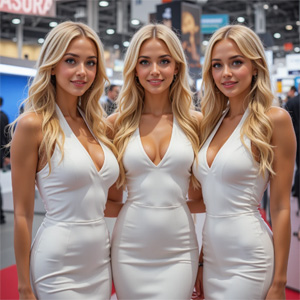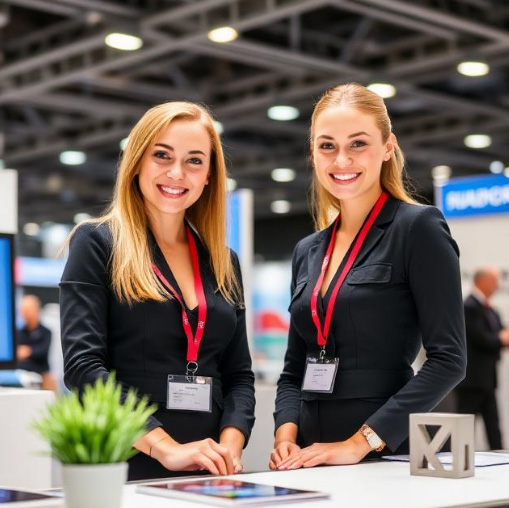
MOSCOW – In Crocus Expo Convention Center, the air is a chemical cocktail of expensive french perfume, nail monomer, and fresh print toner. It is the opening day of InterCHARM, Eastern Europe’s largest beauty trade show. Amidst the chaos of 1,600 exhibitors and nearly 100,000 visitors, a young woman in a pristine white lab coat and high heels stands frozen in a perfect smile.
She is not a brand ambassador in the traditional Western sense. She is the promouter—or as international exhibitors call them, the Russian exhibition assistant. For four days in October, these professionals become the most valuable asset for foreign brands trying to crack the lucrative Russian market.
More Than Just a Beautiful Face
To the untrained eye, they are simply models handing out samples. But to the seasoned exhibitor, the Russian promouter is a multi-tool of survival.
“If you come from China or Europe with just your product and your English-speaking staff, you will fail,” says a Moscow-based logistics coordinator who has worked with over fifty international brands at InterCHARM. “The Russian buyer is suspicious. They want to speak to someone who understands their skin, their climate, and their language.”
These assistants bridge a massive cultural gap. While Western and Asian exhibitors focus on technology and ingredients, the local assistant focuses on trust. They are hired not just for their cheekbones, but for their emotional intelligence. They must identify the difference between a bored browser, a student looking for free samples, and the regional buyer for a chain like L’Etoile or Rive Gauche—retail giants that control 85% of the market.
The Skillset: Chemistry and Charm
The evolution of the Russian exhibition assistant mirrors the evolution of the Russian beauty consumer. Ten years ago, a pretty face and a tray of tester strips were sufficient. Today, due to the mass exodus of Western brands following 2022 and the subsequent “vacuum” in the market, the consumer has become hyper-educated.
“Now, I have to know chemistry,” admits Anastasia, a 24-year-old cosmetology student who has worked stands for both Korean and Turkish skincare brands. “A client comes up, she doesn’t want a hug. She wants to know the pH level. Why is this peptide better than retinol? Is this allowed by our Ministry of Health? I am not a model; I am a consultant.”
This technical expertise is gold dust for foreign exhibitors. Russian trade shows have a unique intensity. The stakes are high; distribution contracts worth millions of rubles are signed on the show floor. A skilled assistant knows how to handle the “Ministry of Complaint”—the notoriously difficult Russian bureaucracy regarding labeling and certification—by steering conversations away from legal landmines and toward product efficacy.
The “Know Ours” Factor
There is a subtle, shifting dynamic at play in 2026. While international pavilions (from China, Turkey, and Korea) are booming, there is a rising tide of Russian patriotism in beauty. The government-backed “Know Ours” (Znay Nashykh) contest has catapulted local brands like RBG (Russian Beauty Guru) and Krasnopolyanskaya Cosmetica into the spotlight.
Consequently, the role of the exhibition assistant is shifting from “translator” to “storyteller.” For local brands, they emphasize heritage and natural ingredients from Crimea or the Caucasus. For international brands, they must pivot. They can no longer sell “Western luxury”—that marketing script is dead. Instead, they sell parallel imports, high-tech innovation, or ingredients that are scarce in Russia.
“The best assistants today are the ones who can lie expertly,” one Turkish hair extension brand owner jokes grimly over coffee, watching his team work the floor. “We cannot say ‘Made in EU’ anymore. We say ‘Designed in Milan, loved in Moscow.’ The assistant has to sell that story with a straight face. It is a performance.”
The Retail Connect Crucible
The ultimate test for these professionals is not the foot traffic, but the closed doors. InterCHARM features a rigorous segment called Retail Connect, where 40+ federal retail chains sit in private booths for speed-dating style negotiations.
Here, the exhibition assistant transforms into a secretary-general. They sit beside the brand owner, flipping through portfolios, calculating Minimum Order Quantities (MOQs), and whispering logistical realities into the ear of the foreign CEO.
“They save us,” admits an Indian essential oil manufacturer. “The Russian retailer asks, ‘Can you deliver to Vladivostok in winter?’ We don’t know. We are from Delhi. But our assistant, she knows the roads, she knows the freight forwarders. She says ‘Yes’ for us, and we trust her.”
The Human Element
As the show closes on Saturday evening, the masks slip. The high heels come off, replaced by sneakers. The perfect smiles droop into exhaustion. The assistants sit on the carpet of the empty pavilion, sorting through the garbage bags of leftover samples—their unofficial bonus.
They are the first point of contact for the Russian beauty consumer. In a market defined by volatility, sanctions, and shifting alliances, the promouter offers something rare: human continuity. They are the glossy guardians of the industry, proving that in Russia, beauty is not just skin deep—it is a contact sport played in five-inch heels.