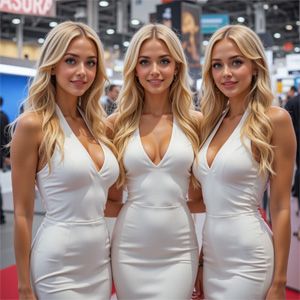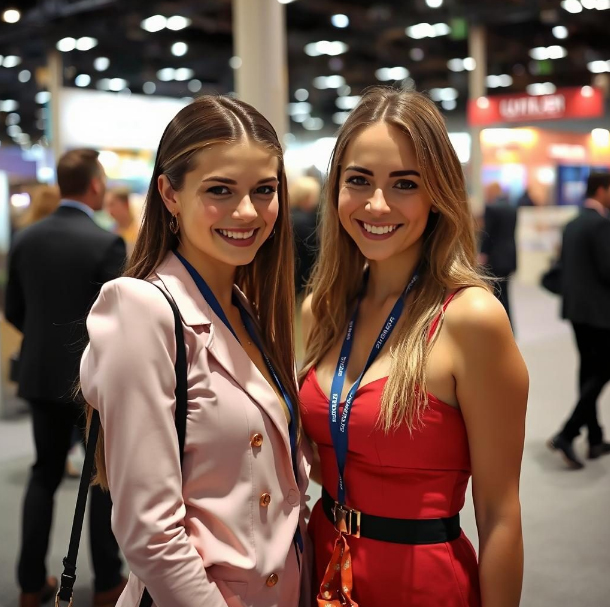
St. Petersburg, Russia — In the vast exhibition halls of the ExpoForum Convention and Exhibition Centre, where heavy industrial machinery and complex energy technologies dominate the floor, a different kind of professional is quietly shaping the visitor experience. They are not engineers or sales directors, but promotional models—a specialized workforce whose role in the city’s booming trade show industry is far more strategic than simple decoration.
As St. Petersburg cements its status as a premier destination for international B2B events, the demand for trained trade show models has grown in tandem. From the St. Petersburg International Gas Forum (SPIGF) to the NEVA maritime exhibition and the Russian Industrialist forum, exhibitors are increasingly relying on specialized staffing agencies to bridge the gap between their technical offerings and a global audience.
A Distinct Role in a B2B Environment
While often grouped with hostesses and stand assistants, trade show models serve a fundamentally different function. According to industry staffing experts operating at major St. Petersburg venues, the distinction is critical. Hostesses are typically tasked with logistics, registration, and lead qualification—functional roles that require communication skills and product knowledge. Models, by contrast, are engaged primarily for visual impact and crowd attraction.
At events like SPIGF, which in its 2025 edition drew a record 35,800 participants from 52 countries, models are deployed to humanize brands that might otherwise be represented only by pipelines, valves, and technical schematics. Moving through pavilions that span over 50,000 square meters, they wear branded attire, distribute invitations, and serve as a visual focal point that draws foot traffic toward a specific booth. In an environment where industrial forums have historically lagged behind consumer exhibitions in social media visibility, the presence of professional models also generates the kind of striking imagery that translates well to digital channels.
The Economics and Logistics
The trade show modeling sector in St. Petersburg operates through a network of specialized agencies that provide vetted talent for B2B events. These agencies handle everything from casting and briefing to on-site supervision and branded uniform coordination. For exhibitors, the investment is calculated against measurable returns: increased booth traffic, higher lead capture rates, and enhanced brand recall.
Pricing for promotional models in the Russian market varies based on experience, language proficiency, and event duration. Recent market rates for promotional work in major Russian cities range from approximately 1,265 to 1,680 rubles per hour, or roughly 7,590 to 10,081 rubles for a standard six-hour shift, depending on the model’s level and the complexity of the assignment. Agencies report that well-briefed promotional teams can drive booth traffic increases of 30 to 70 percent, with lead generation reaching 150 to over 400 contacts per day for high-traffic exhibitions.
For international exhibitors at St. Petersburg events, language capability is a frequent requirement. Models working at forums like SPIGF or NEVA may be expected to communicate in English or other languages, distributing materials and directing foreign visitors to appropriate technical staff for deeper consultations.
Beyond Aesthetics: The Human Infrastructure
The professionalization of trade show modeling in St. Petersburg reflects a broader maturation of Russia’s exhibition industry. Companies seeking to maximize their presence at major forums typically source models through agencies with specific B2B experience, rather than general talent pools. These agencies provide detailed briefings so that models understand the product, the brand’s communication standards, and their specific role within the booth ecosystem.
At the Russian Industrialist forum—which in 2026 will mark its 30th anniversary with an expected 14,000 guests from 20 countries—the presence of models alongside interpreters and stand assistants is viewed not as a cosmetic addition but as part of the “human infrastructure” of a successful exhibition. The same holds for NEVA, Russia’s largest maritime exhibition, where models help navigate visitors through expansive displays of shipbuilding and port technology.
A Specialized Niche Within a Broader Market
It is worth noting that St. Petersburg’s trade show modeling scene is distinct from the fashion and editorial modeling industry for which the city is also known. While fashion weeks and photo shoots draw on a different talent pool, trade show models require a specific aptitude for extended standing, crowd engagement, and brand representation in a professional context. Agencies serving the exhibition sector maintain rosters of models who are specifically trained or experienced in this environment, often with an emphasis on communication skills and reliability over pure runway credentials.
As St. Petersburg continues to host major international forums across energy, industry, and maritime sectors, the trade show model remains a fixture of the exhibition landscape—a visible, human element in the otherwise technical theater of B2B commerce. For exhibitors, the calculation is straightforward: in a hall of thousands, the brand that captures attention first has the best chance of being remembered.