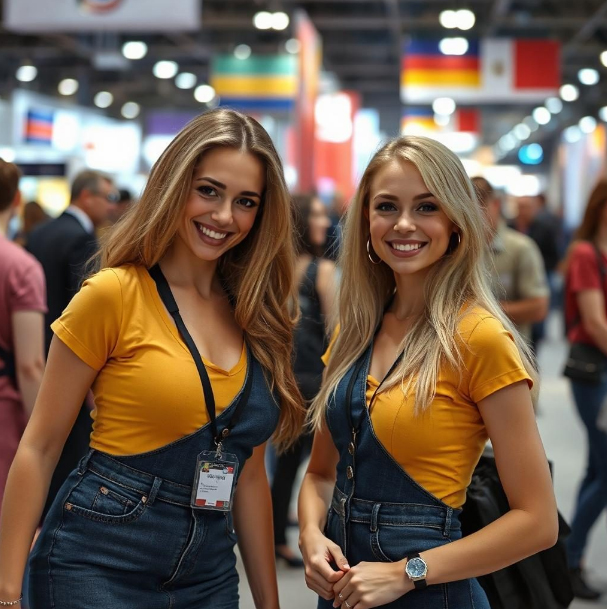
When the Timiryazev Centre opened its doors in October 2024 on the grounds of the Russian State Agrarian University, Moscow Mayor Sergei Sobyanin hailed it as “the beginning of a new development for Timiryazevka.” The three-story, 40,000-square-metre complex was designed to host more than sixty congress and exhibition events annually, transforming a historic agricultural academy into a modern business hub. Yet a building, no matter how advanced its engineering, does not run itself. Behind every successful exhibition at this venue stands an invisible workforce that few visitors ever truly notice: the booth assistants.
More Than a Greeter
The terminology used in the Russian exhibition industry has shifted in recent years. “Hostess” has gradually given way to “booth assistant” or “stand assistant” in professional circles, reflecting an evolution in expectations. At the Timiryazev Centre, the booth assistant is no decorative fixture but the operational backbone of any exhibitor’s stand.
A typical day involves greeting visitors, managing the flow of attendees, distributing catalogues and technical documentation, and supporting the sales team in identifying serious business prospects. Their responsibilities begin before a visitor ever reaches the booth. In the vast halls of the Timiryazev Centre, attendees make split-second decisions about which stands to approach. A professional assistant uses a welcoming demeanor and professional appearance to stop foot traffic, greet guests with proper Russian business etiquette, and create the first impression that defines a brand’s presence.
The role extends into qualification and lead generation. Not every visitor is a potential client. Experienced assistants distinguish between students collecting free pens and procurement managers looking for quotes. They scan badges, ask qualifying questions, and hand off serious prospects to sales managers—a function that directly impacts an exhibitor’s return on investment. In line with Russian exhibition culture, hospitality plays a central role. Offering tea, coffee, or snacks is not merely a courtesy; it is an expected practice that builds rapport and encourages visitors to linger.
Adapting to the Event’s Character
The Timiryazev Centre’s calendar spans an unusually broad range of industries, and the booth assistant’s role shifts accordingly. At Mir Stekla, the glass industry exhibition that occupied the venue in early March 2026, assistants served as the first human contact for visitors ranging from production managers and engineers to architects and procurement specialists. With China representing 89 of the 173 exhibitors, many assistants served a dual function, combining reception duties with interpretation—handling initial inquiries from Russian visitors, explaining product specifications, and collecting contact information for follow-up.
At BUYBRAND, Russia’s largest franchise exhibition, the assistant’s challenge is uniquely abstract: unlike selling a physical product, they are selling a business model—an intangible promise of success. A skilled booth assistant learns to qualify serious investors by asking targeted questions about investment budgets, suitable locations, and whether the visitor is seeking a master franchise or a single unit. This filtering ensures that the franchisor’s sales team only spends time on high-potential leads.
At Svyaz, the ICT exhibition held in April 2026, assistants had to be prepared to engage with a diverse professional audience covering telecom equipment, network infrastructure, cybersecurity, data centres, and IoT. For international exhibitors, bilingual assistants handled initial inquiries from Russian visitors, explained product specifications, and collected contact information—requiring not only language skills but also a working understanding of the exhibitor’s product range and the Russian ICT market context.
The Physical and Cultural Demands
The physical demands of booth work at a multi-day exhibition are considerable. Assistants stand for extended periods, manage crowds during peak hours, and maintain a professional demeanor throughout. The Timiryazev Centre’s modern exhibition space requires assistants to navigate the venue efficiently and remain alert across long working days.
What distinguishes exhibition staffing in Russia from other markets is the weight of cultural expectations. Russian business culture places high value on formal presentation and relationship-building. As one industry guide notes, “If staff members dress casually, Russian visitors will directly conclude that the company is ‘informal’ or ‘financially unstable’.” The offering of tea or coffee at exhibition stands is not merely a courtesy but an expected practice that builds rapport and encourages visitors to linger.
The Agency Ecosystem
Exhibitors at the Timiryazev Centre have access to a well-developed agency market serving Moscow’s exhibition venues. Agencies maintain databases of booth assistants with experience across the Timiryazev Centre, Crocus Expo, and Expocentre. They offer transparent selection processes, allowing clients to review candidate profiles with photographs, parameters, language proficiency, and relevant experience before signing a contract.
Market rates for stand personnel at the Timiryazev Centre range from 10,000 to 12,000 RUB per person per day, with uniform rental available from 6,000 RUB per set for the duration of the event. For events requiring active distribution of materials, promoters working “on their feet” command 11,000 to 13,000 RUB per day. Bilingual technical interpreters command daily rates significantly higher than standard promotional staff, with premiums of 40-60% for in-demand language pairs such as Chinese-Russian and English-Russian.
A Strategic Investment
The modern Timiryazev Centre brand ambassador—whether called booth assistant, interpreter, or stand staff—is a strategic investment. They are the human face of a technical brand, the friendly guide in a vast sea of information, and the critical first connection that can lead to significant business partnerships. In the competitive world of Moscow’s industry exhibitions, where major contracts are negotiated and technological standards are set, these professionals are the human connection that illuminates the path to new business.
The Timiryazev Centre’s success depends on this invisible workforce that few visitors ever truly notice. Their roles are distinct, their skills specialized, and their contribution to a successful event often underestimated. But without them, the stands would be silent, the catalogues undistributed, and the serious prospects indistinguishable from the casual browsers. They are, in the truest sense, the operational core of every exhibition stand.