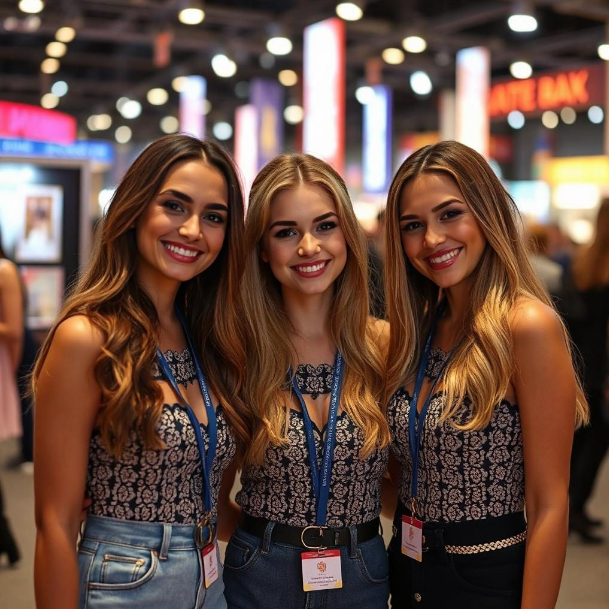
St. Petersburg’s exhibition scene revolves around the vast halls of Expoforum, where the city hosts everything from heavyweight industrial trade fairs to specialised B2B gatherings. Behind the smooth operation of these events is a workforce that rarely makes headlines: the exhibition assistants. Their work spans a wide spectrum, from the polished frontline of international trade shows to the quiet administrative support that keeps galleries and cultural spaces running. In a city that blends serious industry with a rich artistic tradition, the assistant’s role is never one-dimensional.
The Trade Show Frontline: More Than a Friendly Face
For international exhibitors at St. Petersburg’s major industrial events, the local booth assistant is often the most valuable hire on the stand. At Metal Expo 2026, held at Expoforum from 10 to 13 November, over 600 exhibitors and 25,000 industry professionals are expected. For companies arriving from China, Turkey, Iran, and beyond, a skilled Russian assistant bridges the language gap and navigates the regulatory maze that defines the Russian market.
The role has evolved well beyond the old model of decorative hostesses handing out pens. Today’s booth assistant at a metallurgy fair is expected to understand CNC specifications, tolerance levels, and metallurgical properties. They qualify leads, distinguishing procurement directors and chief engineers from casual observers, ensuring that sales teams spend their time on serious buyers. The first question a Russian buyer often asks is not about price but about certification—whether the equipment meets EAC standards—and the assistant must be ready to address it.
Language skills command a premium. A master’s student from St. Petersburg State University, for instance, provided consecutive interpretation for a Chinese manufacturer of heavy industrial equipment, translating technical discussions between engineers and Russian buyers. Another assistant, an English teacher with years of experience, found herself translating multi-million-dollar contracts and corporate decisions, a responsibility she described as both flattering and challenging. The market tiers these roles accordingly: a basic promoter handles crowd flow and badge scanning for around €80–100 per day, a technical specialist with an engineering background earns €120–180, and a business negotiator fluent in multiple languages and familiar with customs exemptions can command €200 or more.
The Administrative Backbone: Galleries and Organisers
Away from the industrial scale of Expoforum, St. Petersburg’s gallery and cultural scene relies on assistants of a different cast. Galleries like Space Four, located near Gorky metro station, seek assistants fluent in English at B2 level or above to manage the showroom, handle document flow, liaise with partners and contractors, and support exhibitions and international projects. The work is administrative precision mixed with an aesthetic sensibility—updating website content with photos and descriptions of works, receiving guests, and ensuring the space runs smoothly during events.
Event organisers also depend on assistants to keep logistics moving. Congress and exhibition company Imperia Forum recruits interns for Expoforum events, offering a modest 500 RUB per day plus a KPI bonus. The duties are straightforward but essential: carrying out the coordinator’s instructions, greeting guests at the registration desk, and escorting them to negotiation areas. For those curious about the exhibition business from the inside, it is an accessible entry point.
At the more promotional end, agencies hire staff for specific fairs at Expoforum, with pay around 350 RUB per hour for distributing leaflets and managing photo zones. The requirements are explicit—neat appearance, communication skills, and prior promo experience—and the work is temporary, often paid immediately after the event.
What the Work Demands
Across these varied roles, a few constants emerge. Stamina matters: exhibition days are long, standing and speaking for hours while maintaining a professional demeanour. Adaptability is essential, whether pivoting from technical explanations to crowd control or from document archiving to greeting a VIP guest. For international exhibitors, cultural fluency is the invisible skill—knowing when to push for a deal and when to let relationships develop, understanding that in the Russian industrial market, trust is built through personal interaction and demonstrated commitment.
The compensation reflects this diversity. Promotional work sits at the lower end, around 350 RUB per hour or 500 RUB per day for interns. Gallery assistants in full-time roles can expect a stable salary, though vacancies often withhold exact figures until interview. For technical booth specialists at industrial fairs, the daily rates climb significantly, reflecting the specialised knowledge required.
Ultimately, the St. Petersburg exhibition assistant is a connector. They link foreign exhibitors to Russian buyers, galleries to their audiences, and organisers to their attendees. In a city that hosts both the grit of metallurgy and the precision of graphic design biennales, their work is the quiet infrastructure that makes the city’s crowded calendar function—one conversation, one lead, and one smoothly run stand at a time.