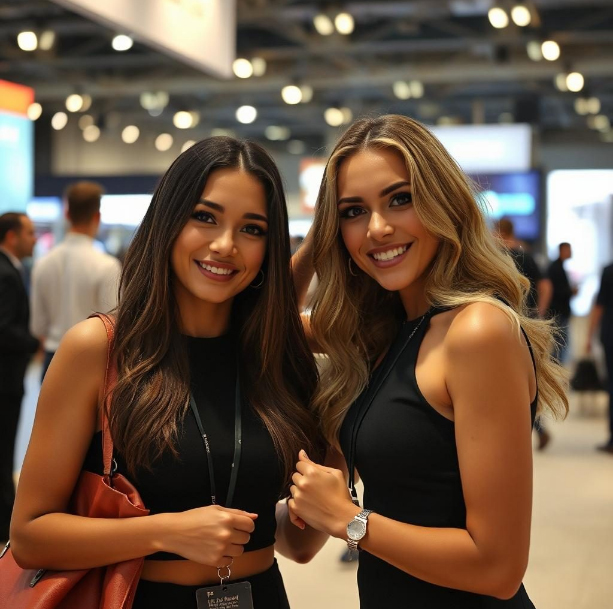
Moscow’s exhibition calendar is relentless. From vast industry trade shows at Crocus Expo and Expocentre to intimate gallery openings and immersive art installations, the city runs on a constant cycle of events. Behind every smoothly operating stand and every well-navigated exhibition hall is a workforce that rarely gets the spotlight: the exhibition assistants. Their roles are as diverse as the events themselves, ranging from bilingual commercial negotiators to technical troubleshooters and passionate cultural mediators.
The Commercial Frontline: Trade Show Assistants
For international companies exhibiting in Moscow, the assistant is often the most critical local hire. At major B2B events like the Global Fresh Market, held at Gostiny Dvor, the role transcends simple interpretation. These assistants are the exhibitor’s “voice, ears, and organisational memory” on the show floor. They do more than translate; they explain product specifications, decode certification requirements like EAC conformity, and navigate the nuances of Russian business culture, where relationship-building often precedes contracts.
The demand for specific language pairs is telling. While Russian-English remains the standard, there is strong demand for Russian-Turkish, Russian-Chinese, and Russian-Farsi speakers, reflecting broader trade patterns. Agencies supply trained staff for roughly €120 per day, though budget-conscious exhibitors often tap into Moscow’s linguistic universities for capable student volunteers. For a logistics company, a trade show assistant is tasked with the basics that drive sales: initial consultations, engaging potential clients, and the meticulous collection of business cards and contact data, with pay often structured as a daily rate plus a bonus per qualified lead.
The Technical and Institutional Backbone
Not all assistant roles are about sales. Within Moscow’s institutional spaces, such as the Museum of Moscow, the exhibition assistant is a technical specialist. The role shifts from conversation to maintenance, requiring a confident user of both PC and Mac, familiarity with Adobe suites, and the physical ability to install, configure, and troubleshoot multimedia and digital signage equipment. This is the behind-the-scenes work that ensures a video installation doesn’t crash and a projector remains aligned throughout a busy weekend.
Similarly, in the commercial gallery world, the assistant is an operational anchor. Galleries seek assistants who can coordinate the complex logistics of exhibition preparation—liaising with artists and curators, managing contractors like printers, maintaining project calendars, and ensuring that the opening night runs without a hitch. This is administrative precision mixed with a deep appreciation for art and design.
The Human Interface: Mediators and Guides
At the more experiential end of the spectrum, the assistant becomes a guide and a host. The “Robot Corporation” at VDNKh employs demonstrators who not only explain exhibits but manage robots and run masterclasses for visitors of all ages, requiring a blend of patience, energy, and public speaking skills. In the contemporary art sphere, institutions like the M’ARS Center for Contemporary Art hire “mediators” for immersive exhibitions like SENS. Evolution of Elements. These assistants are expected to “read” the space with visitors, explain the philosophy behind VR installations, and handle the daily technical boot-up and shutdown of the multimedia exhibits, all for an hourly rate. Even volunteer-based models exist, such as the assistants sought by the Tavrida art cluster, who guide groups through exhibitions in exchange for experience and formal volunteer hours.
What It Takes and What It Pays
The common thread across these varied roles is adaptability. A successful Moscow exhibition assistant must possess a specific type of stamina—the ability to stand, speak, and listen for full days while maintaining a positive demeanor. Whether explaining a complex phytosanitary certificate to a buyer or gently guiding a child through a robot exhibit, the work is fundamentally about human interaction.
Compensation reflects this diversity. Entry-level or project-based trade show work may offer a base plus performance bonuses. Technical specialists in museums can expect a stable salary ranging from 50,000 to 60,000 RUB. Gallery assistants in full-time roles might earn up to 80,000 RUB, while hourly mediators earn around 315 RUB per hour. For students and freelancers, the flexibility is a major draw, allowing them to piece together income from various exhibitions and events across the city.
Ultimately, the Moscow exhibition assistant is a chameleon. They are the first point of contact for a global buyer, the silent fixer of a flickering screen, and the welcoming face at a gallery door. In a city that never stops hosting, they are the essential human infrastructure that turns a display of products or ideas into a functioning, engaging experience.