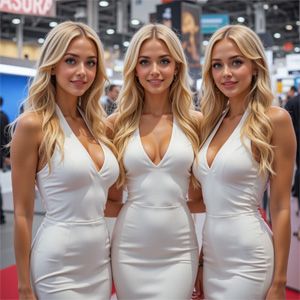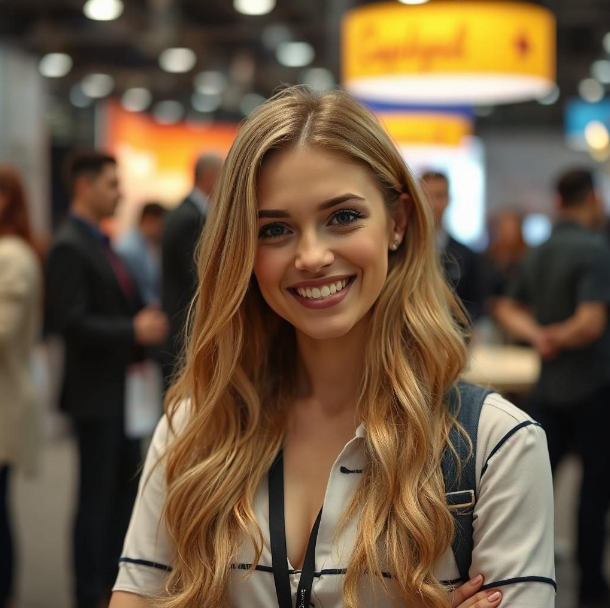
Kazan Expo, the international exhibition centre on the outskirts of Tatarstan’s capital, has become one of Russia’s most internationally oriented venues. Its calendar spans commercial vehicles, construction, metallurgy, oil and gas chemistry, digital technology, and the republic’s flagship forum on Russia–Islamic world cooperation. Behind the stands and national pavilions, a specialised workforce of hostesses, booth assistants, and promotional models forms the human interface between exhibitors and the professionals they seek to reach. At Kazan Expo, these roles carry a distinctive inflection: the venue’s international participation—particularly from China, Turkey, and the Islamic world—means that language capability and cultural fluency command a premium, and the staffing market blends local Kazan agencies with Moscow-based providers accustomed to the demands of large trade fairs.
The Venue Context: Scale and International Traffic
The scale of Kazan Expo’s flagship events explains why staffing matters. The BRICS Construction Week forum, scheduled for November 2026, expects more than 100 companies from Russia, BRICS countries, CIS states, Turkey, and Iran, alongside over 50,000 industry specialists. The TEMP global metalworking forum in December 2026 brings together equipment manufacturers and key customers including AVTOVAZ and KAMAZ. COMTRANS, Russia’s largest commercial vehicle exhibition, moves to Kazan Expo in September 2026 for the first time, bringing foreign exhibitors and visitors from China, Turkey, and Europe. For exhibitors at these events, the booth is not a passive display but an active commercial environment, and the staff positioned at its edge determine whether a passing engineer becomes a qualified lead or walks past.
The Hostess and Booth Assistant: Triage and Technical Ambassadorship
The functional distinction between hostessing and booth assistance at Kazan Expo is less about title than about consequence. At COMTRANS, booth assistants are described as “technical ambassadors” who can intelligently discuss specifications, operate demo displays, and qualify leads—far more than brochure distributors. The audience for the event is highly concentrated with decision-makers: a significant portion of attendees are CEOs or directors, with many others in purchasing roles, and a large majority influence or make purchasing decisions independently. A generalist hostess who cannot distinguish a question about powertrain components from one about fleet management telematics will struggle.
Recruitment and staffing models at Kazan Expo reflect this tiered reality. Service providers typically deploy standard hostesses for welcome, badge scanning, and traffic management; technical booth assistants for product demonstrations and lead qualification; and VIP or hybrid assistants for multilingual management of delegations and complex negotiations. The physical demands are substantial: setup and teardown, handling heavy product samples, managing security protocols, and maintaining the stand’s functionality throughout multi-day events.
Language capability commands a premium. The shifting linguistic landscape of Russia’s automotive and industrial supply chains has made trilingual assistants—who speak Russian, English, and Mandarin or Turkish—highly sought after. At COMTRANS, interpreters must understand specialised terminology related to powertrain components, fleet management, telematics, commercial transport regulations, and cold-weather operational requirements crucial for the Russian market. Beyond technical expertise, these professionals serve as cultural bridges: experienced assistants know to offer hospitality, engage in polite conversation, use formal titles correctly, and manage business card exchanges respectfully—gestures that can make the difference between a closed deal and a lost opportunity.
The Model: Visual Representation and Engagement
Moscow-based agencies serving venues including Kazan Expo publish rates that provide a baseline for budgeting. Promotional models for exhibition work typically command between 1,265 and 1,680 RUB per hour, or approximately 7,590 to 10,081 RUB for a six-hour shift, depending on the model’s level, language requirements, and custom uniform needs. The functional brief for promotional models includes actively attracting visitors to the stand, distributing promotional materials, delivering initial product consultations, conducting interactive activities, and collecting contacts and feedback. Agencies report that well-briefed promotional models can increase stand traffic by 30 to 70 percent and raise conversion by 20 to 40 percent.
Kazan’s local model market supplements this provision. Agencies such as MT Models list participation in presentations, promotional actions, and exhibitions among their models’ work directions, alongside fashion shows and photo and video shoots. Diamond Communication, a Kazan-based advertising holding with an international modelling agency, explicitly positions itself at the intersection of modelling and promotional staffing, with expertise in exhibition stand construction and staffing across 30 Russian cities. Their clients include major exhibitions and forums, and they maintain a permanent staff of 150 models with a database of 15,000.
The distinction between a model and a hostess at Kazan Expo lies primarily in emphasis: models focus on visual presentation and brand representation, while hostesses and assistants handle informational and logistical tasks. In practice, the same person may move between functions as the event requires, and the casting criteria for major exhibitions often incorporate model appearance alongside communication skills and language capability.
Sector-Specific Demands: From Commercial Vehicles to Construction
The specific exhibitions at Kazan Expo shape staffing needs in ways that generalist agencies must accommodate. For COMTRANS, the technical vocabulary spans engine and powertrain systems, diagnostics and repair, aftermarket parts, and commercial fleet management—a domain where generalist interpreters are quickly exposed. Russian buyers in this sector prioritise durability, after-sales support, and performance in extreme climates, and assistants who understand these priorities add value beyond translation.
The BRICS Construction Week and TEMP metalworking forums present different profiles. Construction industry assistants need familiarity with materials, technologies, and equipment terminology, while metalworking events demand enough literacy to distinguish inquiries about welding systems from those about machining centres. For these events, the most effective staffing decisions separate interpretation and technical liaison from reception and crowd management.
The logistical realities of Kazan Expo also shape staffing. The venue is approximately 40 kilometres from Kazan’s city centre, and professional booth staff must be prepared for challenges ranging from managing loading zones to navigating security protocols. Strict timelines for equipment delivery and specific rules for accessing pavilions during build-up and breakdown days require careful planning—and staff who arrive prepared for these conditions rather than discovering them on the first morning.
Practical Considerations for Exhibitors
For companies planning to exhibit at Kazan Expo, several practical considerations apply. Staffing should match booth scale and event type: a standard stand typically requires one to two assistants, while larger demonstration areas or national pavilions may need three to five staff with differentiated roles.
Language capability should be specified explicitly. Kazan Expo’s international participation means that English is the baseline for many stands, but exhibitors from China, Turkey, or Iran may require additional language pairs. The trilingual assistants who command a premium in the current market are not optional for exhibitors seeking to engage seriously with Russian buyers in technical sectors.
Product training matters. Agencies that provide briefing on products, scripts, and qualification criteria produce measurably better outcomes than those that supply personnel with no preparation. For technical exhibitions, separating interpretation from operational functions produces better results than expecting one person to handle everything. And booking early is critical: Kazan’s local agency market is smaller than Moscow’s, and demand for experienced bilingual staff peaks during major events like COMTRANS, BRICS Construction Week, and KazanForum.
The human infrastructure of Kazan Expo—the hostesses managing reception, the assistants qualifying leads, the models drawing attention—is not incidental to the exhibition economy. It is the layer through which brands become legible to an international audience, and through which the venue’s calendar of industrial and economic forums becomes productive commercial encounters rather than mere displays of products.