Ekaterinburg-EXPO, the international exhibition centre on the southern edge of Yekaterinburg, hosts a calendar anchored by INNOPROM but extending across agriculture, electrical engineering, mining, and international youth events. Behind the stands and product displays, a specialised workforce of hostesses, booth assistants, and promotional models keeps the commercial machinery running. At Ekaterinburg-EXPO, these roles carry a distinct regional character: the venue serves the industrial Urals, where exhibitors expect personnel who can function credibly in technical environments, and where the local staffing market combines Moscow-standard professionalism with the practical sensibilities of a manufacturing region.
The Hostess and Booth Assistant: Rates and Realities
Yekaterinburg’s agency market publishes rates that provide a baseline for budgeting. Hostesses and promotional models for exhibition work typically command between 1,000 and 1,500 RUB per hour, with full-day engagements (eight to ten hours) priced from 8,000 to 12,000 RUB depending on language requirements and experience. Assistants with English or Chinese language capability command a premium, particularly during INNOPROM week, when demand for bilingual personnel peaks and agencies advise booking well in advance.
The functional expectations align with broader Russian exhibition standards but carry an industrial inflection. A hostess manages reception, distributes materials, and serves as the initial filter for visitor inquiries. At INNOPROM—which occupied 50,000 square metres across all four pavilions in 2026, with more than 850 companies and five national pavilions—the hostess role leans toward crowd management and professional decorum. With delegations from Indonesia, Kazakhstan, Uzbekistan, Kyrgyzstan, Belarus, Vietnam, India, and China moving through the halls, a well-positioned hostess who can greet visitors in English or Chinese and direct them appropriately becomes a genuine commercial asset rather than a decorative presence.
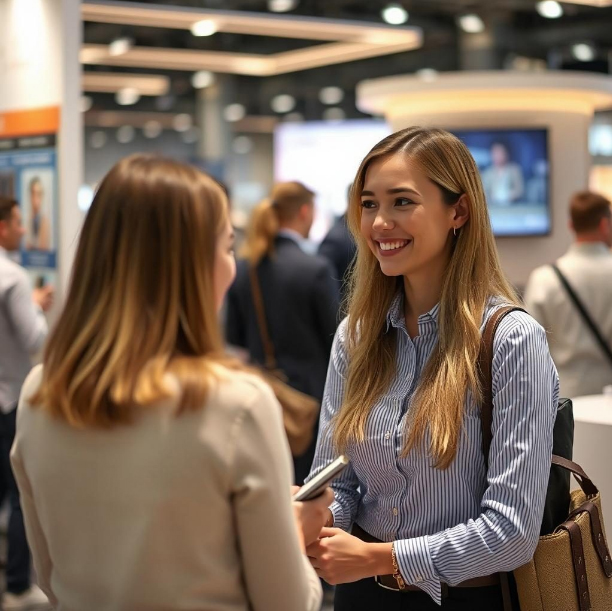
Booth assistants at Ekaterinburg-EXPO often find themselves functioning as triage specialists. Agency descriptions of the role emphasise active engagement rather than passive presence: attracting visitors to the stand, delivering initial product explanations, collecting contact information, and ensuring that serious prospects are connected with technical or sales staff. At INNOPROM, where discussions involve CNC machine tolerances, robotics integration, and industrial IT platforms, the assistant’s ability to distinguish a plant director from a curious student determines whether senior engineers spend their time productively.
The Model: Visual Impact in Industrial Halls
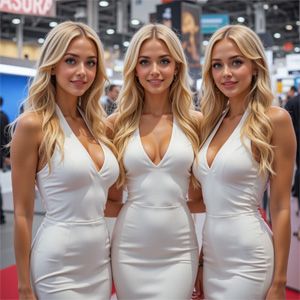
While the line between hostesses and models can blur, models at Ekaterinburg-EXPO serve a distinct function: active engagement with the broader exhibition floor. Promotional models may move through pavilions in themed attire, attract attention to a brand through striking imagery, and direct visitors toward specific stands. In industrial contexts, where booths showcase heavy equipment and complex technologies, models create a visual focal point and draw crowds that might otherwise pass by.
Yekaterinburg’s local model agencies supply personnel for exhibitions and presentations alongside fashion shows and photo shoots. Rates for promotional models working exhibition shifts typically range from 1,200 to 1,800 RUB per hour, with premium rates for candidates meeting specific height, appearance, or language requirements. The practical distinction between a model and a booth assistant lies primarily in emphasis: models focus on visual presentation and promotional engagement, while assistants handle informational and logistical tasks. In practice, individuals working in these roles frequently possess overlapping skills, and the boundaries shift depending on the event’s needs.
At the International Youth Festival in September 2026, which drew over 10,000 young leaders from 191 countries, the model and hostess functions merged with cultural ambassadorship. The city organised an information stand in Russian and English with a qualified interpreter on hand, and volunteer assistants—students selected for language proficiency and trained on delegation protocols—accompanied ambassador delegations throughout the event. These volunteers functioned as full assistants, handling not only greeting and direction but logistics, scheduling adjustments, and the countless small tasks that diplomatic accompaniment entails.
Sector-Specific Demands: From INNOPROM to Agroprom Ural
The specific exhibitions at Ekaterinburg-EXPO shape staffing needs in ways that generalist agencies must accommodate. For INNOPROM, the flagship event, exhibitors increasingly seek assistants with technical backgrounds—students from Ural technical universities, for instance, who can follow a conversation about automation systems or energy technology well enough to know when to escalate. The Ural Chamber of Commerce and Industry, which has operated a translation department since 1959, provides interpreters and simultaneous equipment for the event, but the booth assistant role remains a separate staffing category that exhibitors typically source through agencies or direct recruitment.
Agroprom Ural, held in late October alongside the Interregional Agro-Industrial Exhibition of the Ural Federal District, presents a different profile. The exhibition brings together producers of equipment for livestock and crop farming, alongside agrochemicals, seeds, greenhouse equipment, and veterinary products. Booth assistants working for agricultural machinery manufacturers need enough familiarity to direct inquiries about seeding equipment, irrigation systems, or grain storage to the correct specialist—a domain where generalist hostesses are quickly exposed.
Elektrotechnika. Energetika, running concurrently with the mining exhibition Rudnik, covers power supply systems, cable products, lighting, charging stations, and building automation. With more than 350 participants and over 6,000 visitors expected across the combined exhibitions, assistants working these halls must navigate a vocabulary of high- and low-voltage equipment that leaves little room for improvisation. For these events, the most effective staffing decisions separate interpretation and technical liaison from reception and crowd management.
Practical Considerations for Exhibitors
For companies planning to exhibit at Ekaterinburg-EXPO, several practical considerations apply. Staffing should match booth scale and event type: a standard stand typically requires one to two assistants, while larger demonstration areas may need three to five staff with differentiated roles.
Product training matters. Agencies that provide briefing on products, scripts, and qualification criteria produce measurably better outcomes than those that supply personnel with no preparation. For technical exhibitions, separating interpretation from operational functions produces better results than expecting one person to handle everything. And booking early is critical: the Ural Chamber of Commerce and Industry notes that simultaneous interpreters’ schedules are filled well in advance, and the same pressure applies to experienced bilingual booth staff during INNOPROM week.
The human infrastructure of Ekaterinburg-EXPO—the hostesses managing reception, the assistants qualifying leads, the models drawing attention—is not incidental to the exhibition economy. It is the layer through which brands become legible to visitors, and through which the venue’s industrial calendar becomes productive commercial encounters rather than mere displays of machinery.