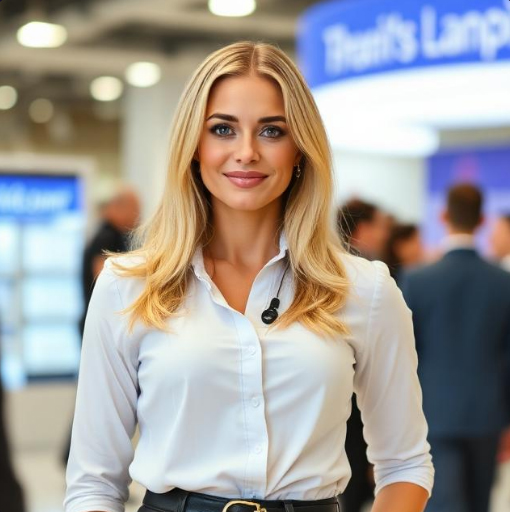
At Moscow’s Crocus Expo or the timeless VDNH, the hum of a thousand soldering irons meets the bass thrum of industrial EDM. The annual Expo Electronics or ChipExpo is a cathedral of Russian tech ambition—drone jammers, mil-spec connectors, counterfeit-detecting scanners. But before any deal is signed, before a single oscilloscope is switched on, you will meet her: the elektronika devushka (electronics girl).
She is not a model. She is a semi-conductor in human form. In an industry defined by cold precision and paranoid secrecy, the Russian electronics hostess is the unexpected interface between raw hardware and human trust.
The Anti-Sparkle Uniform
Forget the dairy industry’s soft white lab coats. Electronics is a different beast. The uniform here is a black polo shirt, antistatic wrist strap (often fake, worn for show), and safety glasses perched on the forehead like a third eye. Skirts are forbidden—too much risk of snagging on a live wire display. Hair must be tied back, not for hygiene, but for fire safety.
“One spark from a cheap Chinese power supply and your hair is a candle,” says Alina, 24, a radio-physics student working her third ChipExpo. “We are not selling yogurt. We are selling defense contracts and industrial automation. You cannot look soft. You must look like you know how to short a capacitor.”
The aesthetic is utilitarian chic meets post-Soviet grit. Nails are short, unpainted. Makeup is “conference room” neutral. The goal is to project reliability—the visual promise that the microchips on display won’t fail at -40°C on a Siberian oil rig.
The Diagnostic Smile
Where a dairy hostess offers a warm spoon, an electronics hostess offers a cold fact. Her greeting is not “Welcome” but: “What is your input voltage?” or “Are you here for commercial or military grade?”
This is not rudeness. It is triage.
“A buyer from Rostec has fifteen minutes to verify component authenticity,” explains Dmitry, a trade show manager. “Our hostesses are trained to identify counterfeit capacitors by weight and surface texture. They can recite IP ratings for dust and water resistance. Small talk is a distraction.”
And they do it all while wearing a smile that is technically correct but emotionally neutral—the so-called “oscilloscope smile”: flat, calibrated, and utterly reliable.
Gatekeepers of State Secrets
The electronics floor is different from any other industry expo in Moscow. Half the booths are surrounded by discreet velvet ropes. Visitors must show passports or corporate credentials before approaching a sample tray.
The hostess is the first line of defense.
“You learn to spot the ‘tourists’—people who touch everything but ask nothing,” says Vera, a veteran of four electronics shows. “They take photos of the back of a circuit board, not the front. I have confiscated three phones this year.”
She is trained to deflect espionage with grace. When a stranger asks for a “small sample” of a chip, she laughs: “Eto ne konfeta” (This is not a candy). When a visitor pushes for technical specs not on the brochure, she deploys the shutdown: “Eta informatsiya ne dlya otkrytogo dostupa” (This information is not for open access).
Unlike dairy hostesses, electronics girls are often actual engineering students—some with backgrounds in radio-frequency identification (RFID) or embedded systems. They can discuss soldering temperatures, signal interference, and thermal paste viscosity. The smile is real, but so is the technical literacy.
Wages, Risk, and the Western Confusion
The pay is higher than dairy: 6,000 to 10,000 rubles per shift ($60–$100 USD), plus a lunch of dubious quality and a metro card. But the risks are greater. Static discharge can ruin a $50,000 prototype. A spilled coffee can short a live demo. One wrong phrase can lose a government contract.
Western visitors often misinterpret the intensity. “American tech reps hug you and ask about your weekend,” says an Italian exhibitor. “Russian electronics hostesses do not touch you. They hand you a datasheet with two fingers, like a priest offering communion. You either respect it or you leave.”
The Soldering Iron and the Smile
As Russian electronics pivots toward import substitution—replacing Western chips with domestic Elbrus processors—the role of the hostess is evolving. She is no longer just a greeter. She is a brand ambassador for Russian technological sovereignty.
“Foreigners look at our booth and see a girl with safety glasses,” says Alina, adjusting her antistatic strap. “But when I explain the difference between our military-grade resistor and the Chinese knockoff—when I quote the actual test data—they stop staring at my face and start looking at the component.”
In the high-voltage world of Russian electronics trade shows, the girl in the black polo is the final quality control. She does not just hand out brochures. She certifies that Russian tech, despite sanctions, leaks, and the long shadow of Soviet-era paranoia, still works.