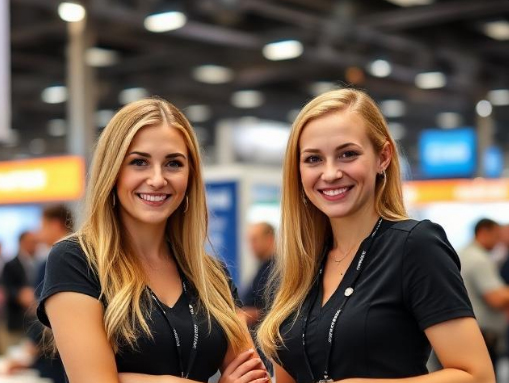
MOSCOW – In the sprawling, bustling halls of Crocus Expo on the outskirts of Moscow, the future of Russian civil aviation is being written. Engineers debate runway lighting systems, procurement officers analyze baggage handling technologies, and airline executives negotiate terminal expansion contracts.
Yet, before any million-dollar handshake is sealed, the first point of contact for a visitor is not a CEO or a lead engineer—it is the exhibition hostess. At major events like the National Aviation Infrastructure Show (NAIS) , HeliRussia, and other specialized forums, the role of the hostess has evolved dramatically. Far beyond a decorative function, these professionals have become the strategic gatekeepers, brand ambassadors, and the operational “glue” of high-stakes exhibition stands.
The Stage: Moscow’s Premier Aviation Hub
Moscow has established itself as a critical hub for the aviation infrastructure industry. The flagship event, NAIS, is Russia’s largest airport-focused exhibition and forum. Supported by the Ministry of Transport of Russia and the Federal Air Transport Agency (Rosaviation), the show brings together hundreds of exhibitors and thousands of professionals to showcase solutions for airfields, terminals, and ground support equipment.
Alongside NAIS, HeliRussia dominates the rotorcraft sector, while the International Aviation and Space Salon (MAKS) ranks among the top global aviation forums. At these venues, competition for attendee attention is immense, requiring exhibitors to deploy highly trained support staff.
Beyond the Smile: The Gatekeeper Role
Modern hostesses are hired for “industrial stamina” and intellectual rigor, not just appearance. According to agencies specializing in exhibition talent, the requirements for shows like HeliRussia and NAIS are exceptionally rigorous.
One of their primary functions is Lead Qualification. At an event that can attract nearly 8,000 visitors, a stand might see hundreds of passersby per hour. The hostess is trained to filter this traffic instantly—distinguishing between a curious student, a journalist, and a decision-maker from an airport authority. By managing wait times, they ensure that technical sales staff and engineers are not interrupted by general inquiries, allowing the experts to focus on serious negotiations.
The “Invisible” Hybrid: Hostess-Interpreter
Given the international nature of Moscow’s aviation infrastructure shows, a monolingual hostess is rarely sufficient. The most sought-after professionals are those who combine hosting skills with linguistic ability.
At NAIS 2025, much of the international business was conducted in English or Mandarin, reflecting shifting trade alliances. A hostess who can welcome a guest in Russian, explain a company’s product in English, and then direct a Chinese delegation to the correct meeting room is worth significantly more than a standard hire.
These “Hostess-Interpreter” hybrids fill a crucial gap. While a technical interpreter handles deep-dive engineering discussions in the back room, the hostess-interpreter manages the flow of general conversation—translating small talk, product tags, and basic queries without pulling an engineer away from a complex task.
Technical Lexicon and Cultural Fluency
The aircraft industry demands a different caliber of staff compared to consumer trade shows. In this environment, a hostess must possess a specific technical lexicon.
“Hiring agencies note that these professionals must be fluent not just in English and Russian, but in the specific jargon of the industry. This includes terminology related to avionics, airframe maintenance, MRO (Maintenance, Repair, and Overhaul), and UAVs.”
Furthermore, the audience at these events is elite. Attendees include representatives from the Russian Ministry of Transport and Rosaviation. The hostess must navigate government protocol as easily as corporate negotiation, understanding that Russian business etiquette can be formal and demanding.
Operational Stamina and Logistics
The physical environment of these events adds another layer of complexity. Crocus Expo is a massive venue located about 20 kilometers from central Moscow, and traffic is notoriously difficult. Hostesses are expected to arrive early—often before the 10:00 AM opening—to prepare the stand.
During events like MAKS (held at Zhukovsky airport), staff may work outdoors on static display lines. The role often extends into logistics: managing hospitality, arranging transportation for VIPs, and ensuring presentation schedules run on time. As the “operational anchor,” the hostess ensures that meeting rooms are prepared and that coffee and brochures are always available.
In the cold, vast halls of Crocus Expo, where the noise of the tarmac occasionally bleeds into the exhibition space, the hostess is the warm signal in the noise. She is the first handshake and the last smile.
For any international company looking to break into the Russian airport modernization market—valued at billions of dollars—investing in a professional, specialized hostess is not a luxury. As one industry briefing put it: “She doesn’t design the runway, but she makes sure the right planes land on it”.