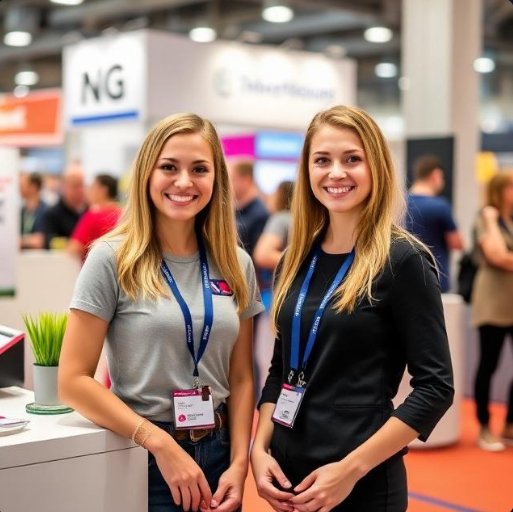
The air inside Moscow’s Crocus Expo or Timiryazev Centre is rarely calm. At events like Weldex (welding), Metalloobrabotka (metalworking), or CTT Expo (construction), the atmosphere is a thick cocktail of hydraulic fluid, hot metal, and high-stakes negotiation. Amidst the towering cranes and the hiss of pneumatic drills, there is a figure who stands out not because of the machinery, but because of the blazer and the smile.
She is the Russian Exhibition Assistant—known locally as a promouter—and in the brutal world of B2B industrial sales, she is the most underestimated weapon in a foreign exhibitor’s arsenal.
Gone are the days when these staff members were merely “hostesses” handing out pens and candy. In 2026 Moscow, the industrial exhibition assistant is a hybrid creature: part engineer, part diplomat, and full-time crisis manager.
The “Hard Hat and Heel” Dynamic
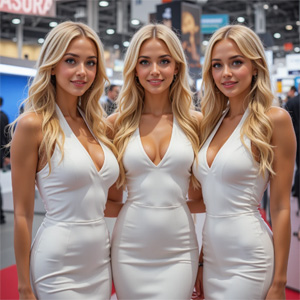
Walk through the welding section of Technoforum, and you will notice a sharp visual contrast. The visitors are almost exclusively male—burly engineers and procurement managers with calloused hands and briefcases full of GOST (Russian state standard) specifications. The assistant, however, is often young, female, and impeccably dressed, though usually wearing mandatory safety footwear and protective glasses.
This contrast is not a coincidence; it is a strategy.
“When a Russian engineer sees a woman in heels walking past a semi-automatic welding inverter, he stops,” explains Elena, a five-year veteran of the Weldex show. “He stops not to flirt. He stops because he is confused. He thinks she is lost. When I then open my mouth and start explaining the duty cycle of his machine, he listens. The shock opens the door”.
That door is notoriously hard to crack. Russian industrial buyers are famously skeptical of foreign salespeople. A Chinese or Turkish manufacturer can bring the best laser cutter in the world, but without a local voice to translate its value into Russian technical slang, the booth remains empty.
The Three Tiers of Industrial Assistants
Not all assistants are created equal. In the Moscow market, agencies classify staff into specific tiers based on technical ability and risk level.
- The Basic Promoter (€80-100/day): The entry-level role. They manage the crowd, scan badges, ensure the coffee machine is running, and keep the booth tidy. They are the “warm body” necessary for high-traffic flow.
- The Technical Specialist (€120-180/day): This is the “sweet spot” for most industrial exhibitors. These assistants often hold degrees from institutions like Bauman Moscow State Technical University (BMSTU) or MISiS. They understand PLC systems, tolerance levels, and metallurgical properties. They can explain why your CNC machine beats the competitor’s without reading from a script.
- The Business Negotiator (€200+/day): Reserved for closing deals with state corporations. These assistants are fluent in English (or Chinese) and Russian, but also understand the legal labyrinth of EAC certification and customs exemptions. They don’t just translate words; they translate intent during high-level boardroom meetings.
The “GOST” Barrier
The single biggest hurdle for any foreign exhibitor in Moscow is the regulatory environment. The Russian standards system (GOST) is dense, unforgiving, and often alien to Western or Asian engineers.
A Russian buyer’s first question is rarely about price. It is about certification: “Does it have an EAC Certificate?”.
I recently observed an interaction at a metalworking expo where a Turkish machinery dealer nearly lost a sale in ten seconds. When asked about certification, the dealer shrugged. Before the client could walk away, the Russian assistant intervened. She didn’t lie. She gently explained that while the full EAC was in progress, the machine already held a specific “Letter of Permission” valid for the client’s region. She bought the dealer time, saved the negotiation, and effectively saved a $200,000 deal.
A skilled assistant knows the major bodies—EAC, GOST R, Rostechnadzor. She can steer a conversation away from a dangerous “no” toward a safer “let me connect you with our technical department.”
The 2026 Landscape: Sanctions, Supply Chains, and Sensitivity
Since 2022, the role of the assistant has become even more strategic. With the departure of major European and American brands from the Russian market, a vacuum has opened. Chinese, Turkish, Indian, and domestic Russian manufacturers are racing to fill it.
However, the conversation has changed.
“Two years ago, a Russian buyer might have asked for German quality,” says a senior coordinator. “Today, they say, ‘Give me something that works, preferably without Western components.’ But they also worry about spare parts. If I represent a Chinese brand, I must explain the supply chain. Where is the warehouse in Moscow? How fast can you deliver to Novosibirsk?”.
The assistant has therefore become a Supply Chain Consultant. She must know the logistics of getting a broken machine fixed in the harsh Russian winter. A machine that cannot be repaired quickly is worthless—and the assistant is the one who manages that expectation from the very first handshake.
Crisis Management on the Floor
Finally, the industrial assistant is the “firefighter” of the exhibition hall.
Machines break down. Power trips fail. A hydraulic hose bursts on the demo model, and the audience starts laughing. While the foreign engineers panic, the local assistant takes control.
“The worst was a German packaging machine that just stopped mid-demo,” recalls a logistics coordinator. “The German engineer turned red and started yelling in English. The Russian assistant immediately stepped in, made a joke to the crowd about ‘technology needing a coffee break,’ and directed the local techs to fix the fuse. She saved the brand’s reputation in three sentences”.
In the noisy, high-stakes environment of Moscow’s industrial exhibitions, your product is only half the battle. The other half is trust.
The Russian exhibition assistant is the human bridge between foreign engineering and Russian reality. She converts amperes into trust, GOST standards into plain language, and foreign steel into local infrastructure. If you are planning to exhibit in Moscow, invest less in the giveaway pens and more in the person holding them. She is, quite literally, your best return on investment.