MOSCOW – The air inside Crocus Expo’s Pavilion 1 is thick with dust. Not from construction, but from the constant opening and closing of heavy sample catalogs filled with ceramic tiles, power tools, and window profiles. Overhead, industrial lighting rigs cast a harsh glare on displays of sanitary ware and insulation materials. It is the opening day of MosBuild, the largest international building and interiors exhibition in Russia and the entire CIS region.
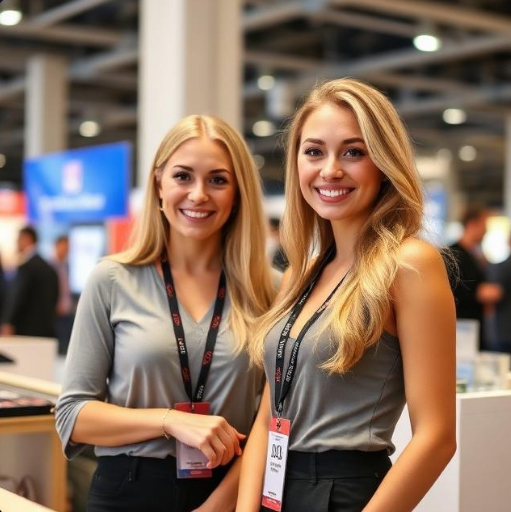
Amid the labyrinth of 1,300+ exhibitors and the steady flow of tens of thousands of professional buyers stands a figure who is neither an architect nor a sales director. She is the promouter – the Russian exhibition assistant – and in the rough, high-stakes world of Russian construction, she is as essential as a foundation.
The Hard Hat in Heels
A building trade show is not a comfortable place. Unlike beauty or fashion expos, where the mood is polished and pleasant, construction fairs are utilitarian, tense, and high-intensity. Buyers are engineers, foremen, procurement agents, and private developers. They do not browse; they interrogate.
“When a Russian project manager walks up to a stand selling waterproofing membranes, he doesn’t say ‘hello,'” explains Anna, a 34-year-old assistant who has worked ten building exhibitions. “He picks up the sample, bends it, scratches it with his key, and then looks at you. His first word is rarely ‘good morning.’ It is often a technical question about tensile strength or frost resistance.”
The assistant’s first job, then, is to survive that first glance. Russian construction buyers are famously dismissive of foreign salespeople who cannot speak the language of GOST (the Russian national standards system). A pretty smile and a tray of coffee are worthless here. What they need is instant, credible, technical competence.
From Bilingual to BIM-Ready
The profile of a successful building exhibition assistant has shifted dramatically over the past decade. The old model – hiring a university student with good English – is now obsolete.
“I hold a degree in civil engineering from Moscow State University of Civil Engineering,” says Daria, 31, who has assisted Chinese lighting and German tool manufacturers. “Last year at MosBuild, a buyer asked me to explain not just the lumens of our lamp, but how its driver would handle voltage fluctuations common in Russian regional power grids. The Chinese engineer next to me didn’t know. I did.”
This level of expertise commands a premium—often costing three to four times the rate of a standard hostess—but for serious exhibitors targeting the Russian market, it is non-negotiable. The assistant must understand everything from thermal insulation calculations to the specific requirements of Russian SNiP (Construction Norms and Regulations). She must be able to read a technical drawing, identify a counterfeit certification mark, and explain the difference between a Turkish and a Chinese thermal break system in plain, persuasive Russian.
Navigating the GOST Labyrinth
For any foreign building material manufacturer, the single greatest barrier to entry in Russia is certification. GOST certificates, EAC (Eurasian Conformity) marks, fire safety permits, and sanitary approvals form a dense, intimidating thicket.
A buyer’s first question is rarely about cost. It is: “Is it certified for use in Russia?”
“I had a client from Turkey with a beautiful, affordable line of laminate flooring,” recalls Sergei, a senior exhibition coordinator for a large Moscow trade fair. “On paper, it was perfect. But when a Russian buyer asked for the EAC certificate number, the Turkish director had no idea what he was talking about. The assistant saved the day. She calmly explained that the documentation was ‘in the final stage of submission’ and offered to connect the buyer with their legal consultant. She bought them time.”
A skilled assistant does not just translate; she pre-qualifies. She ensures that her foreign employer knows exactly which documents to bring, which claims to avoid, and which questions to expect. She is the first line of defense against a costly regulatory mistake.
The Three Pillars of the Building Industry Assistant
Based on the high-stakes environment of events like MosBuild, Russian Construction Week, and RosBuild, the role rests on three critical pillars:
1. The Technical Communicator
Buyers at construction exhibitions ask specific, technical questions. The assistant must be able to handle the first wave of inquiries, distinguishing between a casual visitor and a serious procurement manager.
- Product Knowledge: Understanding specifications for materials—from tile abrasion resistance (PEI rating) to insulation R-values and tool voltage requirements
- Application Context: Explaining how a product performs in Russia’s extreme climate (winter temperatures of -30°C)
- Certification Awareness: Knowing which GOST or EAC standards apply to each product category
2. The Cultural Bridge
Russian business culture remains formal, direct, and relationship-driven. A local assistant provides:
- Language Fluency: While some Russian buyers speak English, most prefer to conduct technical evaluations and price negotiations in their native language
- Formal Address: Using proper titles and patronymics to show respect to senior buyers
- Hospitality Protocol: Knowing that offering tea or coffee is not optional but an expected gesture of goodwill in Russian business settings
- Trust-Building: Russian buyers often need extended explanations before trusting a new supplier—a patient, knowledgeable assistant builds that bridge
3. The Logistics and Supply Chain Consultant
Since 2022, the Russian construction industry has undergone a seismic transformation. With the departure of many Western brands, a massive vacuum has opened. Buyers’ priorities have shifted.
“Two years ago, a buyer would ask, ‘Is this German?'” says Olga, an assistant for a Chinese facade systems company. “Now they ask, ‘Is this available? Do you have a warehouse in Moscow? Can you deliver to Yekaterinburg in winter?’ Speed and reliability have become as important as quality.”
The assistant must therefore know shipping times from different countries, customs clearance procedures, and the location of regional distribution hubs. She reassures buyers that, even with global uncertainties, their pallets of tiles or coils of steel will arrive on time.
The Venue: Crocus Expo and Beyond
Moscow’s premier building exhibitions are held primarily at Crocus Expo International Exhibition Center, one of Europe’s largest and most sophisticated exhibition complexes.
Key Venue Information for Crocus Expo:
| Detail | Information |
|---|---|
| Location | Pavilion 1, Crocus Expo, Krasnogorsk, Moscow Region |
| Nearest Metro | Myakinino (direct connection to the complex) |
| Distance from Central Moscow | Approximately 20 km (65-66 km mark of MKAD ring road) |
| Key Event | MosBuild (held annually) |
Professional assistants know to arrive early—often before the 10:00 AM exhibition opening—to ensure the booth is pristine, product samples are displayed properly, and demonstration equipment is ready. Many use public transport (the metro) to avoid Moscow’s notoriously unpredictable traffic.
Why Hire a Dedicated Building Industry Assistant?
The benefits of engaging a specialized assistant for construction exhibitions extend far beyond simple reception duties:
| Benefit | Impact |
|---|---|
| Technical Credibility | An assistant who speaks the language of engineering builds immediate trust with Russian buyers |
| Qualified Lead Generation | Technical assistants can filter visitors effectively, ensuring sales teams focus on high-value prospects |
| Regulatory Guidance | Familiarity with GOST/EAC certification prevents costly compliance errors |
| Logistical Reassurance | Knowledge of Russian shipping and warehousing answers buyers’ critical “availability” questions |
| Cultural Fluency | Native understanding of Russian business etiquette facilitates smoother negotiations |
Professional agencies such as MoscowHostess specialize in providing trained stand assistants for industrial and construction exhibitions, with access to personnel who hold engineering degrees and have specific experience at building trade shows.
The 2026-2027 Landscape: Import Substitution and Opportunity
Russia’s construction market, valued at over $260 billion, continues to drive massive demand. The national housing shortage and government “import substitution” policies have created unprecedented opportunities for manufacturers from China, Turkey, India, and Belarus.
At MosBuild 2026, which drew over 1,300 exhibitors from 50 countries and approximately 68,000 professional visitors, this new reality was on full display. The role of the exhibition assistant has evolved to meet it—becoming as much about supply chain reassurance as product explanation.
For international exhibitors, this represents a golden window of opportunity. But success requires more than bringing quality products. It requires the right human interface—a professional who can translate cubic meters into trust, GOST standards into plain language, and foreign materials into the foundations of Russian homes.
The Human Element in a Concrete World
At the end of four grueling exhibition days, when the stands are dismantled and the last buyers have left with their heavy bags of samples, the assistants gather in quiet corners, rubbing sore feet, and comparing notes.
“This is the truest work I know,” says Anna, reflecting on her decade of experience. “You are not selling a dream. You are selling a roof that will not leak, a pipe that will not burst in minus thirty degrees, a tile that will not crack. If I do my job well, a family in Novosibirsk will be warm and dry this winter. That is not glamorous. But it is real.”
Conclusion: An Investment in Market Access
Moscow’s building industry exhibitions—most notably MosBuild—offer international manufacturers unparalleled access to one of the world’s largest construction markets. However, success at these events requires more than an impressive product lineup and a glossy brochure.
In an environment where technical credibility is paramount and Russian buyers prefer to conduct evaluations in their native language, a professional local exhibition assistant is not an expense. It is a strategic investment.
The right assistant brings:
- Engineering literacy to answer technical questions credibly
- Regulatory knowledge to navigate the GOST/EAC labyrinth
- Cultural fluency to build trust with skeptical buyers
- Logistical expertise to address supply chain concerns
In the tough, pragmatic, high-stakes world of Russian construction, the professional exhibition assistant is the ultimate asset. She is part engineer, part diplomat, part psychologist, and part supply chain manager. She does not wear a hard hat, but she protects her clients from more dangers than falling debris.
She is the one who translates foreign products into Russian foundations.
Planning to exhibit at MosBuild or other Russian construction industry events?
Contact specialized staffing agencies such as MoscowHostess at least 2 weeks before your event to secure experienced assistants with genuine engineering backgrounds and native Russian fluency. For maximum effectiveness, request assistants who have specific experience with your product category (tools, finishes, structural materials, or MEP systems) and can demonstrate familiarity with relevant GOST/EAC certification requirements.