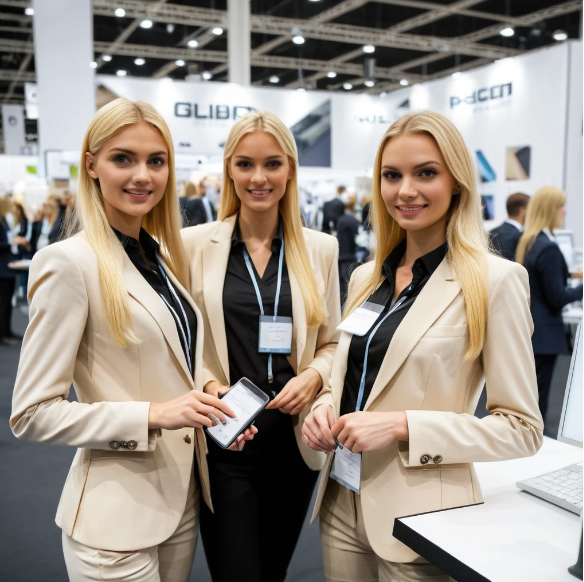
The air inside Pavilion 3 of Moscow’s Crocus Expo smells like a complex fusion of fresh herbs, roasted coffee, and freshly baked bread. On the exhibition floor of WorldFood Moscow or Prodexpo, foreign exhibitors stand proudly behind their gleaming counters, surrounded by colorful packaging and product samples. Yet, amidst the noise of 22,000 professional buyers and the chaos of 1,100 competing brands, there is one person who truly speaks the local language—both literally and culturally. That person is the Russian exhibition helper.
For international food brands looking to crack the Russian market, hiring a local booth assistant or hostess is not a luxury. It is survival. Here is why these professionals have become the most valuable asset on the Moscow trade show floor.
The Hard Truth: No One Speaks English
Let us address the elephant in the hall. While Moscow is a global city, the average Russian food buyer—whether from a giant chain like Auchan or a regional distributor in Siberia—does not speak business English.
“The majority of retailers, distributors, and importers prefer Russian for negotiations,” explains a guide for stand assistants. “Product-specific terms like ‘shelf life,’ ‘halal certification,’ and ‘private label’ require accurate translation.”
A foreign exhibitor who tries to go it alone will find themselves smiling helplessly while a potential million-ruble deal walks away to the next booth where someone actually speaks their language.
This is where the Russian exhibition helper becomes a bridge. Fluent in both Russian and usually English (or the exhibitor’s native tongue), they ensure that no question goes unanswered and no lead gets lost in translation.
More Than Just a Pretty Face
To the untrained eye, a “booth assistant” might look like a hostess—someone who pours coffee, hands out samples, and looks professional. But the reality of the food exhibition industry in Moscow is far more sophisticated.
From “Hostess” to “Technical Strategist”
The role has evolved dramatically. Today’s food industry helpers are often required to have backgrounds in food technology, chemistry, or biology.
Consider Olga, a 29-year-old graduate of the Moscow State University of Food Production who has worked for both a Turkish juice company and an Italian winery at Prodexpo. “Last year, a buyer picked up a sample of my client’s new lemonade,” she recalls. “He didn’t sip it. He asked me for the exact percentage of citric acid and the type of preservative. When I answered immediately, his entire attitude changed. He started negotiating.”
A simple hostess could not handle that. A technical assistant can.
These helpers are expected to understand complex production specifications, translate them from English or Mandarin into clear Russian, and even spot questionable certification documents from across the table. They know how to rephrase foreign marketing claims to avoid triggering the suspicions of Russia’s notoriously strict sanitary inspectors (Rospotrebnadzor).
The “Taste Wall” Strategy
Russia has a unique palate. It is a nation of traditional kvass, birch sap, and strong tea. Western-style products are often viewed with curiosity rather than loyalty.
“The worst mistake a foreign exhibitor can make is to assume that what sells in Berlin or Shanghai will sell in Moscow,” notes an experienced event organizer. “The assistant’s job is to translate the product’s identity for the local tongue.”
An American soda that is too sweet will be rejected as “synthetic.” A European craft beer that boasts about bitterness will bomb. A good Russian helper knows this. Instead of selling the product as-is, they guide the conversation toward “authenticity,” “natural ingredients,” and “honesty”—concepts that resonate deeply with the modern Russian consumer.
“I tell them our juice isn’t the sweetest,” says Anastasia, an assistant for a Chinese beverage brand. “I tell them it’s ‘honest.’ That word works magic here.”
The 2026 Context: A Geopolitical Game Changer
The departure of many Western food giants from Russia after 2022 has created a vacuum—and a golden opportunity.
Local brands like Chernogolovka and Ochakovo have exploded in popularity, while international players from Turkey, China, India, and the Middle East have rushed in to fill the gap. For a Russian exhibition helper in 2026, this means navigating a minefield of consumer sentiment.
“Two years ago, a Russian buyer might have asked for ‘something European,'” says Vladimir, a senior translator at Bevitec. “Today, they are proud to ask for Russian ingredients. The assistant working for a foreign brand has to be very careful. You cannot sell ‘Western luxury’ anymore. You sell ‘global technology’ and ‘respect for local taste.'”
This often involves creative storytelling. A Korean tea brand might be positioned not as a foreign product but as an “Eastern wellness solution” compatible with Russian traditions. A Turkish carbonated drink might be compared favorably to the Soviet-era classic, Buratino.
The assistant is not just a promoter. She is a cultural diplomat.
The Logistics: Where to Find These Helpers?
Foreign companies have several options when hiring exhibition staff in Moscow.
1. Specialized Staffing Agencies
Companies like moscowhostess.ru and event service providers offer trained assistants with specific industry experience. They handle vetting, training, and logistics.
2. Freelance Platforms
Search for bilingual assistants with retail or FMCG experience. This offers flexibility but requires careful screening.
3. Local Universities
Plekhanov Russian University of Economics and Moscow State University of Food Production are excellent sources. Students studying marketing, economics, or food technology often work at exhibitions and are eager for hands-on experience.
The Cost of Success
Hiring a helper is an investment, but a necessary one. Rates in Moscow vary based on experience and appearance:
| Experience Level | Hourly Rate (₽) | Daily Rate (8h) |
|---|---|---|
| Student / Entry-Level | 1,000 – 1,500 ₽ | 8,000 – 10,000 ₽ |
| Experienced Assistant | 1,500 – 3,000 ₽ | 10,000 – 12,000 ₽ |
| Brand Ambassador | 3,000 – 4,000 ₽ | 10,000 – 15,000 ₽ |
Premium food brands often pay higher rates for attractive, technically skilled staff.
The Million-Ruble Handshake
Perhaps the most intense moment for any food exhibition helper is the live tasting.
This is not an open bar. It is a test. A Russian distributor does not sip. He sniffs, swirls, interrogates, and then—if satisfied—nods. In these seconds, the assistant’s performance is critical.
“I once had a distributor throw a sample back at me and say it tasted like medicine,” recalls Olga. “I didn’t flinch. I took his glass, poured a new one, and said, ‘Then let me show you why this is exactly what your competitors are missing.’ I explained the antioxidant levels. He signed an intent to buy before lunch.”
Conclusion: Your Silent Sales Engine
As the lights dim on the final day of WorldFood Moscow or Prodexpo, the foreign exhibitors pack up their leftover samples and fly home. But the ones who signed the most contracts? They leave behind their secret weapon—their Russian helper.
These individuals are the silent sales engine of Moscow’s food trade shows. They are the ones who overcame the language barrier, navigated the cultural nuances, and turned a foreign product into a local opportunity.
For any company planning to exhibit in Moscow, do not just ship your products. Hire a Russian helper. In this market, they are not just staff. They are your voice.
Key Events in Moscow Requiring Professional Helpers:
- WorldFood Moscow (September, Crocus Expo) – Russia’s largest international food fair
- Prodexpo (February, Crocus Expo) – The #1 food exhibition in Russia
- Bevitec – Beverage technology and production
- Upakovka – Processing and packaging machinery
- Ingredients Russia – Food additives and raw materials