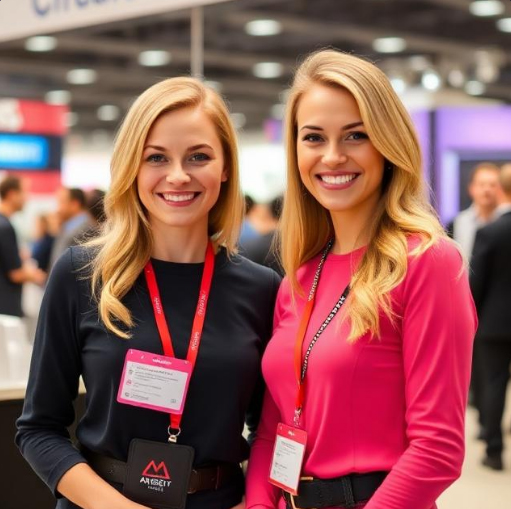
Trade shows remain one of the most powerful marketing channels in business. Nothing replaces face-to-face interaction, the ability to read body language, or the serendipity of a hallway conversation. But a great booth with poor staffing is worse than no booth at all.
Your trade show staff are not just bodies in branded polo shirts. They are your front-line brand ambassadors, lead generation engines, and real-time market researchers. Treating them as such requires a deliberate approach to recruitment, training, and deployment.
This article provides a strategic framework for professional trade show staffing—from defining roles to measuring performance.
The High Cost of Understaffing
Consider the investment: booth space (5,000–50,000+), exhibit design and fabrication (10,000–100,000+), shipping and logistics (2,000–10,000), and marketing materials (1,000–5,000). Yet many companies staff their multi-thousand-dollar booths with whoever happens to be available that week—junior employees, tired executives who would rather be elsewhere, or temporary hires given a five-minute briefing.
The math does not work. A single missed lead from a qualified buyer can represent more value than the entire booth cost. Professional staffing is not an expense; it is the multiplier on your entire trade show investment.
Defining the Roles: One Size Does Not Fit All
Effective trade show booths use a team structure, not a crowd of generalists. Each role requires a different skill set and personality type.
The Greeter (The Magnet)
This person stands at the front of the booth, makes eye contact, smiles, and initiates conversation. Their job is not to sell—it is to stop traffic.
- Key traits: Warm, approachable, energetic, comfortable with strangers.
- Experience level: Entry to mid-level. Enthusiasm matters more than product knowledge.
- Primary metric: Number of visitors drawn into the booth.
The Demonstrator (The Expert)
Once a visitor shows interest, the demonstrator takes over. This person knows the product inside and out. They run live demos, answer technical questions, and build credibility.
- Key traits: Deep product knowledge, clear communicator, patient.
- Experience level: Senior individual contributor, product manager, or applications engineer.
- Primary metric: Depth of engagement (time spent per qualified visitor).
The Qualifier (The Gatekeeper)
In high-traffic environments, not every visitor deserves a full sales conversation. The qualifier asks two or three strategic questions to determine if a lead is worth passing to a closer.
- Key traits: Quick thinker, good judgment, polite but efficient.
- Experience level: Mid-level sales or business development.
- Primary metric: Number of qualified leads passed.
The Closer (The Hunter)
This is your senior salesperson. They do not talk to everyone. They only engage with leads that the qualifier has vetted as high-potential. Their job is to schedule a next-step meeting or demo before the prospect leaves the booth.
- Key traits: Persuasive, strategic, able to handle objections.
- Experience level: Senior sales, account executive, or regional manager.
- Primary metric: Meetings booked and opportunities created.
The Logistics Lead (The Glue)
Someone must manage the invisible work: scanning badges, entering notes, restocking materials, coordinating shift changes, and handling problems (lost luggage, broken displays, staffing illnesses).
- Key traits: Organized, calm under pressure, resourceful.
- Experience level: Operations, marketing coordinator, or experienced manager.
- Primary metric: Operational uptime and staff satisfaction.
A well-staffed booth of five people, each with a clear role, will outperform a booth of fifteen people milling about aimlessly every time.
Sourcing Professional Trade Show Staff
Once you define your roles, you need to find the right people. You have three primary options.
1. Internal Staff (Your Own Employees)
Best for: Deep product expertise, brand consistency, long-term relationships with key customers.
Pros: No learning curve on your product or culture. Greater accountability. Builds employee skills and engagement.
Cons: Expensive (travel, lodging, per diem, and lost productivity at home office). Your best salespeople may resent booth duty.
Strategy: Rotate booth shifts so no single employee spends more than four hours on the floor per day. Pair introverted product experts with outgoing greeters.
2. Professional Staffing Agencies
Specialized agencies recruit, train, and deploy experienced trade show talent. They maintain rosters of professionals who work multiple shows per year.
Agencies to consider:
- Hype Events – Focus on promotional and trade show staffing across North America.
- Exhibitus – Full-service trade show management including staff.
- The Showstoppers – Event staffing for technology and consumer electronics shows.
Best for: Large booths, multi-day shows, or when your internal team is geographically distant.
Pros: Professionals arrive trained in booth etiquette, lead capture, and crowd engagement. No internal distraction. Easy to scale up or down.
Cons: Less product knowledge at the start. Requires a detailed briefing and training session before the show.
3. Hybrid Model (Core Internal + Agency Augmentation)
This is the most common approach for established exhibitors. You send 2–3 senior internal people (demonstrators and closers) and hire 3–5 agency staff (greeters and qualifiers).
Best for: Most medium to large exhibitors.
Pros: Balances expertise with energy. Cost-effective. Your internal team focuses on high-value conversations while agency staff handle volume.
Training: The Difference Between Amateurs and Professionals
You can hire the best staff in the industry, but without training, they will fail. Professional trade show training covers three areas.
Pre-Show Training (2–4 hours, one week before the show)
- Product and messaging: What are the top three things every visitor should know?
- Lead qualification criteria: What makes a lead “hot” versus “cold”?
- Competitive positioning: How do you handle “How are you different from X?”
- Logistics: Where is the restroom? The coffee? The press room?
Booth Briefing (30 minutes, each morning of the show)
- Daily goals: How many leads? Which target accounts are attending?
- Role assignments: Who is greeting, demonstrating, qualifying, closing today?
- Schedule: Shift times and break rotations.
- Problem escalation: Who handles an angry visitor? A competitor snooping? A technical failure?
Post-Show Debrief (60 minutes, after the show closes)
- What worked? Which demos drew crowds? Which messaging fell flat?
- What did we learn? Competitive intelligence, customer pain points, feature requests.
- Lead handoff: Clean process for transferring scanned badges and notes to sales.
Untrained staff will smile and hand out pens. Trained staff will qualify, demo, and close.
Professional Appearance and Conduct
Trade show staffing is a professional role, and appearance matters—not for objectification, but for brand representation.
- Uniforms: Clear, consistent, professional. Branded polo shirts or blazers with clean pants or skirts. Avoid overly casual attire (jeans, sneakers) or anything that draws attention away from the product.
- Nametags: Large, readable from 10 feet. Include name, title, and company. No handwritten tags.
- Behavior: No phones on the booth floor. No eating or drinking in view of attendees. No sitting unless medically necessary. No side conversations among staff.
- Energy management: Rotate staff every 60–90 minutes. A tired, slumped greeter kills more conversations than a closed booth.
Measuring Trade Show Staffing ROI
Professional staffing is an investment. You must measure it. Track these metrics before, during, and after each show.
| Metric | How to Measure | Benchmark |
|---|---|---|
| Booth traffic | Count of people entering (clickers or badge scans) | Varies by show size |
| Engagement rate | Qualified conversations / total booth visitors | 30–50% |
| Lead volume | Number of badge scans with follow-up notes | Target set pre-show |
| Lead quality | % of leads that enter your sales pipeline | 20–40% within 90 days |
| Cost per lead | Total staffing cost / number of leads | Compare to other channels |
| Cost per meeting | Total staffing cost / scheduled post-show meetings | 2–5x lower than outbound sales |
Review these metrics within two weeks of the show, while memories are fresh. Use them to refine your staffing plan for the next event.
Common Mistakes and How to Avoid Them
| Mistake | Consequence | Fix |
|---|---|---|
| Staffing with available people, not the right people | Low energy, poor conversations, missed leads | Define roles before recruiting |
| No pre-show training | Inconsistent messaging, frustrated visitors | Schedule mandatory training |
| No shift schedule | Burnout by Day 2, declining performance | Rotate every 60–90 minutes |
| No post-show lead follow-up | Wasted investment, frustrated sales team | Assign ownership before the show |
| Ignoring staff wellness | Illness, absences, low morale | Provide water, breaks, comfortable shoes |
The Bottom Line
Professional trade show staffing is not about finding attractive bodies to stand in a booth. It is about assembling a strategic team of communicators, experts, and operators who turn a physical space into a revenue-generating asset.
Define your roles. Source deliberately—internal, agency, or hybrid. Train rigorously. Dress professionally. Measure everything. And treat your booth staff not as warm bodies, but as the most important variable in your trade show ROI equation.
The difference between a booth that collects business cards and a booth that closes deals is standing right in front of you. Hire accordingly.