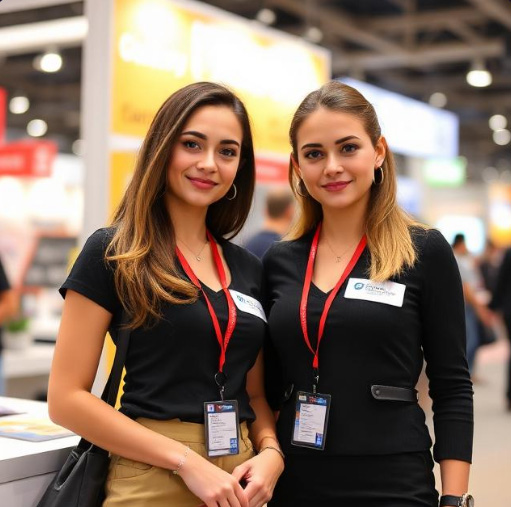
In the sprawling, high-energy halls of Moscow’s Crocus Expo International Exhibition Center, the air crackles with a different kind of electricity. It is not the roar of industrial machinery or the rustle of luxury fabrics—it is the palpable, relentless buzz of Web3, digital assets, and decentralized finance.
This is the stage for Blockchain Forum 2026, the largest crypto and Web3 event in the Commonwealth of Independent States (CIS) region and one of the top two globally. In April 2026, this event drew an unprecedented 16,388 participants from around the world. It was a venue where mining rigs hummed beside luxury NFT art, and where the founders of major exchanges huddled with representatives from the Central Bank of Russia, the State Duma, and the Ministry of Energy for high-level regulatory sessions.
Amidst the volatility of crypto markets and the complexity of blockchain technology, one professional ensures that the “human protocol” runs without a glitch: the Russian crypto exhibition assistant. In an industry where trust is established in a handshake after a whitepaper is reviewed, and where a single investment deal can involve millions of dollars of digital currency, these specialists are the essential interface between a global vision and the Russian market.
The “Decentralized” Professional: Defying the Standard Archetype
The crypto industry prides itself on disruption, and the role of the booth assistant at these events is no exception. The traditional “booth model” or a simple brochure-greeter is not just inadequate for an event like Blockchain Forum 2026—they are a poor fit for the culture.
“Crypto is a community-driven space,” explains a Moscow agency head. “Attendees are usually developers, investors, miners, and ‘whales.’ They want to talk to someone who understands tokenomics, consensus mechanisms, and the difference between a centralized and decentralized exchange.”
According to Russian exhibition staffing agencies, the modern crypto booth assistant must be a hybrid professional. They function as part brand ambassador, part tech enthusiast, and part cultural protocol officer. They don’t just staff a table; they facilitate the community’s entry into a project.
The visitor profile at Blockchain Forum 2026 proves why this matters. The forum was explicitly described as “a meeting place for whales, foundations and top companies” and “the main networking hub of the industry in the region”. These are not speculative retail investors looking for a free T-shirt; they are venture capitalists, fund managers, CTOs of Web3 startups, and government regulators.
The Crypto-Specific Skillset: From Hashrates to Halving
To understand the specific demands of a crypto booth assistant, one must look at the ecosystem categories on display at events like Blockchain Forum 2026.
The exhibition floor at the 2026 forum hosted 250 leading crypto companies showcasing a vast range of technologies:
| Category | Specific Examples |
|---|---|
| Exchanges & Trading | Spot/futures platforms, DEXs (Decentralized Exchanges), algorithmic trading interfaces, OTC desks |
| Mining & Infrastructure | ASIC miners, GPU rigs, immersion cooling systems, hosting facilities, mining pools |
| Blockchain Platforms & Web3 | Layer 1/Layer 2 networks, Smart contract auditors, NFT marketplaces, DeFi protocols (lending/staking) |
| Payments & On-Ramping | Crypto payment gateways, crypto-to-fiat solutions, stablecoin issuers, digital wallets |
| Regulatory & Security | KYC/AML compliance tools, Cybersecurity solutions for Web3, Tax reporting software |
| AI & Blockchain Convergence | “AI Future Forum” exhibits focusing on the intersection of artificial intelligence and crypto |
A booth assistant working this floor must be able to intelligently discuss these categories and ask the right qualifying questions.
Key Terminology for Crypto Booth Assistants
To be effective, a Russian assistant must sound like they belong in the “Crypto Twitter” (CT) space and the Telegram chats, but in fluent Russian and English:
| Category | Key Terms (English/Russian) |
|---|---|
| Market & Trading | Bullish (Бычий) / Bearish (Медвежий), Liquidity (Ликвидность), Volatility (Волатильность), FOMO (Страх упустить выгоду), Whales (Киты) |
| Technology | Hashrate (Хешрейт), Consensus (PoW/PoS), Smart contract (Смарт-контракт), Bridge, Gas fees (Комиссия за газ), Layer 2 |
| Assets | NFT (НФТ), Stablecoin (Стаблкоин), Altcoin (Альткоин), DeFi (ДеФи), Tokenomics (Токеномика) |
| Operations | Cold/Hot Wallet (Холодный/Горячий кошелек), Staking (Стейкинг), Mining (Майнинг), Airdrop, Whitelist |
The Three Pillars of the Crypto Booth Assistant
Based on the unique culture and high financial stakes of events like Blockchain Forum, the role of the crypto assistant rests on three critical, non-traditional pillars.
The Community Onboarding Specialist (The “Crypto Native”)
Unlike traditional finance (TradFi), crypto projects thrive on community engagement. An attendee doesn’t want to be “sold to”; they want to be “let in.” The assistant must act as a community moderator IRL (In Real Life).
A skilled assistant engages visitors with the specific language of the space:
- “Are you long on this narrative, or just browsing?”
- “Are you mining, staking, or running a node?”
- “What’s your stack? Are you looking for institutional custody or just self-custody solutions?”
- “Have you joined our Discord?”
They guide new users through setting up a wallet to claim a “swag bag” token, explain how a staking rewards mechanism works in simple terms, and filter out “crypto tourists” from serious liquidity providers and ecosystem developers.
At Blockchain Forum 2026, a significant focus was on the “convergence of AI and Web3”. An assistant on the floor of the AI Future Forum needed to understand the nuances of decentralized compute power and AI agents transacting on-chain to answer visitor questions intelligently.
The Regulatory Bridge
A major highlight of Blockchain Forum 2026 was the “high-level dialogue between crypto businesses and government institutions”. With representatives from the Central Bank, Ministry of Finance, and State Duma in attendance, the environment was politically charged and technically specific.
Russian assistants play a crucial role in this dynamic. They help international Web3 projects navigate the local legal and linguistic landscape. They reassure potential Russian partners that the foreign project understands local nuances regarding compliance and data sovereignty.
For international crypto exchanges or custodians, the assistant helps translate questions about Russian licensing, adherence to the “Digital Financial Assets” (DFA) law, and interaction with Rosfinmonitoring (the Federal Financial Monitoring Service). They interpret the intent of a regulator’s question as much as the literal meaning.
The Gatekeeper to the “Whales”
While a general assistant manages a brochure stand, a crypto assistant manages access to the private networking areas. Blockchain Forum 2026 was explicit about its purpose: “a meeting place for whales, foundations and top companies”.
The assistant is the gatekeeper for VIP rooms and private dinners. They ensure that only verified high-net-worth individuals or fund managers get past the velvet rope, using their soft skills to vet attendees discreetly.
At the official AfterParty, headlined by Russian artist L’One, the assistant might transition from booth staff to event host, checking whitelisted wallets on a phone scanner before allowing entry to an exclusive side-event.
The Venue Factor: Conquering Crocus Expo in the Digital Age
While the venue itself—Crocus Expo IEC—is the same concrete giant that hosts industrial and fashion shows, the “vibe” is entirely different for crypto events.
The scale is immense. Blockchain Forum 2026 was not a small meetup; it was a mega-event filling multiple halls, with an exhibition area featuring 250 companies and side stages for the “AI Future Forum”. Assistants must be intimately familiar with the layout of Pavilion 3 to direct attendees to the right panel discussion about DeFi regulations vs. the mining hardware zone.
Furthermore, crypto events are famous for draining phone batteries. A professional assistant knows the location of every charging station in Crocus Expo—a vital piece of logistics for visitors needing to access their hot wallets or two-factor authentication codes.
The Growing Importance of the Russian Crypto Market
Several factors make the Russian crypto space particularly dynamic—and particularly demanding for exhibition staff.
The $376 Billion Transaction Volume
Russia represents a massive digital asset market. Reports indicate that crypto trading volumes in the country have reached staggering heights, with annual transactions exceeding $376 billion USD. This immense liquidity attracts global exchanges and projects to Moscow, eager to capture a share of the user base.
Institutional Interest & Regulation
Unlike the “Wild West” days, Russia is moving toward regulatory clarity. The presence of the Central Bank and Ministry of Energy at the 2026 forum signals that industrial mining and digital assets are being integrated into the formal economy. Assistants who understand the difference between the experimental legal regime and general taxation rules are invaluable for international companies seeking compliant entry.
The Shift to Mining & Hardware
With the rise of industrial mining in regions like Siberia, there is a massive demand for hardware (ASICs) and energy infrastructure solutions. For a hardware manufacturer, the assistant needs to know the difference between immersion cooling and air cooling, and be able to discuss power consumption (watts) and noise levels confidently.
The Hierarchy of Crypto Booth Assistants
Given the technical demands and varying needs of exhibitors, Moscow agencies typically offer a tiered staffing model for crypto events:
| Role | Primary Function | Required Knowledge | Best For |
|---|---|---|---|
| Bilingual Hostess | Welcoming visitors, badge scanning, managing giveaway lines, directing traffic | Professional presentation; basic crypto awareness (knows Bitcoin/Ethereum); friendly demeanor | Mining hardware vendors, large exchanges with high foot traffic |
| Community Ambassador | Explaining DeFi protocols, helping with wallet setups, Discord/Telegram invites, Q&A on tokenomics | Web3 literacy; understanding of gas fees, staking, bridging; highly social and engaging | DeFi protocols, GameFi projects, NFT launches |
| Technical Interpreter | Translating complex smart contract audits, facilitating VIP investor calls, discussing hashrate specs with miners | Advanced tech vocabulary; understanding of consensus mechanisms; ability to bridge English/Russian code language | B2B SaaS for crypto, Institutional custody solutions |
The “Digital” vs. “Human” Balance
In an industry that prides itself on code and automation, the human element is paradoxically more important. Blockchain Forum succeeded because it was “not merely a conference; it is an infrastructure-level meeting point for the ecosystem”. Humans make the deals.
An AI chatbot cannot read the room during a bear market panic, nor can it smooth over the cultural friction between a reserved Asian developer and a boisterous Russian miner. The assistant does this.
Conclusion: The Human Consensus Mechanism
In the fast, volatile, and jargon-heavy world of Moscow’s crypto exhibitions, a bright LED display of a mining rig or a stack of glossy “to the moon” stickers is not enough. The difference between a successful project launch and a missed connection in the Web3 space often comes down to the person standing in front of the booth.
The professional Russian crypto assistant is the first validator, the community manager, and the bridge to legitimacy. They translate not just words, but market sentiment, technical specs, and regulatory nuance. They ensure that a Chinese ASIC manufacturer connects with a Russian mining farm, that a European DeFi protocol gains the trust of the Central Bank’s advisors, and that a global exchange finds its footing in the massive Russian market.
For any international Web3 company looking to mine, trade, or build in the dynamic, deep, and hungry Russian digital asset market—a market eyeing regulatory maturity and hosting hundreds of thousands of active traders—investing in a professional Russian assistant is not an expense. It is the essential smart contract for success in the region.
After all, in the world of blockchain, “Don’t trust, verify” is the mantra. And for an international exhibitor, verifying your commitment to the Russian market starts with the assistant you place at the front of your booth. They are the living proof that your project is real.