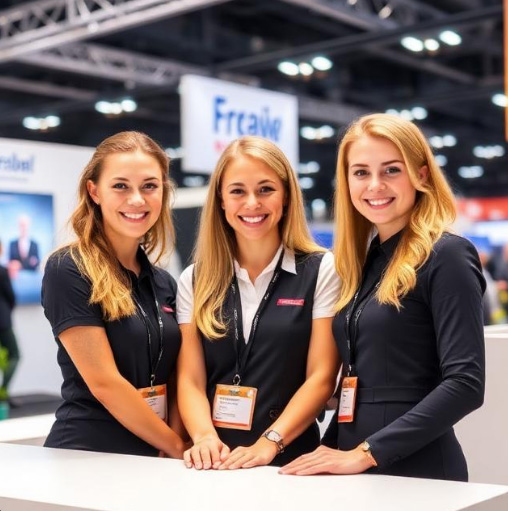
At the sprawling Crocus Expo International Exhibition Center on the outskirts of Moscow, where the future of Russian civil aviation takes shape, the atmosphere is a blend of precision engineering and high-stakes commerce. Engineers debate runway lighting systems, procurement officers analyze baggage handling technologies, and airline executives negotiate terminal expansion contracts.
Yet, before any handshake seals a million-dollar deal, before any technical specification is discussed, a visitor is greeted by a professional whose role is both understated and indispensable: the exhibition hostess.
At events like the National Aviation Infrastructure Show (NAIS) , HeliRussia, and other major Moscow aviation forums, the hostess has evolved far beyond a decorative role. She is the strategic gatekeeper, the brand ambassador, and the silent engine of the exhibition stand.
The Stage: Moscow’s Premier Aviation Infrastructure Events
Moscow has established itself as a critical hub for the aviation infrastructure industry. The flagship event, NAIS (National Aviation Infrastructure Show) , is Russia’s largest airport-focused exhibition and forum, supported by the Ministry of Transport of Russia and the Federal Air Transport Agency (Rosaviation). Held annually at Crocus Expo, NAIS brings together hundreds of exhibitors and thousands of aviation professionals to showcase the latest solutions for airfields, terminals, ground support equipment, and passenger flow management systems.
Similarly, HeliRussia stands as the largest helicopter industry exhibition in Russia, drawing specialists from across the global rotorcraft sector. At both events, the competition for attendee attention is fierce. With major Russian entities like Rostec and Russian Helicopters in attendance, and international delegations seeking entry into the Russian market, exhibitors cannot afford to blend in.
Beyond the Smile: The Modern Hostess’s Strategic Role
The role of a stand hostess at these high-stakes events is multifaceted and demands a specific skill set that combines professionalism, industry awareness, and soft power.
According to industry specialists in Moscow, the modern hostess serves as the “face of the company” —the critical first filter between the bustling expo aisle and the sales team inside the booth.
The Gatekeeper and Lead Generator
The primary function of a hostess is to manage the flow of human traffic. At an event as large as NAIS, which can attract nearly 8,000 visitors, a stand might see hundreds of passersby per hour. The hostess is trained to:
- Qualify Visitors: By asking strategic questions, she distinguishes between a curious student, a journalist, and a decision-maker from an airport authority.
- Manage Wait Times: During peak hours, she ensures that the technical sales staff are not interrupted by general inquiries, allowing the engineers to focus on serious negotiations.
- Capture Data: She collects business cards, scans badges, and schedules follow-up appointments, ensuring that no potential lead walks away without a connection.
The Logistics Coordinator
In the high-pressure environment of a trade show, the hostess often acts as the operational anchor of the booth.
“The stand hostess is responsible for creating a warm and inviting atmosphere,” notes an industry briefing, but this extends to logistics. She ensures that presentation schedules run on time, that meeting rooms are prepared, and that hospitality (coffee, water, brochures) is always available. In the context of Moscow’s aviation events, where delegations may include government officials, this level of service is paramount.
The “Invisible” Translator: The Hostess-Interpreter Hybrid
Given the international nature of Moscow’s aviation infrastructure shows, a monolingual hostess is rarely sufficient. The most sought-after professionals are those who combine hosting skills with linguistic ability.
At NAIS 2025, for example, the majority of international business was conducted in either English or Mandarin, reflecting the shifting trade alliances in the aviation sector. A hostess who can welcome a guest in Russian, explain the company’s product in English, and then direct a Chinese delegation to the correct meeting room is worth significantly more than a standard hire.
This “Hostess-Interpreter” hybrid fills a crucial gap. While a technical interpreter handles the deep-dive engineering discussions in the back room, the hostess-interpreter manages the flow of general conversation on the floor, translating small talk, product tags, and basic queries without needing to pull an engineer away from a complex task.
The Venue Factor: Conquering Crocus Expo
The operational environment plays a significant role in the demands placed on a hostess. Crocus Expo is a massive venue located about 20 kilometers from the center of Moscow, and traffic is notoriously difficult. During the morning rush hour, a journey from the Garden Ring can take over an hour.
Hostesses are expected to arrive early—often before the 9:00 AM or 10:00 AM opening—to prepare the stand for the day. This requires discipline and logistical planning. Additionally, Crocus Expo hosts multiple events simultaneously; a hostess must be intimately familiar with the layout of the specific pavilions to give accurate directions to lost attendees.
Why Local Expertise Matters
Hiring a hostess through a specialized Moscow agency offers distinct advantages over contracting general temporary staff. Agencies that focus on the aviation and infrastructure sectors maintain a roster of personnel who are pre-vetted for:
- Professional Appearance & Grooming: Aviation is a high-trust industry; the hostess must project absolute reliability.
- Basic Technical Vocabulary: While not engineers, they know the difference between a “baggage carousel” and a “boarding bridge.”
- Cultural Fluency: Russian business etiquette can be formal. A hostess knows how to address officials from the Federal Air Transport Agency correctly.
Conclusion: The Silent Deal-Makers
In the cold, vast halls of Crocus Expo, where the noise of the tarmac occasionally bleeds into the exhibition space, the hostess is the warm signal in the noise. She is the first handshake, the last smile, and the operational glue that holds the stand together.
For any international company looking to break into the Russian airport modernization market—valued at billions of dollars—investing in a professional, specialized hostess is not a luxury. It is the most cost-effective strategy for ensuring that the right people talk to the right engineers at the right time. She doesn’t design the runway, but she makes sure the right planes land on it.