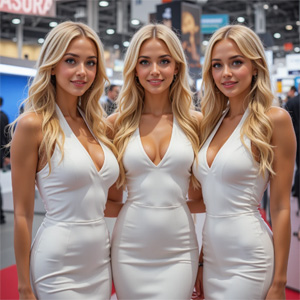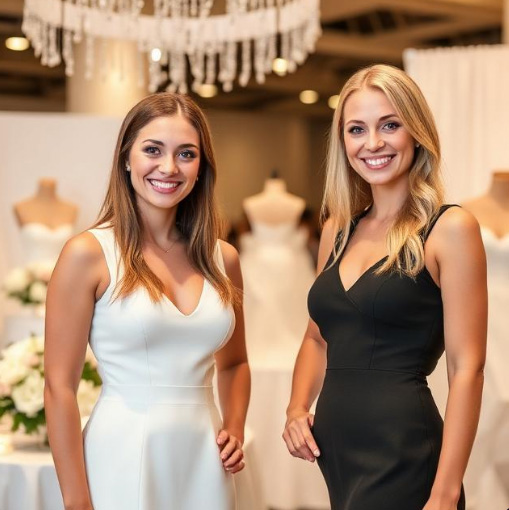
MOSCOW – The air inside the Main Stage Exhibition Center smells of fresh lace, steamed satin, and expensive perfume. It is the opening day of Wedding Fashion Moscow, the largest bridal trade fair in Russia, Central Asia, and Eastern Europe. Racks of white gowns stretch toward the ceiling, catching the soft pink light. Amid the swirl of bridal consultants and boutique owners stands a woman in a simple black dress and comfortable flats. She is not a bride, nor a designer. She is the promouter – the Russian exhibition assistant. And in this industry, she is the invisible thread that holds a multimillion-dollar deal together.
At first glance, a wedding trade show might seem like the most glamorous and least technical of all industrial exhibitions. There are no welding arcs, no chemical formulas, no heavy machinery. There is only beauty, emotion, and the promise of a perfect day. But beneath the surface of tulle and roses lies a hard-nosed business environment. Russian bridal buyers are famously skeptical, detail-obsessed, and culturally specific in their tastes. And the Russian exhibition assistant is the only person who can navigate this delicate terrain.
More Than a Pretty Smile
To an outsider, the assistant at a wedding show appears to be a simple hostess – greeting visitors, pouring champagne, handing out lookbooks. But ask any international exhibitor who has tried (and failed) to crack the Russian market, and you will hear a different story.
“I brought my Italian gowns to Moscow three years ago,” recalls a designer from Milan. “The first day, no one stopped. On the second day, I hired a local assistant. Suddenly, buyers were touching the fabric, asking questions, staying for twenty minutes. She didn’t just translate. She explained to them why my lace was better than the Turkish competitor’s. She knew what Russian mothers-in-law look for in a sleeve.”
That knowledge is gold. The Russian wedding market is deeply traditional, family-oriented, and regionally diverse. A bride in Moscow has different expectations from a bride in Yekaterinburg or Vladivostok. A boutique owner from Kazakhstan cares about different details than a buyer from Belarus. The assistant must understand all of these nuances.
The Technical Side of Romance
What kind of technical knowledge does a wedding assistant need? Far more than most people imagine.
“I have a degree in fashion construction from the Russian State University of Design,” says Elena, 29, who has worked with Chinese, Turkish, and Belarusian bridal brands at Wedding Fashion Moscow. “Last year, a buyer picked up one of our gowns, turned it inside out, and asked me about the seam finish. Was it a French seam? A serged edge? A flat-felled seam? If I had hesitated, she would have walked away.”
Elena rattles off these terms without thinking. She also knows fabric weights, the difference between poly satin and silk charmeuse, and the specific requirements of Russian dry cleaning standards. She can look at a gown and estimate its shipping volume for air freight to Novosibirsk. She knows which styles flatter the typical Russian body type (broad shoulders, narrow hips) and which designs will be rejected by conservative mothers.
“This is not a beauty contest,” she says flatly. “This is industrial sales. The only difference is that our product happens to be white and pretty.”
The Cultural Minefield
Russia’s wedding culture is distinct. Unlike in China, where renting a wedding gown is common, Russian brides overwhelmingly purchase or custom-order their dresses. They treat the gown as a family heirloom, something to be preserved and perhaps passed down. This means the buyer’s expectations are extraordinarily high.
“A Russian bride will visit ten salons before choosing her dress,” says Olga, a veteran exhibition assistant with eight years of experience. “Her mother comes with her. Sometimes the grandmother too. They will inspect every button, every bead, every centimetre of hem. If the gown is expensive, they want to know why. If it is cheap, they want to know what is wrong with it.”
The assistant’s role at a trade show is to pre-empt these questions. She must present the gown’s price, quality, and origin in a way that feels honest yet persuasive. She must know when to speak to the young bride (dreams, trends, Instagram) and when to address the mother (quality, durability, value for money). In some cases, she must gently steer a conversation away from a sensitive topic – such as the country of origin of certain materials, given shifting sanctions and supply chain realities.
“You never lie,” Olga says firmly. “But you choose your words carefully. You say ‘designed in Italy’ not ‘manufactured in Italy’. You say ‘European-inspired’ not ‘European-made’. The Russian buyer respects honesty, but she also understands the global situation. The assistant is the one who finds the honest middle ground.”
Wedding Fashion Moscow: A Unique Ecosystem
Wedding Fashion Moscow is not a public bridal fair. It is a professional B2B trade show , attended by approximately 6,000 industry professionals – boutique owners, wholesalers, agents, and bridal salon buyers from Russia, Kazakhstan, Belarus, Armenia, and Uzbekistan. For foreign brands, it is the most direct route into the huge Russian-speaking bridal market.
The show has its own rhythm. The busiest hours are not the mornings but the late afternoons, when buyers have finished their rounds and are ready to sit down and negotiate. The most important days are not the first day (general browsing) but the second and third days, when orders are actually placed.
“A good assistant knows this schedule by heart,” says a Chinese bridal accessory brand owner who has exhibited at Wedding Fashion Moscow for three consecutive years. “She tells us when to push, when to rest, and when to close the deal. She also reminds us that Russian buyers hate being rushed. You never say ‘sign today for a discount’. You say ‘I have a special offer for my favourite clients’ and let them feel special.”
The 2026 Landscape: Local Brands Rising
The Russian wedding industry has changed dramatically since 2022. With the departure of many Western luxury brands and the disruption of traditional supply chains, local Russian designers have surged in popularity. Names like Rina Rive, Evelina Khromtchenko’s bridal line, and a host of atelier brands from St. Petersburg and Moscow now compete directly with international exhibitors.
For the exhibition assistant working for a foreign brand, this means a new kind of sales conversation.
“Two years ago, a Russian buyer would ask ‘is this Italian?’” says a Turkish wedding dress manufacturer’s representative. “Now she asks ‘is this available immediately? Do you have a warehouse in Moscow? Can I see a sample in two days?’ Speed and reliability matter more than origin.”
The assistant has therefore become a logistics consultant. She must know the shipping times from different countries, the customs clearance procedures, and the locations of local warehouses. She must reassure buyers that, even with global uncertainties, their gowns will arrive on time for the spring wedding season.
Behind the Veil: The Human Connection
At the end of the final day, when the gowns are packed into garment bags and the last lookbooks are stuffed into bags, the assistants sit down on empty display platforms. They take off their comfortable flats – the heels were abandoned years ago – and rub their sore feet.
“I love this work,” says Anastasia, a 27-year-old who has assisted Chinese, Turkish, and Italian brands. “Every gown I sell will be worn on the happiest day of someone’s life. That is a beautiful feeling. But the real satisfaction comes from solving problems. When a buyer from Vladivostok trusts me enough to place a million-ruble order without ever touching the fabric because she trusts my description – that is the moment I know I am good at my job.”
In the glittering, emotional, high-stakes world of Moscow’s wedding trade shows, the Russian exhibition assistant is the ultimate behind-the-scenes professional. She is part fashion technician, part cultural diplomat, part psychologist, and part logistics manager. She does not wear a white coat or a hard hat. But her role is no less essential than any industrial engineer. She is the one who turns lace into trust, fabric into family memories, and a simple exhibition booth into the beginning of a wedding day that stretches across eleven time zones.