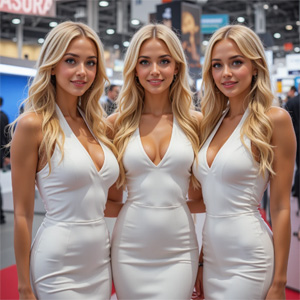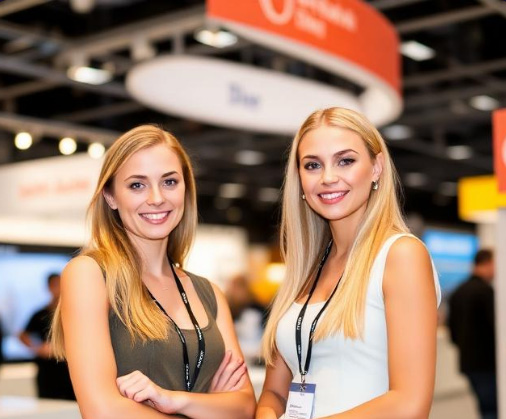
MOSCOW – The air inside Pavilion 1 of Crocus Expo Fairgrounds smells of ozone, hot metal, and burnt flux. A blinding blue arc flares from a robotic welding arm, casting stark shadows across a crowd of bearded men in heavy boots. In the middle of this industrial symphony stands a young woman in a crisp blazer and safety glasses. She is holding a tablet and smiling. She is the promouter – the Russian exhibition assistant – and she is the most unexpected, yet most essential, component of Moscow’s heavy industry trade shows.
At events like Weldex (Russia’s largest international welding exhibition) and Technoforum, the stereotype of the exhibition assistant as a pretty hostess giving away pens collapses entirely. Here, the stakes are measured in tons of steel, million-ruble automation contracts, and the unforgiving technical standards of GOST (the Russian national standards system). In this environment, the assistant is not a decoration. She is a translator of amperage, a diplomat of blue-collar distrust, and a bridge between foreign engineering and Russian reality.
The Hard Hat and the Heel
The visual contrast is immediate. Visitors to welding shows are overwhelmingly male, middle-aged engineers and procurement managers. They carry calloused hands and briefcases stuffed with technical specifications. The assistant, by contrast, is often young, female, and meticulously dressed – though always with the mandatory safety footwear and protective glasses.
“When a Russian engineer sees a woman in heels walking past a semi-automatic welding inverter, he stops,” admits Elena, a 32-year-old assistant who has worked Weldex for five years. “He stops not to flirt. He stops because he is confused. He thinks she is lost. When I then open my mouth and start explaining the duty cycle of his machine, he listens. The shock opens the door.”
That door is notoriously hard to crack. The Russian welding industry is conservative and deeply skeptical of foreign salespeople. A Chinese or Turkish manufacturer can bring the most advanced laser welding system, but without a local voice to translate its value, their booth will remain empty. The assistant provides that voice.
From Translator to Technical Interpreter
The old days of hiring a bilingual university student to hand out brochures are over. Today, successful welding assistants in Moscow possess what recruiters call “technical empathy.”
“I have a degree in materials science from MISiS (National University of Science and Technology),” says Daria, 30, who has assisted German and Chinese welding equipment brands. “Last year, a Russian production manager walked up to our booth, picked up an electrode, and asked me, ‘What is the impact toughness of this weld at minus 40 degrees?’ He didn’t want a datasheet. He wanted me to look him in the eye and give him a number.”
Daria could. She explained the difference between rutile and basic electrodes, discussed preheating requirements for Siberian pipelines, and translated a complex Chinese technical manual into colloquial Russian on the spot. The manager signed a letter of intent before leaving the booth.
This level of expertise is rare and expensive. Top welding assistants command daily rates three to four times higher than standard promotional models. But for serious exhibitors, the investment is non-negotiable.
The GOST Barrier
Perhaps the single greatest challenge for any foreign welding exhibitor is GOST – the Russian system of national standards. Welding equipment, consumables, and procedures must comply with a dense web of regulations that predate and often diverge from ISO or AWS (American Welding Society) standards.
A Russian buyer’s first question is rarely about price. It is about certification.
“I had a client from Turkey with a beautiful new plasma cutter,” recalls Sergei, a senior exhibition coordinator. “The machine worked perfectly. But when a Russian engineer asked if it had a valid EAC (Eurasian Conformity) certificate for welding equipment, the Turkish owner just shrugged. The deal died in ten seconds.”
The role of the assistant is to prevent that shrug. A skilled assistant knows the major certification bodies – EAC, GOST R, and the permits issued by Rostechnadzor (the federal service for ecological, technological, and nuclear supervision). She can steer a conversation away from a dangerous “no” toward a safer “we are in the process of certification” or “let me connect you with our legal department.”
In extreme cases, an assistant might even advise a foreign exhibitor not to demonstrate a piece of equipment at all if it lacks proper documentation. “Saying nothing is better than lying,” says Elena. “Russian engineers respect silence more than a false promise.”
The Cold Reality: Climate and Logistics
Welding in Russia is not a laboratory exercise. It is a matter of building pipelines across permafrost, repairing ships in Murmansk’s freezing docks, and constructing oil rigs in the Caspian Sea. The technical question that matters most is simple: Will it work in the cold?
Foreign exhibitors often forget this. They arrive with glossy brochures showing perfect indoor welds. The Russian visitor looks at those images, nods politely, and then asks a question that the assistant must answer.
“I worked for an Italian brand that made welding inverters,” says Daria. “Their Italian engineers had never tested the machine below minus 10 degrees Celsius. In Yakutia, winter temperatures drop to minus 50. The assistant’s job was to say, ‘This machine is ideal for indoor workshops in central Russia,’ and not promise what the machine could not deliver.”
This honest positioning – turning a weakness into a market segment – is a sophisticated sales technique that few foreign exhibitors can execute without a local assistant. She knows the geography of Russian industry: where the factories are, what the climate demands, and which regions are actively investing in new equipment.
The 2026 Landscape: Sanctions and Shortages
The welding industry in Russia has undergone a seismic shift since 2022. The departure of major European and American brands (ESAB, Lincoln Electric, Fronius) created a vacuum that Chinese, Turkish, Indian, and domestic manufacturers are racing to fill. Welding consumables – electrodes, wires, fluxes – have become strategic commodities.
For the exhibition assistant, this means navigating a new set of sensitivities.
“Two years ago, a Russian buyer might have asked for German quality,” says a veteran assistant who requested anonymity. “Today, they say, ‘Give me something that works, preferably without Western components.’ But they also worry about spare parts. If I represent a Chinese brand, I must explain the supply chain. Where is the warehouse? How fast can you deliver to Novosibirsk?”
The assistant has become a supply chain consultant. She must know not only the product but the logistics of keeping it running. A machine that breaks down and cannot be repaired quickly is worthless – and the assistant is the one who must manage that expectation from the very first handshake.
Behind the Visor: The Human Connection
At the end of the third day of Weldex, the noise fades. The welding arcs are switched off. The visitors leave with their sore feet and their catalogs. The assistants sit on empty crates, rubbing their eyes behind their safety glasses.
“This is not a glamorous job,” says Elena, pulling off her blazer to reveal a simple t-shirt. “I go home smelling like a factory. My hair smells of smoke. But I love it. Because when I help a Russian engineer trust a machine from a country he has never visited, I am doing something real.”
In the high-stakes, high-spark world of Moscow’s welding trade shows, the Russian exhibition assistant is the ultimate unsung hero. She is the one who converts amperes into trust, GOST standards into plain language, and foreign steel into Russian infrastructure. She is, quite literally, the human weld between two industrial worlds.