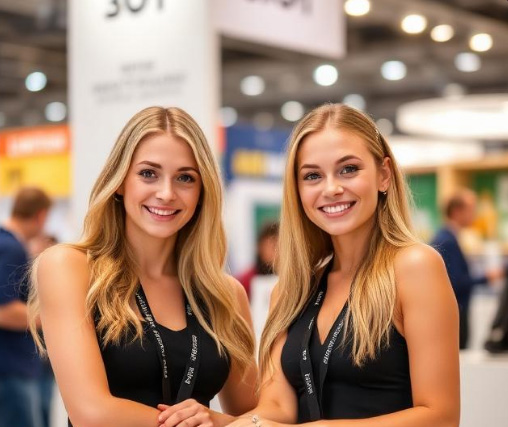
MOSCOW – The air inside Crocus Expo Pavilion 3 smells like a brewery, a juice bar, and a chemical lab all at once. It’s the opening day of Bevitec, Russia’s largest international trade fair for beverages and their production technology. Amid the low rumble of bottling lines and the clinking of tasting glasses, a young woman in a crisp uniform stands strategically next to a stainless steel fermentation tank. She is not an engineer, nor a sales manager. She is the promouter—the Russian exhibition assistant—and in this industry, she is the difference between a signed contract and a missed opportunity.
For years, Western and Asian brands have struggled to penetrate the Russian beverage market. The reasons are many: complex certification laws, unique taste preferences, and a lingering distrust of foreign sales pitches. Enter the local assistant. At trade shows like Bevitec, Prodexpo, and WorldFood Moscow, these professionals have evolved from simple hosts into indispensable strategic assets.
More Than a Pourer
To the casual visitor, a beverage assistant is someone who pours samples and smiles. But ask any seasoned exhibitor, and you’ll hear a different story.
“A Russian buyer will not trust a foreigner telling them their beer is good,” says Sergei, a Moscow-based logistics coordinator who has worked with over thirty international beverage brands. “They will, however, trust their own neighbor in a white coat who can explain why it is good.”
This trust is hard-earned. Unlike beauty trade shows, where the focus is on immediate sensory appeal, beverage trade shows are deeply technical and regulatory. Buyers—often representing large retail chains like Auchan, Magnit, or regional distributors—arrive with a checklist of questions. Is the PH level compliant with Rospotrebnadzor (Russian health authority) standards? Where is the bottling line located? Can the supply chain survive a Siberian winter?
The assistant must answer all of this, often while the foreign brand owner stands by, unable to speak a word of Russian.
The Technical Shift: From Flavor to Formula
The profile of the ideal beverage assistant has changed dramatically in recent years. Gone are the days when a pretty face and a steady hand were enough. Today, exhibitors demand candidates with backgrounds in food technology, chemical engineering, or biology.
“I studied food chemistry at the Moscow State University of Food Production,” says Olga, 29, who has worked for both a Turkish juice concentrate company and an Italian winery at Prodexpo. “Last year, a buyer picked up a sample of my client’s new lemonade. He didn’t sip it. He asked me for the exact percentage of citric acid and the type of preservative. When I answered immediately, his entire attitude changed. He started negotiating.”
Olga’s technical fluency is a superpower. She can translate complex production specifications from English or Mandarin into clear, colloquial Russian. She can spot a questionable certification document from across the table and knows exactly how to rephrase a foreign brand’s marketing claims to avoid triggering the suspicions of Russia’s notoriously vigilant sanitary inspectors.
Navigating the “Taste Wall”
Russia has a unique beverage palate. It is a nation of traditional kvass, birch sap, and strong tea. Western-style sodas and light beers, while popular, are often viewed with curiosity rather than loyalty.
“The worst mistake a foreign exhibitor can make is to assume that what sells in Berlin or Shanghai will sell in Moscow,” says a seasoned event organizer. “The assistant’s job is to translate the product’s identity for the local tongue.”
At the annual Prodexvo, which features a massive Russian Beverage Pavilion, assistants working for international brands must constantly “soften” the sales pitch. They know that a Russian buyer will perceive an overly sweet American soda as synthetic. They know that a European craft beer that wins awards for bitterness will be rejected outright. So instead of selling the product as-is, they guide the conversation toward “authenticity” and “natural ingredients”—concepts that resonate deeply with the modern Russian consumer.
“I tell them our juice isn’t the sweetest,” says Anastasia, an assistant for a Chinese beverage brand. “I tell them it’s ‘honest.’ That word works magic here.”
The 2026 Context: Sanctions, Substitution, and Survival
The geopolitical landscape has added another layer of complexity. Following the exodus of many Western beverage giants from the Russian market after 2022, the industry entered a period of intense “import substitution.” Local brands like Chernogolovka and Ochakovo have exploded in popularity, while international players from Turkey, China, India, and the Middle East have rushed in to fill the gap.
For an exhibition assistant in 2026, this means navigating a minefield of consumer sentiment.
“Two years ago, a Russian buyer might have asked for ‘something European,’” says Vladimir, a senior translator at Bevitec. “Today, they are proud to ask for Russian ingredients. The assistant working for a foreign brand has to be very careful. You cannot sell ‘Western luxury’ anymore. You sell ‘global technology’ and ‘respect for local taste.’”
This often involves creative storytelling. A Korean bottled tea brand might be positioned not as a foreign product, but as an “Eastern wellness solution” compatible with Russian traditions. A Turkish carbonated drink might be compared favorably to the Soviet-era Buratino soda. The assistant is not just a promoter; she is a cultural diplomat, translating not only words but entire brand identities into a language of trust.
High Stakes at the Tasting Bar
Perhaps the most intense moment for any beverage assistant is the live tasting. This is not an open bar; it is a test. A Russian distributor does not sip. He sniffs, swirls, interrogates, and then—if satisfied—nods.
In these seconds, the assistant’s performance is critical. She must pour with precision, maintain eye contact, and deliver a 15-second “elevator pitch” that addresses the three unspoken questions: Is it safe? Is it legal? Is it profitable?
“I once had a distributor throw a sample back at me and say it tasted like medicine,” recalls Olga. “I didn’t flinch. I took his glass, poured a new one, and said, ‘Then let me show you why this is exactly what your competitors are missing.’ I explained the antioxidant levels. He signed an intent to buy before lunch.”
The Unseen Heroes
As the lights dim on the final day, the assistants quietly pack up the remaining samples—their unofficial bonus. They exchange contact information with buyers they cultivated over four grueling days. They take off their heels and become regular people again.
But for the exhibitors who hired them, they are nothing short of heroes. In a market defined by volatility, suspicion, and rapid change, the Russian exhibition assistant stands as the last, best defense against a failed trade show investment. They are the liquid gold guardians of Moscow’s beverage halls—proving that in Russia, even a simple glass of juice requires a translator, a technician, and a tactician, all wrapped in one impeccably dressed professional.